

Why Food Sensitivity Testing Matters for Your Health
Food sensitivity testing is a way to identify which foods may be triggering uncomfortable symptoms like bloating, headaches, fatigue, or digestive distress in your body.
Quick answer — here’s what you need to know:
- Food sensitivity tests most commonly measure IgG antibody responses to foods via a blood or finger-prick sample
- They are different from food allergy tests, which measure IgE antibodies and identify potentially life-threatening reactions
- Major allergy organizations like the AAAAI do not currently recommend IgG testing as a diagnostic tool
- The most reliable methods remain elimination diets and oral food challenges under professional guidance
- At-home kits can be a helpful starting point, but results should always be reviewed with a qualified healthcare provider
Researchers estimate that 32 million Americans live with food allergies — and far more struggle with undiagnosed sensitivities or intolerances that quietly affect their quality of life every day. In our clinical experience at NuWell Health, we have seen that uncovering these hidden triggers is often the breakthrough moment for clients who have struggled with “unexplained” symptoms for years.
At NuWell Health, we have found that addressing food reactions is often a key piece of the puzzle for clients dealing with persistent physical and mental health challenges — and that getting the right information upfront makes all the difference.
I’m Stephen A. Luther, MS, MEd, LPC, a Licensed Professional Counselor and founder of NuWell Health, with over 25 years of experience in whole-person, root-cause wellness. My work integrating mind-body approaches has shown me how food sensitivity testing — when used wisely — can be a meaningful step toward lasting health and healing.
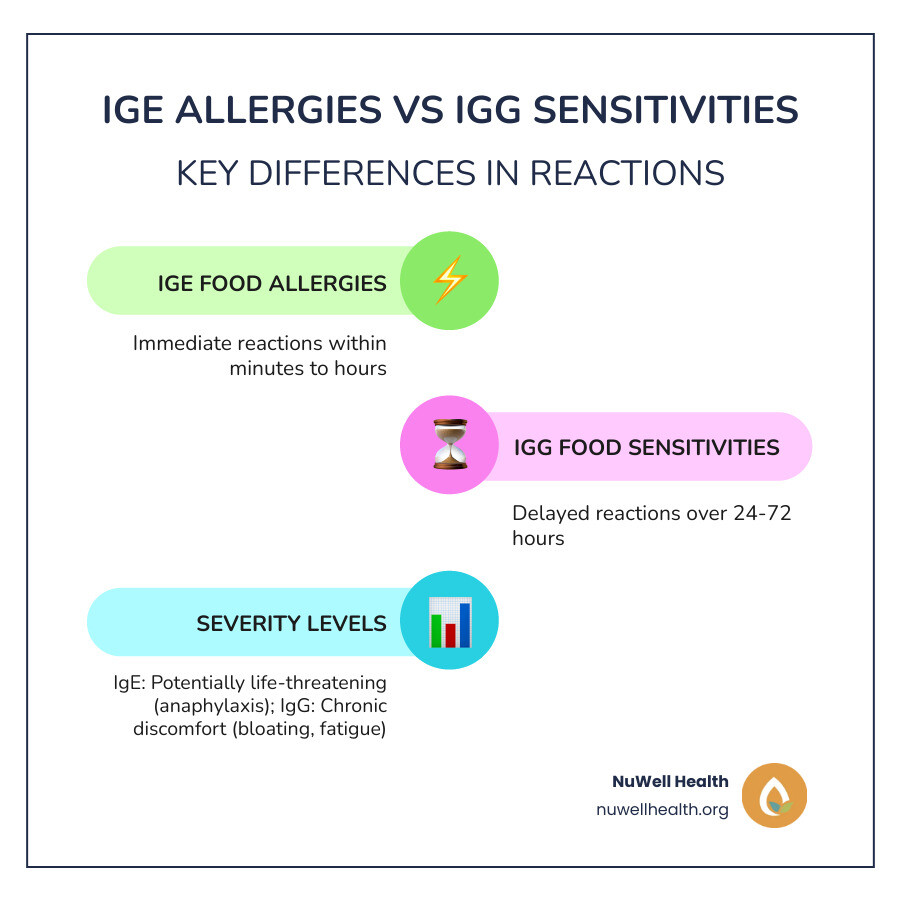
Allergy, Sensitivity, or Intolerance? Understanding the Difference
In our clinical practice at NuWell Health, we often see people using these terms interchangeably, but they represent very different biological processes. Understanding the nuance is the first step toward finding the right solution.
Food Allergies (IgE-Mediated)
A true food allergy involves the immune system’s production of IgE antibodies. This is an immediate, often severe reaction where the body perceives a specific food protein as a threat. The most common food allergies in adults include shellfish, milk, peanuts, and tree nuts. Symptoms can include hives, swelling, shortness of breath, or even life-threatening anaphylaxis. Because these reactions happen quickly, the trigger is usually easy to identify.
Food Sensitivities (IgG-Mediated)
Food sensitivity testing primarily focuses on IgG antibodies. Unlike IgE, IgG responses are typically delayed. You might eat a piece of bread on Monday and not feel the “brain fog” or joint pain until Tuesday or Wednesday. Because of this 48-to-72-hour window, it is nearly impossible to identify sensitivities through memory alone. While not life-threatening, these reactions create chronic low-grade inflammation.
Food Intolerances (Non-Immunological)
An intolerance is generally a digestive issue rather than an immune system issue. The classic example is lactose intolerance, where the body lacks the enzyme (lactase) needed to break down milk sugar. Other common intolerances involve histamines, sulfites, or food additives like MSG.
At-A-Glance Comparison
| Feature | Food Allergy (IgE) | Food Sensitivity (IgG) | Food Intolerance |
|---|---|---|---|
| Immune System | Yes (IgE) | Yes (IgG) | No (Enzyme/Chemical) |
| Onset | Immediate (Minutes) | Delayed (Hours to Days) | Variable (30 min to hours) |
| Severity | Can be life-threatening | Uncomfortable/Chronic | Uncomfortable |
| Common Symptoms | Hives, wheezing, anaphylaxis | Bloating, migraines, fatigue | Gas, diarrhea, cramping |
| Example | Peanut allergy | Gluten sensitivity | Lactose intolerance |
At NuWell Health, we also recognize the link between these reactions and skin health. Research suggests that about 35% of individuals with atopic dermatitis (eczema) may experience flare-ups provoked by specific food triggers. By identifying these root causes, we can help the body return to its natural state of balance.

The Science Behind Food Sensitivity Testing
When you take a food sensitivity testing kit, the laboratory is usually looking for IgG antibodies. But what does that actually mean?
The Role of IgG and IgG4
IgG is the most abundant type of antibody in the blood. When your immune system is repeatedly exposed to a food, it produces IgG. Some researchers and medical organizations, such as the American Academy of Allergy, Asthma & Immunology (AAAAI) and the European Academy of Allergy and Clinical Immunology (EAACI), argue that the presence of IgG4 (a subclass of IgG) is actually a marker of tolerance rather than sensitivity.
In other words, having high IgG levels for almonds might just mean you eat a lot of almonds and your body has learned to recognize them. In fact, food-specific IgG antibodies are found in healthy children and adults alike.
Scientific Validation and Controversy
This is where the science gets tricky. Because IgG can indicate both “exposure” and “sensitivity,” the medical community is divided. While commercial labs use CLIA-certified processes to ensure the results are technically accurate (meaning they really did find those antibodies), the interpretation of those results is what matters most.
At NuWell Health, we have found that IgG tests are best used as a “map” rather than a final destination. They show us where the immune system is most active, allowing us to prioritize which foods to investigate further through clinical history and elimination.

The Accuracy of At-Home Food Sensitivity Testing Kits
The rise of at-home food sensitivity testing has made these insights more accessible than ever. Most kits require a simple finger prick to collect a few drops of blood on a card.
- Reactivity Levels: Results are typically graded on a Class 0-3 scale. Class 0 indicates normal reactivity, while Class 3 indicates high reactivity.
- Results Correlation: Many leading at-home labs boast a 95-99% correlation in their quality control testing, ensuring that the lab work itself is highly reliable.
- Physician Review: Reputable companies have their results reviewed by independent board-certified physicians before they reach your inbox.
However, the limitation of these kits is that they cannot account for your personal medical history. A “High Reactivity” result for wheat doesn’t necessarily mean you have Celiac disease; it just means your IgG levels are elevated. This is why professional guidance is essential to turn data into a healing plan.
Reliable Methods for Identifying Food Triggers
While blood tests provide a snapshot, the “gold standard” for identifying what truly bothers your body remains the elimination diet and the oral food challenge.
The Elimination Diet
This process involves removing suspected trigger foods for a period of 4 to 6 weeks. This gives the body’s inflammatory markers time to settle and the gut lining a chance to begin healing. At NuWell Health, we view this as a period of “rest” for the temple that is your body.
After the elimination phase, you enter the reintroduction phase. You add foods back one at a time, every 2-3 days, while carefully tracking your symptoms. If you reintroduce dairy and your migraines return within 24 hours, you have a clear, functional answer that no blood test can replicate.
Oral Food Challenges
An oral food challenge is the most definitive way to confirm an allergy. Under strict medical supervision, a patient is fed increasing doses of a food protein to check for a reaction. This is often used for children to see if they have outgrown an allergy, though it can be stressful and requires professional oversight to ensure safety.
The NuWell Health Approach
We believe that your health is a gift to be stewarded. When we look at Allergies and Food Sensitivity, we aren’t just looking for a list of “bad foods.” Our experience at NuWell Health has shown that the most profound healing occurs when we combine functional insights with a focus on restoring the body’s natural rhythm. We look at:
- Gut Health: Is a “leaky gut” allowing food particles to enter the bloodstream and trigger an immune response?
- Preventive Lifestyle: How can we nourish your body to prevent these sensitivities from developing in the first place?
- Spiritual Alignment: We treat the mind, body, and spirit. Stress and spiritual unrest can manifest as physical inflammation, making you more reactive to the world around you—including your food.
Safer Alternatives to Commercial Testing
If you aren’t ready for a blood test, there are other ways to find clarity.
- The Food Diary: This is the simplest and most effective tool we recommend. By recording what you eat and how you feel (mood, energy, digestion), patterns emerge.
- Systematic Reintroduction: Even without a full elimination diet, you can try removing one major category (like dairy or gluten) for two weeks and noting the changes.
- Nutrient Density Focus: Sometimes, “sensitivities” are actually reactions to highly processed additives. Switching to a whole-food, natural diet often resolves symptoms without the need for complex testing. At NuWell Health, we’ve seen that returning to these natural, whole foods is often the most powerful medicine.
A Note on Alternative Methods
You may encounter tests like bioresonance (using hair samples) or hair analysis. While some find these helpful in a complementary medicine context, it’s important to know they are not recognized by conventional medicine. Bioresonance equipment like the Mars III system is used by practitioners worldwide to look at “energy signatures,” but these should never replace a medical evaluation for true allergies.
Frequently Asked Questions About Food Sensitivity Testing
Navigating food sensitivity testing often brings up more questions than answers. Here are the most common concerns we address at NuWell Health.
What are the most common symptoms of food sensitivity?
Symptoms are often “vague” and can affect almost any system in the body. We frequently see:
- Digestive: Bloating, gas, abdominal pain, and indigestion.
- Neurological: Migraines, “brain fog,” and chronic fatigue.
- Musculoskeletal: Joint pain and unexplained muscle aches.
- Skin: Rashes, itching, or exacerbations of eczema.
Because these are delayed reactions, you might not connect your Wednesday headache to your Monday night pizza.
Is IgG testing recommended by medical organizations?
Most major organizations, including the AAAAI and EAACI, do not currently recommend IgG testing for diagnosing food allergies or sensitivities. Their stance is that IgG is a normal sign of food exposure. However, many functional medicine practitioners find it to be a useful tool for prioritizing an elimination diet. It helps us “narrow the field” so you aren’t trying to eliminate 50 foods at once.
Should I consult a professional before changing my diet?
Absolutely. One of the biggest risks of food sensitivity testing is unnecessary restriction. In our experience at NuWell Health, we have seen patients who, after seeing a long list of “reactive” foods, stop eating so many things that they become malnourished or develop an unhealthy relationship with food.
At NuWell Health, we help you interpret these results within the context of your whole life. We ensure you maintain nutritional balance while we work on the root cause—which is often improving your gut health so you can eventually tolerate those foods again.
Conclusion: Holistic Healing and the Body as a Temple
At the end of the day, food sensitivity testing is just one tool in your wellness toolbox. Our goal at NuWell Health is to empower you with self-care strategies that treat the root cause of your symptoms, not just the “smoke” they produce. Through our work at NuWell Health, we have witnessed firsthand how reclaiming control over your nutrition can lead to a renewed sense of purpose and vitality.
We believe that your body is a temple, and learning how to nourish it properly is an act of stewardship and self-love. Whether you choose an at-home kit, a clinical blood draw, or a disciplined elimination diet, the objective is the same: to live a life free from the burden of chronic inflammation and discomfort.
By focusing on preventive lifestyle changes and a holistic perspective that integrates mind, body, and spirit, you can move past the confusion of “trigger foods” and into a state of vibrant health.
If you’re ready to dig deeper into your health journey, you can find more info about allergies and food sensitivity on our dedicated resource page. Let’s work together to find the answers your body has been trying to tell you.
This article was researched with AI and heavily edited by Jordan Oliver for accuracy and relevance.
Jordan is an author, ordained minister, and online host for His Glory TV, sharing biblically grounded insights on faith, prayer, and spiritual growth. She is the co-founder of Triple-Braided Cord Co., an intercessory prayer and healing ministry inspired by Ecclesiastes 4:12.
Jordan holds a Bachelor’s degree in Communications and Religious Studies from High Point University and is a certified Spiritual Life Coach through iCoachLife in Nashville, Tennessee. Drawing from her ministry, coaching, and academic experience, she creates trustworthy, faith-based content that helps readers grow in their relationship with God. Learn more about Jordan here.