

Why Mind Body Spirit Healing Is the Missing Piece in Modern Wellness
Mind body spirit healing is a holistic approach that treats the whole person — not just symptoms — by recognizing that your mental, physical, and spiritual health are deeply connected and directly influence each other.
Here’s what you need to know at a glance:
- What it is: An integrated approach combining evidence-based therapies with practices like meditation, yoga, breathwork, and somatic healing
- Who it’s for: Anyone experiencing recurring symptoms, chronic stress, trauma, or feeling “stuck” despite conventional treatment
- Why it works: Imbalance in one area — mind, body, or spirit — creates ripple effects across the others
- How to start: Daily practices like mindful movement, breathwork, journaling, and working with a qualified integrative practitioner
- Key benefit: Addresses root causes rather than masking symptoms, supporting long-term resilience and wellbeing
As human beings living in a complicated world, we face obstacles that challenge us on every level — emotionally, physically, and spiritually. Many people find that conventional approaches help manage symptoms, but don’t fully resolve what’s underneath. That gap is exactly where mind, body, spirit healing begins.
I’m Stephen A. Luther, MS, MEd, LPC, a Licensed Professional Counselor with over 25 years of experience specializing in mind, body, spirit healing, trauma recovery, and whole-person wellness. My work at NuWell Health is built around helping individuals find and treat the root causes of their struggles — not just the surface symptoms — so they can truly thrive.
Defining Mind Body Spirit Healing and the Power of Connection

When we talk about mind, body, spirit healing, we aren’t just using a trendy catchphrase from April 2026. We are describing a fundamental shift in how we view human health. For centuries, Western medicine often treated the body like a car—if a part broke, you fixed that specific part and went on your way. While that’s great for a broken arm, it often fails when dealing with chronic anxiety, fatigue, or the lingering weight of trauma.
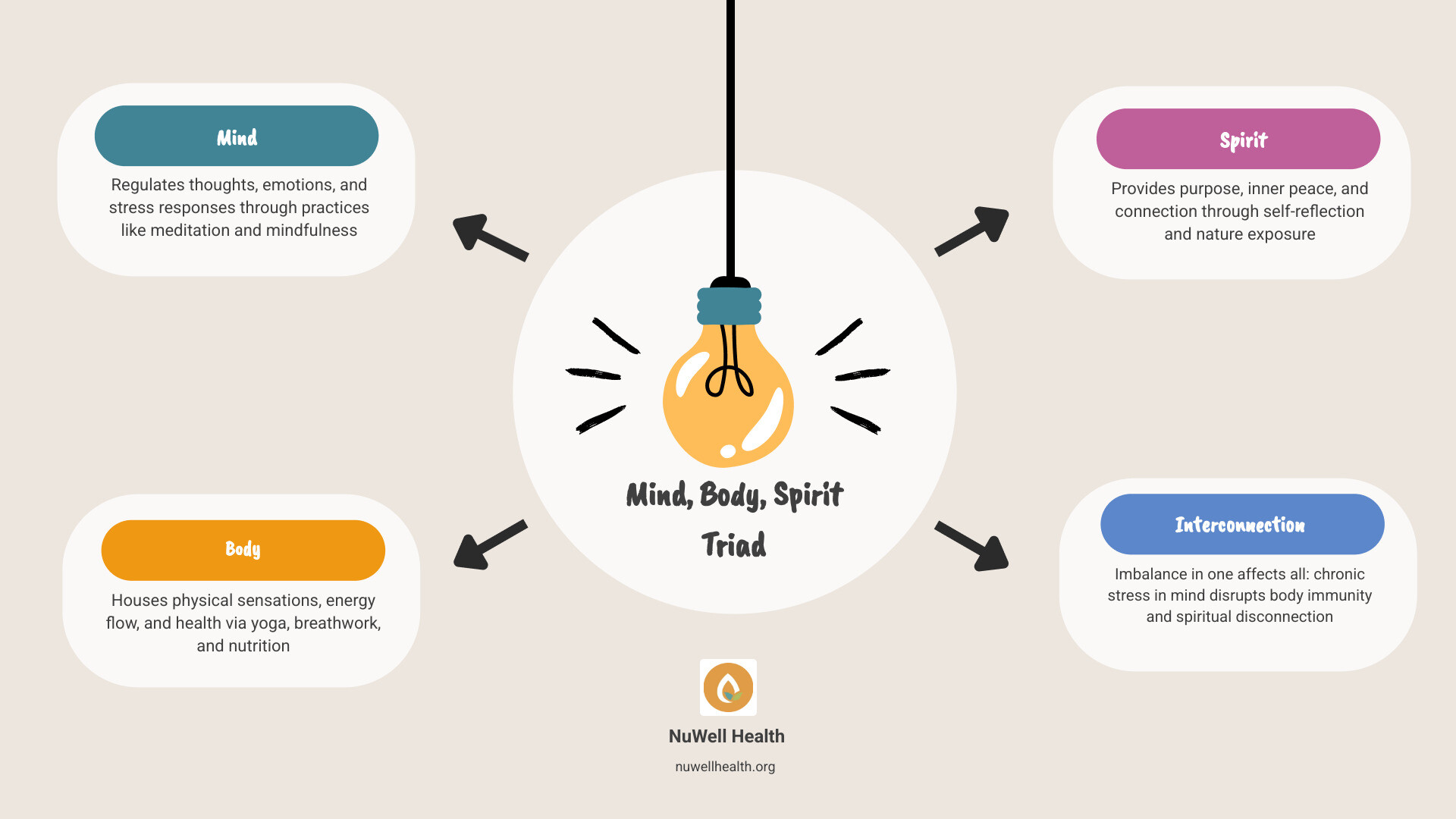
Holistic health is the understanding that you are a “whole” whose true nature is honored through internal resources. It recognizes that your thoughts (mind) create emotions and vibrations that directly affect your physical state (body), and these are all powered by your “WIFI” or life force (spirit).
How It Differs from Traditional Therapy
Traditional talk therapy is a powerful tool, but it primarily operates from the “top-down.” You talk about your problems, analyze your thoughts, and try to change your behavior. Mind, body, spirit healing adds “bottom-up” and “middle-out” approaches. We don’t just talk about the stress; we look at how it’s stored in your nervous system and how your spiritual disconnection might be fueling a sense of purposelessness.
By accessing our “wise self,” we move beyond just managing a diagnosis. We move toward compassionate empowerment. As noted in Holistic Healing: Nurturing Mind, Body, and Spirit, this approach concurrently improves physical, mental, emotional, and spiritual components of health. At NuWell Health, we believe this is the key to the mind-body connection in mental health, allowing us to guide individuals back to their most authentic selves.
The Science and Importance of Holistic Health
You might be wondering, “Is this just ‘woo-woo’ science?” Actually, the research backing these connections is staggering. In the scientific community, we now know that thoughts and attitudes positively or negatively affect how our body works.
The Physical Impact of Emotional States
When you are stressed, your body produces cortisol. Short-term, cortisol helps you run away from a metaphorical bear. Long-term, it wreaks havoc on your immune system, digestion, and heart health. Research shows that practicing meditation, mindfulness, and prayer can significantly lower these cortisol levels and improve overall wellness.
Consider these powerful statistics and facts:
- Trauma’s Reach: 82% of breast cancer survivors experience PTSD symptoms, proving that physical illness is rarely just physical.
- Social Connection: The health risks associated with poor social relationships are comparable to biomedical risk factors like obesity, physical inactivity, and even smoking.
- Diverse Modalities: There are more than a hundred types of documented holistic healing practices, many of which are now being studied at the university level.
The Health Hexagon Model
To understand why this matters, we often look at the “Health Hexagon.” This model integrates six key areas: diet, sleep, exercise, nature exposure, social connections, and a sense of purpose. If one side of the hexagon collapses, the whole structure weakens. This is why natural health for mental wellness is so effective—it reinforces all six sides.
Common Practices for Mind Body Spirit Healing
Core Modalities for Mind Body Spirit Healing
In our practice, we use a variety of tools to help bridge the gap between mind, body, and spirit. These aren’t just “extra” services; they are foundational to the healing process.
- Meditation and Mindfulness: These practices help calm the mind and increase self-awareness. They teach us to observe our thoughts without being swept away by them.
- Mindful Movement: Yoga is the ultimate integration tool. It uses physical postures for the body, breathing techniques for the mind, and a focus on the “larger self” for the spirit.
- Breathwork: Techniques like the 4-7-8 breathing can “reset” the nervous system almost instantly.
- Nutrition: We are learning more every day about the “second brain” in our gut. What you eat directly impacts your mood and mental clarity.
If you are curious about what mind-body-spirit therapy can help with, it’s important to understand that these tools often enhance the benefits of traditional clinical work. This is a big part of understanding naturopathic medicine and its role in modern care.
Restoring the Connection After Trauma
Trauma is perhaps the most significant disruptor of the mind-body-spirit connection. Trauma isn’t just the event that happened; it’s what happens inside you as a result. The body “keeps the score,” storing trauma in your cells and nervous system even if your conscious mind tries to forget it.
When trauma occurs, we often dissociate—we “leave” our bodies to survive the pain. This creates a spiritual wound and a physical disconnection. To heal, we use specialized therapies:
- EMDR (Eye Movement Desensitization and Reprocessing): Uses bilateral stimulation to help the brain reprocess traumatic memories so they no longer trigger an intense emotional response.
- Brainspotting: A rapid technique that uses your field of vision to find where trauma is “stuck” in the brain and body.
- Somatic Experiencing: Focuses on releasing the physical tension and “thwarted survival energy” trapped in the body.
At NuWell Health, we prioritize a roots-over-remedies approach. We don’t want to just give you a coping skill to manage the symptoms of trauma; we want to help you process the trauma at the cellular level so the symptoms naturally dissipate.
How to Start Your Daily Healing Journey
Practical Steps for At-Home Mind Body Spirit Healing
You don’t need a specialized center to begin your mind-body-spirit healing journey. You can start today with simple, consistent rituals.
- Morning Rituals: Instead of reaching for your phone, start your day with five minutes of stillness, prayer, or stretching. This sets a tone of “presence” rather than “reactivity.”
- Journaling: Use “titrated journaling” to explore your feelings safely. Ask yourself, “Who is present in me right now? What do they need?”
- Nature Exposure: Getting outside reduces cortisol and reminds us of our connection to something larger. Even a ten-minute walk can shift your perspective.
- The 4-7-8 Breath: Inhale for 4 seconds, hold for 7, and exhale slowly for 8. This is a “kill switch” for the stress response.
- Sleep Hygiene: Your body cannot heal if it isn’t resting. Aim for 7-9 hours of sleep and limit screens before bed.
By incorporating these habits, you begin to explore more mind-body connection resources within your own life.
Signs of Imbalance and Choosing a Practitioner
How do you know if your connection is out of whack? Your body usually tells you long before your mind admits it. Signs include:
- Chronic fatigue that doesn’t go away with rest.
- Emotional numbness or feeling “stuck.”
- Digestive issues like IBS or frequent stomach aches.
- Chronic muscle tension, especially in the neck and shoulders.
- A sense of being “disconnected” from your purpose or joy.
When looking for a practitioner, qualifications matter. You want someone who understands both the clinical and the holistic. Look for licensed psychotherapists (LPC, LCSW) who have additional certifications in somatic work, or practitioners with degrees like MD (Medical Doctor), ND (Naturopathic Doctor), or DC (Doctor of Chiropractic) who specialize in integrative care. You can find more about these roles in the naturopathic medicine and holistic care categories.
Frequently Asked Questions about Mind-Body-Spirit Wellness
Can mind-body-spirit healing be combined with conventional medicine?
Absolutely. In fact, we recommend it. This is called complementary care. For example, someone undergoing chemotherapy (conventional) might use Reiki or massage (holistic) to manage side effects and maintain their spirit. The key is an evidence-based risk-benefit analysis. Holistic practices should support and enhance your medical treatments, not necessarily replace them, especially in serious health situations.
How does spiritual health impact overall wellness?
Spiritual health is the “WIFI” of your well-being. It’s not necessarily about religion—though it can be—but about your sense of purpose, sacredness, and connection to the world. When you are spiritually healthy, you have a buffer against stress. You understand that your life has meaning, which fosters resilience and joy. It is the path to true self-actualization and growth.
What are the signs that my connection is out of balance?
Beyond the physical symptoms mentioned earlier, look for “mental fog” and relational conflict. When we are disconnected from ourselves, we tend to be more reactive with others. If you find yourself snapping at loved ones or feeling a constant sense of “spiritual dryness,” it’s a sign that your triad—mind, body, and spirit—needs realigning.
Conclusion
At NuWell Health, we believe that wholeness is your birthright. It isn’t something you have to “earn” or a destination you reach; it’s a state of balance you return to with tenderness and curiosity. By embracing mind-body-spirit healing, you move away from a life of just “getting by” and toward a life of long-term vitality.
You were never meant to carry the weight of the world alone. Whether you are dealing with the echoes of the past or the stresses of the present, there is a path back to your wise, empowered self. Take that first step today—your mind, body, and spirit will thank you.