
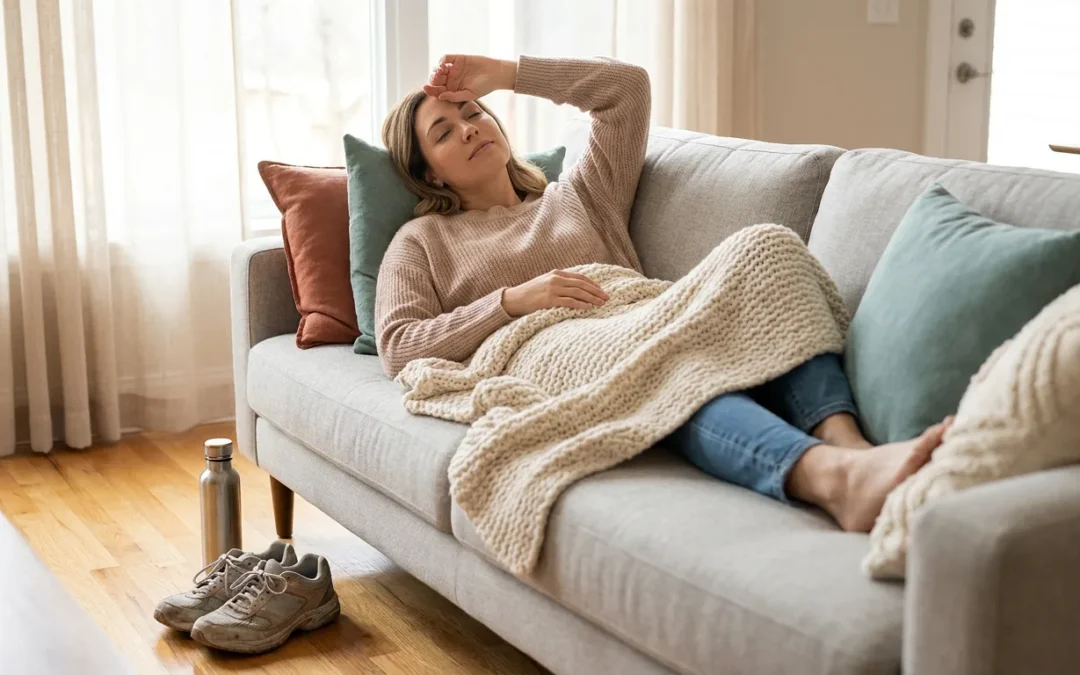
Why do I feel worse after exercise when I am trying to get healthier? It is a fair question, and the answer starts with your own pattern. Do not try to out-train a repeated crash. Pause plans to increase exercise, write down what happens, and talk with a healthcare professional. If fatigue is your main concern, our page on support for persistent fatigue explains how our practitioners can work alongside your medical care.
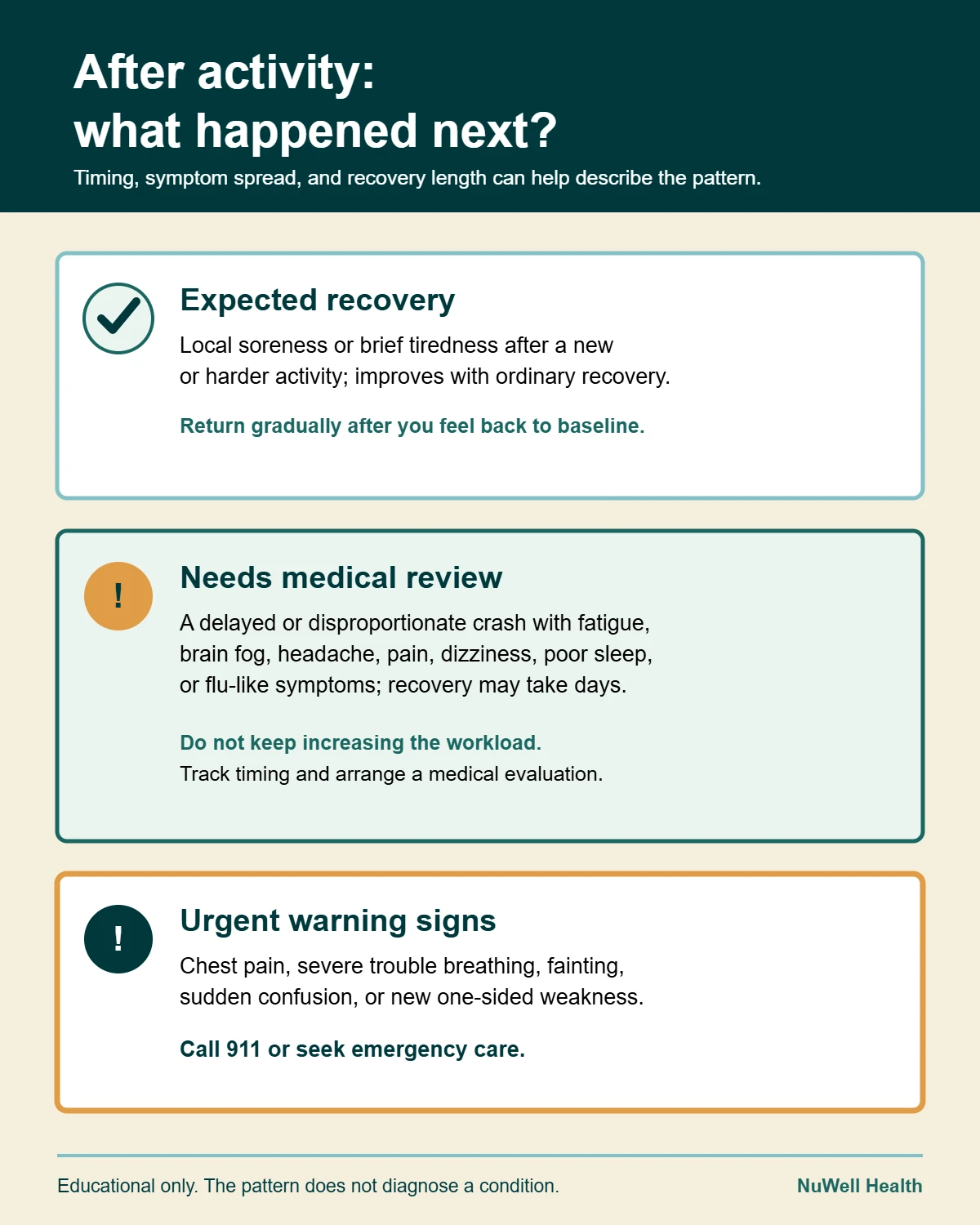
Call 911 for chest pain, severe trouble breathing, fainting, sudden confusion, new weakness on one side of the body, or another medical emergency.
Start with the pattern, not a diagnosis
Feeling “worse” can mean several things. For example, your legs may be sore after strength training. You may feel briefly tired after a long walk on a hot day. On the other hand, you may notice a broader change that affects concentration, sleep, pain, heart rate, dizziness, or your ability to finish basic tasks.
The pattern matters more than the word fatigue. Ask yourself three questions. First, was the effort ordinary for you? Next, did symptoms begin during the activity or much later? Finally, did you recover with normal rest, or did the effect carry into the next day or beyond?
This comparison is not a screening test. After all, exercise can uncover heart, lung, nerve, metabolic, sleep, medication, or other concerns, and a clinician needs your history to decide what to check.
Post-exertional malaise is more than ordinary soreness
The Centers for Disease Control and Prevention describes post-exertional malaise, often shortened to PEM, as a worsening of symptoms after even minor physical or mental effort that a person could have handled before becoming ill. The CDC notes that symptoms typically worsen 12 to 48 hours after activity and can last for days or even weeks (CDC).
PEM is one of the core symptoms of myalgic encephalomyelitis/chronic fatigue syndrome, or ME/CFS. It is also commonly reported with Long COVID. During a crash, people may notice severe tiredness, trouble thinking, headaches, dizziness, sore throat, or sleep problems. In the CDC’s examples, even showering or a trip to the grocery store can leave someone needing days to recover (CDC: Symptoms of ME/CFS).
Still, one hard recovery after a tough workout does not establish PEM. ME/CFS cannot be diagnosed from one symptom or a home test. CDC guidance calls for a thorough medical history, a physical and mental health exam, and testing to look for other explanations (CDC: Diagnosing ME/CFS).
Several health concerns can make activity feel harder
A change in exercise tolerance has many possible explanations. Poor sleep, recent illness, heat, dehydration, not eating enough, anemia, thyroid concerns, medication effects, heart or lung conditions, pain, and loss of fitness can all affect energy and recovery. Likewise, stress and low mood can change sleep, motivation, muscle tension, and how hard effort feels. None of these should be assumed from an article. If your tiredness is mostly about sleep, our guide to feeling tired after sleeping enough may also help.
A recent infection matters too. The CDC lists fatigue, brain fog, dizziness when standing, a pounding heart, shortness of breath, chest pain, and symptoms that get worse after physical or mental effort among commonly reported Long COVID symptoms (CDC: Long COVID). Because other illnesses can cause overlapping symptoms, tell your clinician when the change began and whether it followed COVID-19 or another infection.
Exercise intolerance and PEM are not the same thing. Exercise intolerance can mean being unable to keep going because of breathlessness, chest symptoms, muscle weakness, or low fitness. PEM, by contrast, describes a wider symptom flare that is often delayed. A person can have one pattern, both, or neither.
Track what happens before and after activity
A simple one- or two-week log can show timing that is easy to miss. In fact, the CDC suggests clinicians consider asking patients to keep a diary of activities and symptoms for a couple of weeks. Consider noting:
- Activity: physical, mental, emotional, and social effort, with how long it lasted and anything unusual.
- Right away: breathlessness, pain, dizziness, weakness, a pounding heart, or unusual tiredness during or soon after.
- Later: check again that evening and over the next two days for fatigue, brain fog, headache, sleep changes, pain, or sore throat.
- Function: what you could not do, or had to change, because of symptoms.
- Recovery: when you got back to your usual baseline, if you did.
- Context: sleep, recent illness, meals, fluids, heat, stress, medicines, and supplements. Do not change these on your own.
In other words, rough notes are fine. You do not need perfect numbers or a wearable device. If tracking increases health anxiety, feeds an eating disorder, or starts to feel rigid, stop and bring what you have to a qualified professional.
What to do when you feel worse after exercise
If activity keeps causing delayed or prolonged worsening, set aside any fixed plan that adds more exercise each week no matter how you feel. For PEM, the CDC recommends activity management, often called pacing: planning activity and rest so you stay within your current limits and avoid repeated push-and-crash cycles (CDC).
However, pacing is not the same as avoiding all movement, and it is not a cure. The CDC also notes that deconditioning is harmful, so keeping up the activities you can tolerate matters. The right balance depends on the cause, your current function, and your medical risks. A clinician or rehabilitation professional who understands post-exertional symptoms can help shape a plan.
- Pause increases in intensity or length until a professional has reviewed the pattern.
- Then break necessary tasks into smaller parts, with rest in between.
- Do not exercise through chest pain, faintness, severe breathlessness, or marked dizziness.
- Keep taking prescribed medicine as directed, and ask your prescriber or pharmacist whether any of it affects energy, heart rate, or blood pressure.
- Ask for help with demanding tasks when a crash makes driving, cooking, caregiving, or work unsafe. Do not drive when you are very sleepy, faint, or confused.
Also, do not start a restrictive diet, stimulant, electrolyte routine, or supplement plan based only on a crash after activity. “Natural” products can interact with medicines and may not be safe with some health conditions.
When feeling worse after exercise needs a doctor
Book a medical visit when the change is new, repeated, getting worse, or out of proportion to the effort. Seek care sooner when recovery takes longer than expected, ordinary tasks trigger a crash, or symptoms are limiting work, school, caregiving, or personal care.
- Chest symptoms, breathlessness, or a pounding heart with activity
- Faintness, or dizziness when you stand up
- New weakness, fever, or unexplained weight change
- Sleep problems or new pain that will not settle
- A crash after a recent infection, including COVID-19
- Any recent change in medicines or supplements
In short, the evaluation should follow your history. There is no single “fatigue panel” or supplement plan that fits everyone.
When to seek urgent help
How NuWell can complement your medical care
A repeated crash after activity deserves medical evaluation. NuWell does not diagnose ME/CFS, Long COVID, heart or lung disease, or any other condition through a blog post or a discovery call. Instead, NuWell’s practitioner-led, whole-person care can complement your physician’s work by helping you look at sleep, nutrition, stress, digestion, daily demands, mental well-being, and the care you already receive.
A NuWell practitioner can listen to your full story and consider contributing factors within their professional role. Recommendations are personalized, and testing or supplements are not automatic. At the same time, counseling, medication, rehabilitation, and medical care remain important when they fit your needs. Our approach to mental-health-informed natural health support explains how physical and emotional care can work together.
Frequently asked questions
Why do I feel worse the day after exercise?
A hard or unfamiliar workout can cause ordinary tiredness and muscle soreness the next day. A delayed flare that affects several symptoms or your daily function and lasts for days deserves medical review. Timing alone cannot identify the cause.
Does feeling worse after exercise mean I have ME/CFS?
No. Post-exertional malaise is a core symptom of ME/CFS, but diagnosis requires a larger pattern, including reduced function with fatigue, unrefreshing sleep, and thinking problems or dizziness when upright, with symptoms lasting six months or longer. A clinician also needs to rule out other causes.
Can Long COVID cause a crash after activity?
Yes. The CDC lists symptoms that get worse after physical or mental effort among commonly reported Long COVID symptoms. However, similar symptoms can have other causes, so talk with a healthcare professional about your history and timing.
Should I push through fatigue to rebuild stamina?
Not when activity keeps causing delayed or prolonged worsening. Pause automatic increases and get individual guidance. People without post-exertional malaise may do well with gradual activity, while people with it may need pacing within their current limits.
Can stress cause tiredness after exercise?
Stress can affect sleep, muscle tension, heart rate, recovery, and how hard effort feels. So it may be part of the picture, but it should not be used to dismiss chest symptoms, breathlessness, fainting, delayed crashes, or a clear loss of function.
Sources
- Strategies to Prevent Worsening of Symptoms (post-exertional malaise). Centers for Disease Control and Prevention.
- Symptoms of ME/CFS. Centers for Disease Control and Prevention.
- Long COVID Signs and Symptoms. Centers for Disease Control and Prevention.
- Diagnosing ME/CFS. Centers for Disease Control and Prevention.
- How to Avoid Exercise Injuries. MedlinePlus, U.S. National Library of Medicine.