

When Something Feels Missing: Why People Are Turning to Mind-Body-Spirit Therapy
Mind-body-spirit therapy is a holistic approach to healing that treats the whole person — not just your symptoms. Here’s a quick overview:
| What It Is | What It Does | Who It’s For |
|---|---|---|
| A whole-person therapy framework | Addresses root causes, not just symptoms | Anyone feeling stuck, burned out, or disconnected |
| Integrates mind, body, and spirit | Combines evidence-based methods with holistic practices | Those frustrated by conventional treatment alone |
| Guided by licensed therapists | Produces faster, more sustainable results | People seeking natural, faith-honoring care |
Have you ever felt like you understood why you were struggling — but that understanding alone didn’t actually make you better?
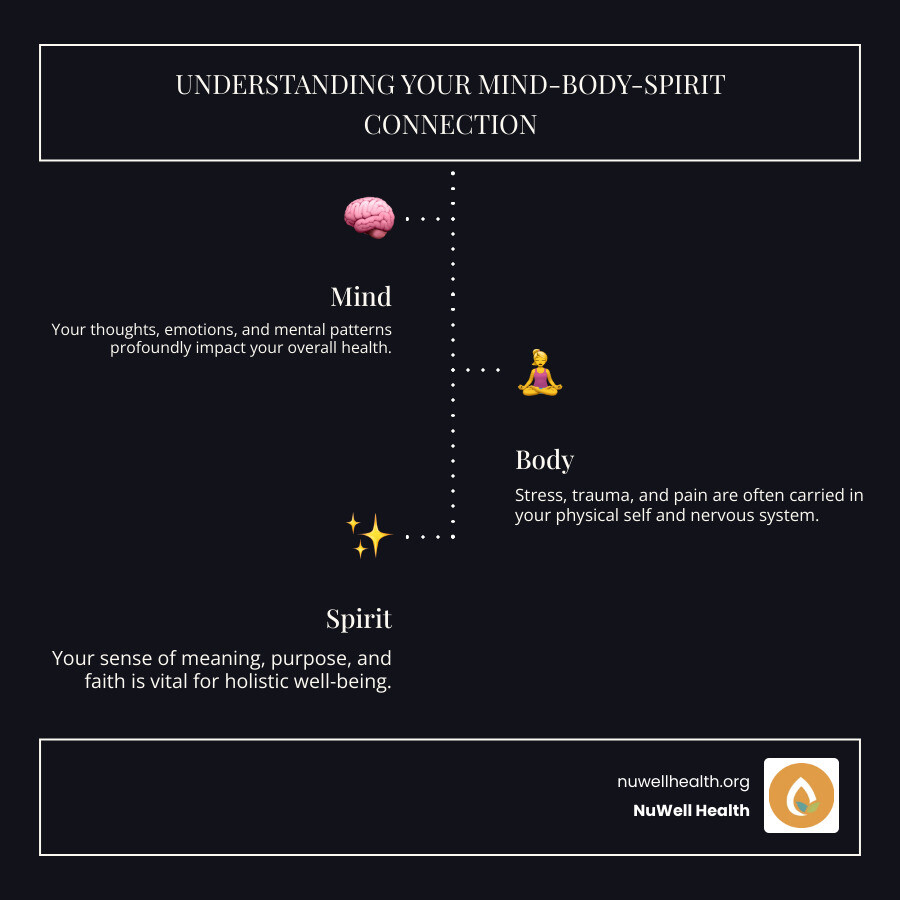
That’s one of the most common frustrations people bring to therapy. Traditional approaches often focus on thoughts and behavior. But many people carry stress, trauma, and pain in their bodies too — and in their sense of meaning, purpose, and faith.
Mind-body-spirit therapy fills that gap. It recognizes that your emotional well-being, physical health, and spiritual life are deeply connected. When one is out of balance, the others feel it too.
In 2026, more people than ever are looking beyond medication and symptom management toward root-cause healing — something that honors the full complexity of who they are.
I’m Stephen A. Luther, MS, MEd, LPC, a Licensed Professional Counselor with over 25 years of experience helping individuals and families heal through integrative mind-body-spirit therapy rooted in compassionate, faith-honoring care. In this guide, I’ll walk you through how this approach works, what to expect, and how to find the right support for your journey.
Defining Mind-Body-Spirit Therapy: A Holistic Framework
At its heart, mind-body-spirit therapy is about achieving internal balance. Most of us have been taught to view our health in silos: if your stomach hurts, you see a doctor; if you feel sad, you see a therapist; if you feel distant from God, you see a pastor. While these specialists are important, this fragmented approach often misses the “why” behind the “what.”
We define this therapy as a holistic framework that integrates traditional psychological techniques with physical and spiritual practices. It moves beyond simple symptom management. Instead of just asking, “How do we stop the panic attacks?” we ask, “What is happening in your nervous system, your thought patterns, and your spiritual life that is creating this state of alarm?”
Research consistently demonstrates that integrative approaches in therapy produce better outcomes than traditional therapy alone. This is because we aren’t just brains in jars; we are embodied souls. Why Your Holistic Mind-Body-Spirit Connection Matters is a concept rooted in the idea that our thoughts influence our physiology, and our physical state influences our spiritual receptivity.
By understanding mind-body-spirit therapy we can see that true wellness is a state of internal harmony, not merely the absence of a diagnosis. Our approach at NuWell Health emphasizes a preventive lifestyle. We want to empower you with self-care tools so that you aren’t just recovering from a crisis, but building a life that resists future imbalances.

Core Domains of Healing: Mind, Body, and Christian Spirituality
To truly heal, we must attend to all three domains of the human experience. If we ignore one, the others will eventually compensate, often leading to burnout or chronic illness.
The Mind: Mental Patterns and Neuroplasticity
Our minds are powerful, but they can also become stuck in “thinking traps” or negative loops. In mind-body-spirit therapy, we look at these patterns not just as “bad thoughts,” but as neural pathways that have been reinforced over time. We use evidence-based techniques to help you develop new, healthier ways of processing information. This involves more than just “positive thinking”; it’s about deep cognitive restructuring.
The Body: Physical Sensations and the Nervous System
The body is often the first to know when something is wrong. Chronic stress can manifest as physical symptoms like headaches, digestive issues, or muscle tension. We recognize that the Mind-Body Connection in Mental Health is a two-way street. By learning to tune into physical sensations, we can identify where stress is stored and use somatic practices to release it. This helps regulate the nervous system, moving you out of a constant state of “fight or flight” and into a state of “rest and digest.”
The Spirit: Christian Values and Moral Clarity
For many, the “spirit” is the most neglected part of therapy. In our practice, we integrate spirituality from a Christian perspective. We believe that spiritual well-being provides a buffer against daily stresses. When we align our values with our actions, we experience a sense of integrity and moral clarity that reduces internal conflict.
Practices like prayer and scripture reflection aren’t just “religious duties”—they are powerful tools for spiritual grounding. This grounding provides inner peace and stabilizes emotions. By viewing life through a spiritual lens, we find meaning in our struggles, which is essential for Roots Over Remedies. When we understand our purpose in God’s plan, we gain the resilience needed to face adversity with hope.
Evidence-Based Techniques in Mind-Body-Spirit Therapy
We don’t just talk about balance; we use specific, proven tools to achieve it. These techniques bridge the gap between clinical psychology and holistic wisdom.
Somatic Practices and Nervous System Regulation
One of the most profound insights of modern therapy is that trauma is not just a memory—it is held in the body’s cells. Even if your mind tries to dissociate from a painful event, your nervous system retains the record. This is why Getting to the Bottom of Emotional Pain and Trauma requires more than just talk.
We use somatic awareness to help you identify where you are holding tension. Techniques such as the 4-7-8 breathwork pattern are incredibly effective for regulating the vagus nerve, which acts as the “off switch” for your body’s stress response.
Furthermore, scientific research on yoga for anxiety shows that gentle, mindful movement can significantly reduce cortisol levels. By combining movement with breath, we teach the body that it is safe, allowing the brain to finally let go of its hyper-vigilance.
Cognitive and Spiritual Integration in Mind-Body-Spirit Therapy
While we honor the body, we also utilize Cognitive Behavioral Therapy (CBT) to address the mental domain. However, we take it a step further by weaving in spiritual truths. Natural Health & Mental Health are enhanced when we view our emotions as messengers rather than enemies.
In this framework, we might use scripture to challenge a lie you’ve believed about your worth, or use the concept of grace to address deep-seated guilt. This integration helps individuals let go of shame and embrace forgiveness—a key component of emotional healing.
We often look toward What is Naturopathic Medicine? principles to support this work, focusing on how nutrition and lifestyle support brain health. When your body is nourished, your mind is clearer, and your spirit is more resilient.
Therapy vs. Coaching: Choosing Your Path to Restoration
It is important to understand the difference between clinical therapy and wellness coaching. Both have value, but they serve different purposes on your healing journey.
| Feature | Mind-Body-Spirit Therapy | Wellness/Spirit Coaching |
|---|---|---|
| Focus | Healing past trauma and clinical issues | Future goals and lifestyle optimization |
| Licensure | Licensed Professional (LPC, LCSW, etc.) | Certification (varies widely) |
| Approach | Trauma-informed, root-cause resolution | Action-oriented, habit-building |
| Insurance | Often reimbursable | Rarely covered |
| Best For | Anxiety, depression, PTSD, deep grief | Burnout prevention, purpose seeking |
At NuWell Health, we prioritize a trauma-informed, clinical approach because we believe in solving the root cause of the issue. Whether you choose therapy or coaching, the goal should always be empowering self-care. We want you to become the expert on your own well-being.
What to Expect: The Journey from Relief to Integration
Healing is rarely a straight line; it’s more like a spiral. However, there are general phases you can expect when you begin mind-body-spirit therapy.
- Relief (Sessions 4-6): Most clients experience an initial “lift” within the first month. As you learn basic grounding tools and feel heard by a compassionate guide, symptoms of acute anxiety or despair often begin to ease.
- Deeper Patterns (3-6 Months): Once the crisis has passed, we begin the real work. This involves identifying the “roots” of your struggles—old wounds, limiting beliefs, or chronic nervous system dysregulation.
- Integration and Embodiment (6-12 Months): This is where the changes become part of who you are. You aren’t just “doing” therapy; you are living a new way. You find that your reactions have changed, your physical health has improved, and your spiritual life is more vibrant.
Our Mind-Body Connection Resources highlight that these sustainable results come from consistent, weekly attendance and a commitment to practicing tools at home.
Frequently Asked Questions about Mind-Body-Spirit Therapy
Is mind-body-spirit therapy covered by insurance?
Yes, in many cases. Because our practitioners are licensed therapists with clinical credentials, sessions are often eligible for insurance reimbursement under standard mental health benefits. We recommend checking with your provider to see if they cover “out-of-network” behavioral health services if we are not directly in your network.
How does this differ from traditional talk therapy?
Traditional talk therapy primarily stays in the “neck up.” It focuses on verbal processing. Mind-body-spirit therapy invites the body’s wisdom and spiritual alignment into the room. Scientific research on integrative therapy outcomes shows that addressing the physiological and existential aspects of a person leads to faster and more sustainable results than talk alone.
What mental health issues can mind-body-spirit therapy help with?
This approach is highly effective for:
- Anxiety and Depression: By regulating the nervous system and addressing cognitive patterns.
- Trauma and PTSD: By releasing stored somatic tension that talk therapy can’t reach.
- Burnout and Chronic Stress: By implementing preventive lifestyle changes.
- Identity and Purpose Struggles: By integrating Christian values and spiritual meaning.
Conclusion
At NuWell Health, we believe you were created for abundance, not just “getting by.” By choosing mind-body-spirit therapy, you are deciding to stop pulling the leaves off the weeds and start addressing the roots.
Our mission is to provide a path to healing that offers fewer side effects and a heavy focus on empowering you to take charge of your health. Through a Christian perspective, we walk beside you as you reconnect your mind, body, and spirit to the source of all healing.
Are you ready to move beyond symptom management and into true restoration? Start your healing journey with us today.
This article was researched with AI and heavily edited by Jordan Oliver for accuracy and relevance.
Jordan is an author, ordained minister, and online host for His Glory TV, sharing biblically grounded insights on faith, prayer, and spiritual growth. She is the co-founder of Triple-Braided Cord Co., an intercessory prayer and healing ministry inspired by Ecclesiastes 4:12.
Jordan holds a Bachelor’s degree in Communications and Religious Studies from High Point University and is a certified Spiritual Life Coach through iCoachLife in Nashville, Tennessee. Drawing from her ministry, coaching, and academic experience, she creates trustworthy, faith-based content that helps readers grow in their relationship with God. Learn more about Jordan here.