

Perimenopause brain fog can feel like losing a familiar word, forgetting why you walked into a room, or needing more effort to stay on task. The Office on Women’s Health says these changes are common in perimenopause and often improve after menopause. However, other things can cause the same fog: broken sleep, hot flashes, stress, depression or anxiety, medicines, thyroid problems, and other health concerns.
Start by noticing the pattern and how much it affects your day. Slower changes that persist, worsen, or get in the way of work, driving, bills, cooking, or self-care deserve a medical conversation. Sudden changes need emergency care, which is covered below. NuWell’s whole-person hormone support can sit alongside that medical care, never in place of it.
What Perimenopause Brain Fog Can Feel Like
“Brain fog” is an everyday phrase, not a medical condition. People use it for word-finding trouble, distractibility, slower recall, misplaced items, mental fatigue, or difficulty keeping several steps in mind. The Office on Women’s Health lists forgetting words and trouble focusing among common perimenopause symptoms. Similarly, a 2026 research perspective in Frontiers in Human Neuroscience describes menopause-related cognitive changes as typically mild, variable, and distinct from dementia.
Even so, common does not mean imaginary or unimportant. After all, a small change can matter a lot when your job, caregiving, or home life demands steady attention. At the same time, it is reasonable to feel worried. The goal is to take the change seriously without assuming the worst or blaming every lapse on hormones.
Why Brain Fog May Show Up During Perimenopause
The hormone transition may change how thinking feels
Perimenopause is the time before menopause when hormone levels change and periods often become irregular. Researchers are still studying how this transition relates to attention, verbal memory, and processing speed. So far, the evidence points to an uneven pattern, not a simple rule that one hormone level causes brain fog. For example, some people notice little change, while others notice clear day-to-day shifts.
Sleep disruption can add to the problem
Night sweats, insomnia, bladder symptoms, pain, and mood changes can all interrupt sleep. As a result, concentration, recall, and emotional control can be harder the next day. So if your fog is worse after broken nights, write that down. Loud snoring, gasping, morning headaches, or strong daytime sleepiness also deserve medical review, because menopause does not rule out a sleep disorder. Do not drive when you feel very sleepy. If exhaustion lingers no matter how you sleep, our guides on feeling tired after sleeping enough and support for persistent fatigue may help.
Mood, stress, and mental load can overlap
Anxiety, depression, ongoing stress, and a heavy mental load draw on the same attention and working memory you use for daily tasks. Even so, that does not mean the fog is “all in your head.” Physical symptoms and emotional strain can be present at the same time. Counseling, psychiatric care, medication management, and mental-health-informed natural health support can work together when each stays within its role.
Other health concerns may look similar
The National Institute on Aging lists several factors that can cause memory problems, including medication side effects, thyroid, kidney, or liver problems, depression and anxiety, sleep problems, alcohol or drug misuse, infections, and low vitamin B12. For this reason, a clinician can use your history, symptoms, an exam, and appropriate testing to sort through those possibilities. Don’t start hormone products or a stack of supplements based only on trouble concentrating.
Track Perimenopause Brain Fog for Two to Four Weeks
A short log can give your clinician a clearer picture without turning every lapse into a test. The Office on Women’s Health also suggests tracking your periods and symptoms to share with your provider. To start, use a notebook or a phone note, record enough to see a pattern, then stop.
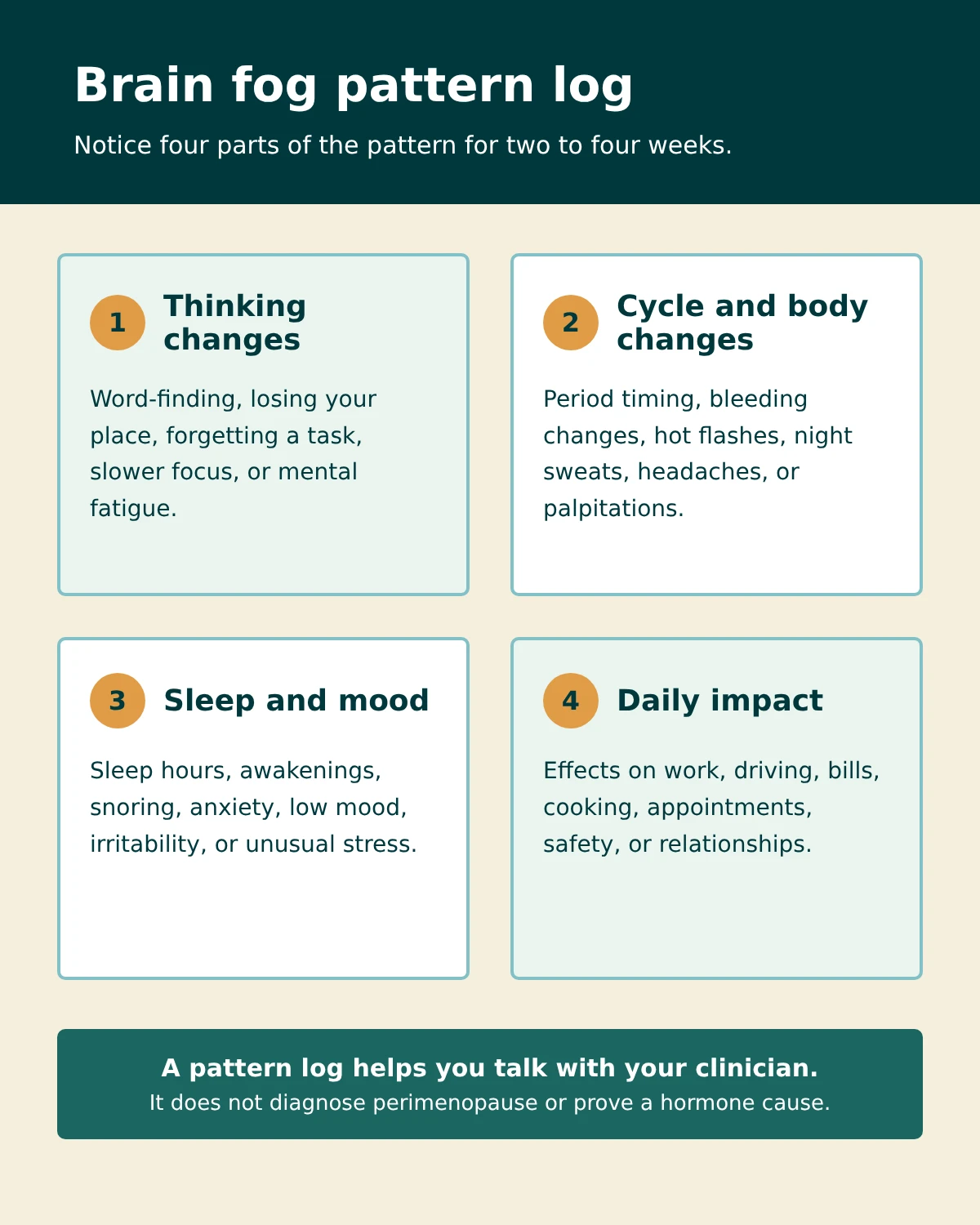
Here is what to note in each part:
- Thinking changes: word-finding, forgetting a task, losing your place, slower focus, or mental fatigue.
- Cycle and body changes: period timing, heavier or lighter bleeding, hot flashes, night sweats, headaches, or palpitations.
- Sleep and mood: hours slept, awakenings, snoring or gasping, anxiety, low mood, irritability, or unusual stress.
- Daily context: caffeine, alcohol, medicines, supplements, meals, illness, pain, workload, and caregiving demands.
- Impact: whether the change affected work, driving, appointments, bills, cooking, safety, or relationships.
Skip the log if tracking could intensify health anxiety or an eating disorder, and talk with a professional directly instead. If your tiredness lines up with the days before your period rather than midlife changes, our article on fatigue before a period covers that pattern.
Bring the Full Pattern to a Medical Visit
Ask for a medical review when the change is new, persistent, worsening, or disruptive. First, bring your log, a list of medicines and supplements, and the date of your last period. Also mention heavy bleeding, hot flashes, sleep trouble, mood changes, headaches, the possibility of pregnancy, or family concerns about your memory.
Perimenopause is usually identified from your age, symptoms, and changes in your periods. Both the Office on Women’s Health and ACOG say hormone blood tests usually aren’t needed. According to ACOG, testing may be offered if you are younger than 45 and have changes in menstrual bleeding, especially if you are younger than 40.
In addition, treatment depends on your whole symptom picture and medical history. The Office on Women’s Health states that hormone therapy is not used to treat brain fog or memory problems alone. A licensed medical professional can discuss the benefits and risks of hormone and nonhormone options for symptoms such as hot flashes, sleep problems, or mood changes. Don’t start, stop, or change hormones, antidepressants, sleep medicines, or other prescriptions without the clinician who manages them.
- Memory or thinking changes that keep getting worse over weeks
- Getting lost in places you used to know well
- Trouble following recipes, directions, or familiar routines
- Asking the same questions over and over
- Problems keeping up with bills, appointments, or self-care
- Period changes before age 45, very heavy bleeding, or any bleeding after 12 months without a period
Small Supports That Reduce Mental Load
While you arrange care, a few simple habits may make the day easier. The National Institute on Aging suggests keeping your keys, wallet, phone, and glasses in the same place each day and using to-do lists, calendars, and notes. In addition, try short focus blocks, protect a regular sleep window when your responsibilities allow, eat regular balanced meals, drink enough fluid, and choose movement that suits your health and energy. These steps support general well-being; they are not a cure for perimenopause brain fog or proof of a hormone cause.
Be cautious with products marketed for memory, hormone balance, or “adrenal” support. The National Institute on Aging warns that pills and supplements promising sharper memory may be unsafe and may interfere with other treatments. After all, natural does not mean risk-free. Ask a pharmacist, physician, or qualified practitioner to review the full product and your health history before you use it.
How NuWell May Complement Your Existing Care
NuWell’s hormone support page lists perimenopause, sleep, mood, energy, metabolism, and concentration among the concerns its practitioners may consider. A NuWell practitioner can help you look at perimenopause brain fog alongside physical health, mental well-being, and daily life, and include spiritual concerns if you want them included. In other words, this whole-person support can sit alongside your primary-care clinician, gynecologist, counselor, prescriber, or other medical professionals.
NuWell does not diagnose conditions or treat emergencies, and its natural-health consulting does not replace medical evaluation or prescription care. Also, testing or supplements are not automatic. Similarly, faith may be part of your care if you want it to be; no particular belief is required. You can meet NuWell’s practitioners to see their roles and areas of focus.
When Brain Fog Needs Faster Help
For slower changes, arrange prompt medical care when memory or thinking keeps getting worse, makes familiar tasks hard, leads to unsafe decisions, or causes you to get lost in familiar places. Also seek care for very heavy bleeding, bleeding after 12 months without a period, fainting, chest pain, or another new severe symptom.
Frequently Asked Questions
Is brain fog a normal part of perimenopause?
Difficulty focusing or recalling words is commonly reported during perimenopause, and it often improves after menopause. Common does not mean every change should be ignored. Persistent, worsening, or disruptive symptoms deserve medical review.
How do I know whether brain fog is hormonal?
You can’t confirm the cause from symptoms alone. Timing with cycle changes, hot flashes, sleep problems, or mood changes may add context, but a clinician should also consider medicines, sleep disorders, thyroid problems, nutrition, mental health, and other medical concerns.
Do I need a hormone test for perimenopause brain fog?
Usually not. Instead, perimenopause is often identified from age, symptoms, and period changes. A clinician may offer testing if you are younger than 45 and have changes in menstrual bleeding, especially if you are younger than 40, or when another condition needs to be ruled out.
Does hormone therapy treat brain fog?
Hormone therapy is not used to treat brain fog or memory problems alone. It may be considered for other menopause symptoms after a licensed clinician reviews your goals, health history, and risks. Don’t use over-the-counter hormone products as a substitute for that review.
When should I worry about memory changes?
Talk with a clinician when changes persist, worsen, or interfere with familiar daily tasks. Call 911 for sudden confusion, trouble speaking, one-sided weakness, vision changes, loss of balance, or a sudden severe headache.
Sources
- Menopause symptoms and relief. Office on Women’s Health, U.S. Department of Health and Human Services. womenshealth.gov. Updated October 19, 2026.
- Menopause basics. Office on Women’s Health. womenshealth.gov. Updated October 19, 2026.
- Do I need to have testing of my hormone levels during perimenopause? American College of Obstetricians and Gynecologists (ACOG). acog.org. Reviewed September 2025.
- Memory Problems, Forgetfulness, and Aging. National Institute on Aging. nia.nih.gov. Reviewed November 22, 2023.
- Signs and Symptoms of Stroke. Centers for Disease Control and Prevention. cdc.gov. Updated May 19, 2026.
- Gazerani P. Menopause-related brain fog as a midlife window in women’s brain aging: toward ecologically valid measurement and digital phenotyping. Frontiers in Human Neuroscience. 2026;20:1814092. PMC13139119.