
St. John’s wort interactions can make some medicines less effective or raise the risk of serious side effects. That matters because many people try this herb for low mood while already taking other medicines. A product being sold without a prescription does not mean it is safe for you or compatible with everything else you take.
This guide covers what the research says, which medicines are most affected, and what to ask before you start. Do not start, stop, or change an antidepressant or any other medicine on your own.
What Is St. John’s Wort?
St. John’s wort (Hypericum perforatum) is a flowering plant sold in the United States as a dietary supplement. It is often marketed for low mood or depression, so many people try it before talking with a clinician.
However, products can differ in the amount and mix of plant compounds. Clinical studies usually test one standardized extract under controlled conditions. As a result, findings from one extract don’t automatically apply to every bottle on a store shelf.
Does St. John’s Wort Help Depression?
It may help some adults with mild or moderate depression, but the evidence has limits. A 2016 systematic review in Systematic Reviews looked at 35 randomized trials with nearly 7,000 people. Compared with a placebo, St. John’s wort produced more treatment responders. In mild and moderate depression, results were similar to standard antidepressants, with fewer side effects reported. However, the studies varied a lot, research on severe depression was thin, and the review searched studies only through 2014.
The National Center for Complementary and Integrative Health (NCCIH) reaches a similar conclusion. It says St. John’s wort may help mild or moderate depression, but it is uncertain whether that holds for severe depression or for use longer than 12 weeks. So no one can promise it will work for you, and it shouldn’t be treated as equal to prescribed care for every reader.
At the same time, depression itself can include low or empty mood, loss of interest, sleep or appetite changes, fatigue, trouble concentrating, guilt, hopelessness, and thoughts of death or suicide. According to the National Institute of Mental Health, treatment usually involves psychotherapy, medication, or both. A health professional can help sort out how severe symptoms are and what else may be going on.
Why St. John’s Wort Interactions Matter
NCCIH warns that St. John’s wort can weaken the effects of many medicines. With other medicines, especially those that affect serotonin, the combination can cause serious side effects. The U.S. Food and Drug Administration gives the same warning about mixing medications and supplements.
Even so, the list below is not complete. Ask a pharmacist or prescriber to check every prescription, over-the-counter medicine, vitamin, and supplement you use.
Antidepressants and other medicines that affect serotonin
NCCIH lists some antidepressants, including amitriptyline and bupropion, among the medicines St. John’s wort can weaken. Combining it with certain antidepressants or other serotonin-affecting drugs may also lead to serotonin syndrome. The Mayo Clinic lists warning signs such as agitation, confusion, heavy sweating, diarrhea, a fast heartbeat, high blood pressure, twitching, and muscle stiffness. Severe signs include high fever, tremor, seizures, and an irregular heartbeat.
Birth control
Both NCCIH and the FDA say St. John’s wort can make birth control pills less effective. A pharmacist or prescribing clinician can explain the risk and what backup protection fits your situation.
Blood thinners, seizure medicines, and heart medicines
In addition, the herb can weaken warfarin, seizure medicines such as phenytoin and carbamazepine, heart medicines such as digoxin and ivabradine, and certain statins such as simvastatin. A change in a medicine’s effect can be serious even when you don’t notice a side effect right away.
Transplant, HIV, and cancer medicines
St. John’s wort can weaken cyclosporine, which is used after organ transplants, some HIV drugs such as indinavir and nevirapine, and some cancer drugs such as irinotecan, imatinib, and docetaxel. For these medicines, a weaker effect could lead to treatment failure. For that reason, don’t rely on a supplement label or an online checker alone.
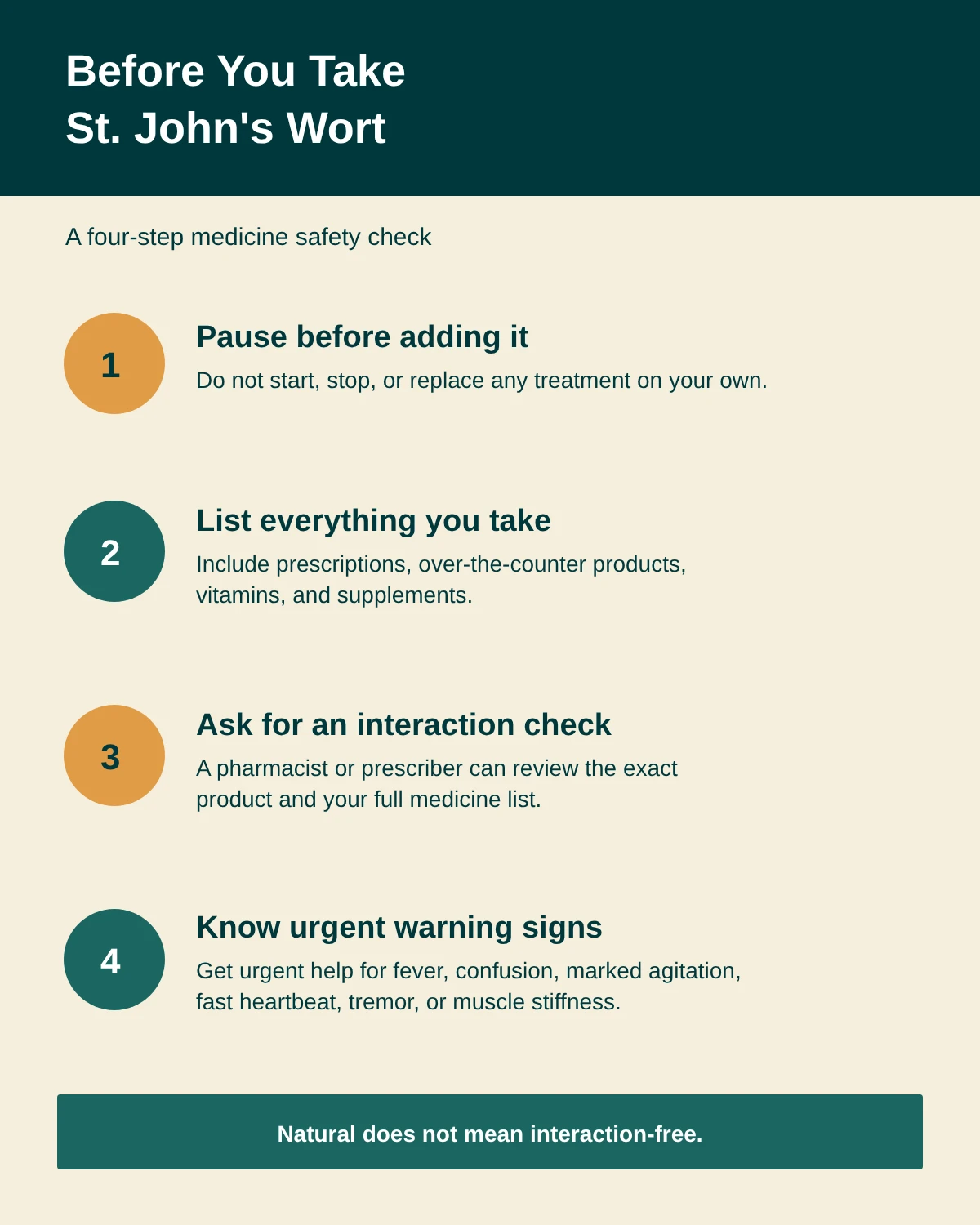
Here is the same checklist in plain text:
- Pause before adding it. Do not start, stop, or replace any treatment on your own.
- List everything you take, including prescriptions, over-the-counter products, vitamins, and supplements.
- Ask a pharmacist or prescriber to check the exact product against your full medicine list.
- Know the urgent warning signs: fever, confusion, marked agitation, fast heartbeat, tremor, or muscle stiffness.
Other Risks and Side Effects
NCCIH lists side effects such as diarrhea, dizziness, trouble sleeping, restlessness, and skin tingling. Severe skin reactions after sun exposure have also been reported, whether the herb is taken by mouth or used on the skin. In addition, NCCIH says St. John’s wort may be unsafe during pregnancy because it may raise the risk of birth defects. Breastfed infants of mothers taking it may have colic, drowsiness, or lethargy.
Also tell your clinicians about any supplements before surgery, before a new prescription, and whenever a medicine changes. Starting or stopping the herb can change how other medicines work, so plan the timing with a qualified professional.
- Could St. John’s wort interact with any prescription or over-the-counter medicine I take?
- Does it affect my birth control, blood thinner, seizure medicine, heart medicine, transplant medicine, HIV medicine, or cancer treatment?
- Is it possible my symptoms point to bipolar disorder, another mental-health concern, a medical condition, or a medication side effect?
- What signs mean I should stop and get urgent care?
- How will we track mood, sleep, side effects, and daily function?
- Who should I contact before adding, stopping, or changing any product?
Before the visit, bring the bottle or a clear photo of the label. Also include the brand, exact ingredients, strength, and how often you take it. Then a pharmacist can compare it with your current medicine list.
What to Do If You Already Take It
Don’t panic, and don’t make a sudden change on your own. Instead, contact a pharmacist or prescriber and share your complete medicine and supplement list. Then ask what steps make sense for you.
If you take an antidepressant, don’t replace it with St. John’s wort or combine the two unless the clinician managing your care has reviewed the plan. Similarly, the same rule applies to any prescribed medicine on the interaction list above.
When to Get Urgent Help
How Whole-Person Care Can Fit
Low mood rarely has one simple cause. Sleep, stress, nutrition, physical health, medicines, relationships, and spiritual concerns can all be part of the picture. Looking at these areas adds context. However, it doesn’t replace depression assessment, counseling, medication management, or medical care. NuWell’s guide to mental-health-informed natural health explains how these pieces fit together.
NuWell practitioners can review your health history, daily patterns, current care, and questions within their professional roles. Even so, decisions about St. John’s wort interactions and any medicine stay between you, your pharmacist, and your prescriber. Learn more about NuWell’s whole-person support for mental well-being.
Frequently Asked Questions
Can I take St. John’s wort with an antidepressant?
Not unless the clinician managing your medicines has reviewed the plan. Some combinations can cause serious serotonin-related side effects, and St. John’s wort can also weaken some antidepressants.
What are the most important St. John’s wort interactions?
NCCIH names some antidepressants, birth control pills, warfarin, cyclosporine, some seizure, heart, HIV, and cancer medicines, and certain statins. The list is not complete, so have a pharmacist check everything you take.
Is St. John’s wort safer because it is natural?
No. Natural products can cause side effects and harmful interactions. Safety depends on the product, your health, and everything else you take.
Can St. John’s wort replace counseling or depression medicine?
Don’t use it to replace or delay care. Depression ranges from mild to severe, and treatment should fit your symptoms, safety, preferences, and medical situation.
Who should check my supplement and medicine list?
A pharmacist or prescribing clinician is a good first contact. Share all prescriptions, over-the-counter products, vitamins, and supplements, including how often you use them.
Sources
- St. John’s Wort: Usefulness and Safety. National Center for Complementary and Integrative Health. nccih.nih.gov. Updated May 2025.
- Mixing Medications and Dietary Supplements Can Endanger Your Health. U.S. Food and Drug Administration. fda.gov.
- Depression. National Institute of Mental Health. nimh.nih.gov. Revised 2024.
- A systematic review of St. John’s wort for major depressive disorder. Apaydin EA, Maher AR, Shanman R, et al. Systematic Reviews. 2016;5(1):148. PubMed.
- Serotonin syndrome: Symptoms and causes. Mayo Clinic Staff. mayoclinic.org.
- Get Help. 988 Suicide & Crisis Lifeline. 988lifeline.org.