

A Christian approach to depression does not ask you to choose between faith and care. If you are a Christian living with depression, you may feel pressure to pray harder, hide what you feel, or treat counseling as a lack of trust in God. You do not have to deny what you are feeling or carry it by yourself.
Depression Is Not a Spiritual Failure
Depression can affect how you feel, think, sleep, eat, work, and connect with other people. According to the National Institute of Mental Health, symptoms can include persistent sadness, irritability, loss of interest, guilt or worthlessness, low energy, trouble concentrating, changes in sleep or appetite, and thoughts of death or suicide. Not everyone has the same symptoms. Persistent or severe symptoms should be assessed by a licensed professional rather than by friends, church leaders, or an online article.
Christians sometimes add spiritual shame to an already heavy burden. You may wonder why prayer feels hard, why worship does not lift your mood, or whether your struggle means your faith is weak. Those questions can be painful. Still, they are not a diagnosis, and they do not prove that God has rejected you.
The Bible is honest about anguish. Elijah was so overwhelmed that he prayed, “I have had enough, LORD… Take my life” (1 Kings 19:4, NIV). In Psalm 42, the writer asks, “Why, my soul, are you downcast?” and then holds on to hope in the same prayer. In Gethsemane, Jesus said, “My soul is overwhelmed with sorrow to the point of death” (Matthew 26:38, NIV). These passages should not be used to diagnose anyone in Scripture. However, they show that God does not require a cheerful performance from people who are suffering. “The LORD is close to the brokenhearted and saves those who are crushed in spirit” (Psalm 34:18, NIV).
A Christian Approach to Depression Includes Professional Care
Sadness and depression are not always the same. The National Institute of Mental Health suggests talking with a health care provider when symptoms last two weeks or more, when they get worse, or when self-care steps are not helping (NIMH: My Mental Health: Do I Need Help?).
- Low mood, hopelessness, or loss of interest that lasts or keeps coming back
- Guilt, worthlessness, irritability, or withdrawal that affects daily life
- Major changes in sleep, appetite, energy, concentration, or functioning
- Using more alcohol or drugs to cope
- Trouble keeping up with work, school, caregiving, or basic self-care
- Any thoughts of death, suicide, or self-harm (call or text 988)
You do not need to decide whether the problem is “spiritual” or “clinical” before asking for help. Depression can have several contributing factors. A qualified professional can consider your symptoms, health history, medications, life circumstances, and safety. In addition, NIMH notes that some medical conditions and medicines can cause the same symptoms as depression, which is one more reason not to self-diagnose.
Faith Can Support Depression Care Without Replacing It
Faith may be a source of meaning, comfort, truth, and community. It can also be a place where hard questions surface. You may feel close to God, distant from God, angry, numb, or unsure what you believe right now. Honest spiritual struggle does not cancel your need for care.
Small faith practices that can help
- Ask one trusted person to pray with you or simply sit with you.
- Listen to a short Scripture passage when reading feels like too much.
- Pray a Psalm of lament, such as Psalm 13 or Psalm 42, to put pain into words.
- Tell a pastor or a mature friend what kind of help you need.
- Let counseling, medication, and medical care be part of the support God provides.
These are pastoral suggestions that fit a Christian approach to depression, not treatments for it. Prayer and Scripture can stay meaningful while a licensed professional provides diagnosis and treatment. A pastor offers spiritual care, while a counselor, psychologist, psychiatrist, or physician has a different role. Good support respects both.
Counseling and Medication Are Not Signs of Weak Faith
Depression treatment typically involves psychotherapy, medication, or both, according to the National Institute of Mental Health. The right plan depends on the person, how severe the symptoms are, medical needs, preferences, and professional guidance. Treatment can take time and may need adjusting.
If you take medication, make decisions about starting, stopping, or changing it with your prescriber. Don’t stop an antidepressant on your own because of something you read online or heard at church. Tell your prescriber about side effects, concerns, supplements, and other medicines you take.
Also, “natural” does not automatically mean safer. For example, the National Center for Complementary and Integrative Health warns that St. John’s wort can interact with certain antidepressants and many other medicines, and that it should not replace conventional care or delay a visit to your health care provider. Ask a clinician or pharmacist before adding any supplement.
Whole-Person Questions Can Add Context
Physical health, mental well-being, relationships, stress, sleep, daily habits, and spiritual concerns can affect one another. Looking at the full picture can help you bring better questions to your care team. It does not prove that one body system or habit caused depression.
Before an appointment, you might jot down:
- When your mood, sleep, appetite, energy, or concentration changed
- Medicines and supplements you take
- Recent illness, pain, hormonal changes, loss, conflict, or major stress
- Alcohol or substance use
- What makes daily life easier or harder
- Which professionals and trusted people are already supporting you
Skip the notes if tracking would increase anxiety or worsen an eating disorder; your provider can ask these questions with you instead. NuWell’s guide to mental-health-informed natural health explains how whole-person questions can sit alongside counseling, psychiatric care, medication management, and medical care.
Four Parts of a Christian Approach to Depression Support
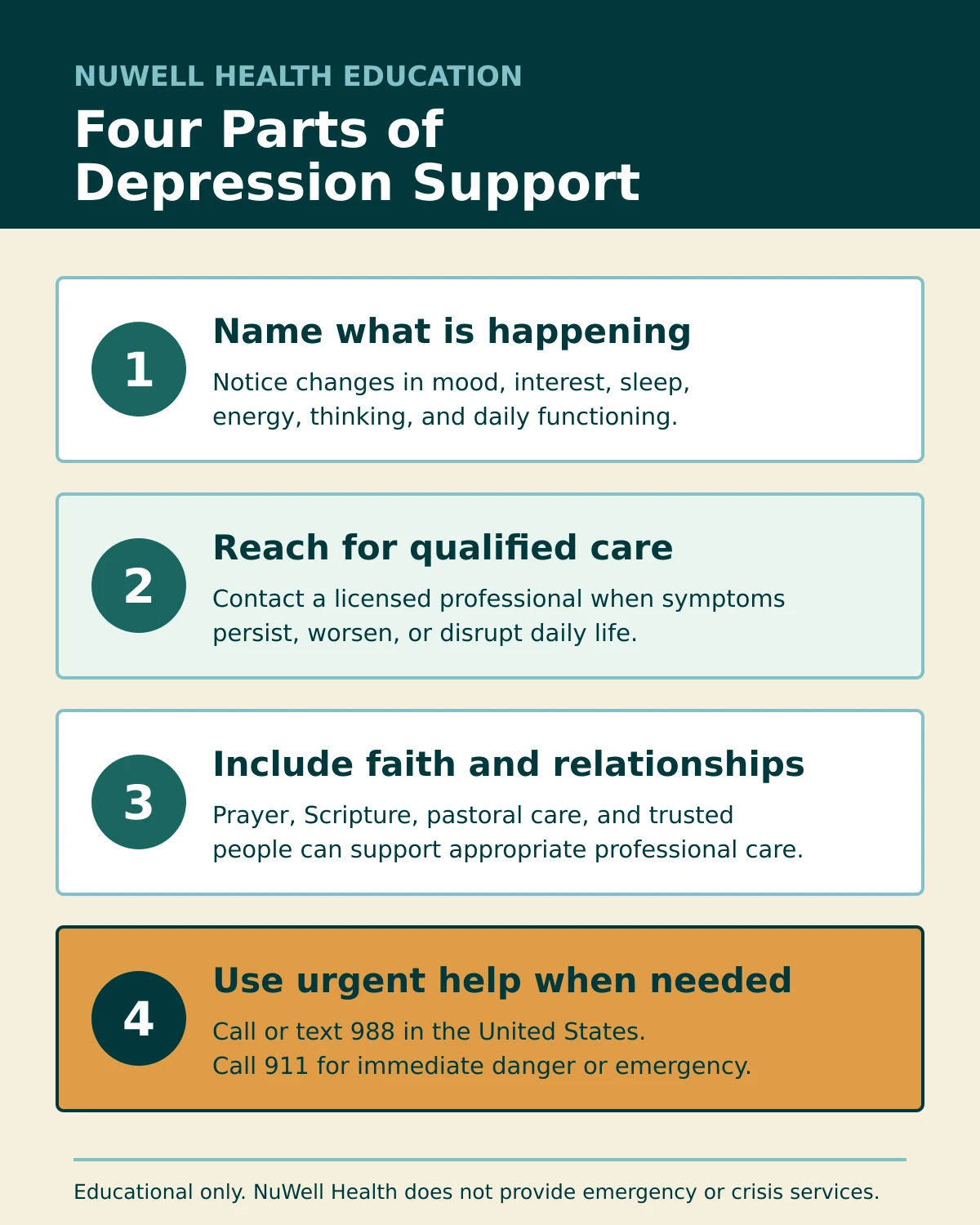
Here is a simple way to hold the pieces together. The same four parts appear in the infographic below.
- Name what is happening. Notice changes in mood, interest, sleep, energy, thinking, and daily functioning.
- Reach for qualified care. Contact a licensed mental-health or medical professional when symptoms persist, worsen, or disrupt daily life.
- Include faith and relationships. Prayer, Scripture, pastoral care, and trusted people can support professional care, if they help you.
- Use urgent help when needed. Call or text 988 for crisis support in the United States. Call 911 for immediate danger or a medical emergency.
Small Steps When Energy Is Low
A Christian approach to depression also makes room for very small steps. Depression can make simple tasks feel huge, so choose one small action that fits the energy you have today. You might text one person, write down your symptoms, schedule a primary-care or counseling appointment, eat a regular meal, or step outside for a few minutes. These actions do not replace treatment. Even so, they can help you reach support and care for basic needs while you seek it.
Try not to turn spiritual practices into a test you can fail. A short prayer is still a prayer, and listening to Scripture still counts as time in Scripture. Accepting a meal, a ride, or help making an appointment is not weakness. It is a concrete form of care.
How Friends and Churches Can Help a Christian With Depression
When someone tells you they are depressed, start by listening. Don’t promise secrecy if they may be in danger. Also, don’t explain their pain as weak faith, hidden sin, poor discipline, or a lack of gratitude.
Helpful support can include:
- Believing the person and taking any talk of suicide seriously
- Helping them contact a licensed professional
- Offering a ride, a meal, child care, or help with one task
- Checking in again instead of expecting one conversation to fix things
- Supporting their treatment plan instead of giving medication or supplement advice
- Contacting 988 or emergency services when safety is at risk
Ask, “What would help today?” A specific offer is often easier to accept than a general promise to help sometime.
Where NuWell Health Fits
NuWell Health offers non-clinical, whole-person natural health support that is mental-health informed and can fit within your own Christian approach to depression. Faith is included only if you want it, and no particular belief is required. Our practitioners can help you look at physical health, nutrition, sleep, stress, lifestyle, and spiritual well-being while respecting the counseling, psychiatric care, medication management, and medical care you already receive.
NuWell does not diagnose or treat depression and does not provide emergency care. Instead, our role is complementary to the care your licensed professionals provide. Virtual care is available nationwide, subject to practitioner availability, professional scope, and your individual needs. Learn more about natural health support for mental well-being, read why NuWell exists, or meet NuWell’s practitioners.
Frequently Asked Questions
Is depression a sin or a sign of weak faith?
No. Depression is not a reliable measure of faith or spiritual standing. It is a serious health concern that can affect mood, thinking, physical functioning, and daily life. A licensed professional can assess persistent or severe symptoms. Pastoral care may support you, but it should not replace appropriate mental-health or medical care.
Can Christians take antidepressants?
Yes. Taking prescribed medication is not proof of weak faith. Medication decisions should be made with a qualified prescriber who knows your health history. Do not start, stop, or change medication based on an article, church advice, or supplement marketing.
Can prayer help with depression?
Prayer may bring comfort, connection, honesty, and hope. It is a faith practice, not a substitute for depression assessment or treatment. Many people pray while also working with a counselor, physician, psychiatrist, or other qualified professional.
What does a Christian approach to depression look like day to day?
It usually means combining small faith practices, trusted relationships, and professional care rather than choosing one. That might look like a short prayer, a check-in with a friend, keeping a counseling appointment, and taking medication as prescribed.
When should someone get urgent help?
Get help right away for thoughts of suicide, urges to self-harm, a suicide plan, immediate danger, or a medical emergency. In the United States, call or text 988 or chat at 988lifeline.org. Call 911 for immediate danger or a life-threatening emergency.
Sources
- Depression. National Institute of Mental Health, revised 2024.
- My Mental Health: Do I Need Help? National Institute of Mental Health, revised 2025.
- If you need to talk, the 988 Lifeline is here. 988 Suicide & Crisis Lifeline.
- 5 Things To Know About St. John’s Wort and Depression. National Center for Complementary and Integrative Health.