
If you keep asking why do I wake up anxious, the timing alone can’t point to one cause. Morning anxiety may be shaped by the day you are anticipating, broken or poorly timed sleep, an anxiety or mood condition, caffeine, alcohol, medicines, physical health, or several of these at once. A brief one- to two-week pattern note can make a conversation with a clinician clearer. Recurring, worsening, or disruptive morning anxiety deserves professional support, and severe physical symptoms or thoughts of self-harm need urgent help.
If you have been wondering why do I wake up anxious, you are not alone, and the experience is real. Waking with a racing mind, a tight chest, a churning stomach, dread, or a fast heartbeat can make it feel as if the day has gone wrong before it has started. It is also a pattern worth describing carefully rather than proof of a “cortisol problem” or a particular diagnosis.
This guide explains what may shape morning anxiety, what to notice for a week or two, what may help in the first minutes after waking, and when to involve medical or mental-health professionals. NuWell’s whole-person approach may complement that care by helping you look at sleep, stress, nourishment, daily rhythms, and spiritual well-being together, if you want them included.
Morning Anxiety Is a Pattern, Not a Diagnosis
“Morning anxiety” is an everyday description, not a formal diagnosis. It can refer to anxious thoughts, physical arousal, or both during the first minutes or hours after waking. Some people notice the feeling settles once they get moving. Others stay anxious through the day.
The National Institute of Mental Health lists restlessness, irritability, trouble concentrating, sleep problems, fatigue, and aches or tension among common anxiety symptoms, and MedlinePlus adds sweating, a pounding or rapid heartbeat, dizziness, and shortness of breath. Those sensations can occur with anxiety disorders, but they can also overlap with other health concerns, which is why a clinician looks at your full history before drawing conclusions.
The useful question is not only “What caused this feeling today?” It is also “What pattern keeps repeating, and what context travels with it?”
Why Do I Wake Up Anxious?
Your body naturally shifts toward wakefulness
Cortisol follows a daily rhythm, and in healthy people it rises quickly in the first 30 to 45 minutes after waking. Researchers call this the cortisol awakening response. A 2025 review in Endocrine Reviews describes it as a burst that has been proposed to help prepare the body for the demands of the coming day, not as a sign that something is wrong.
It is tempting to say a morning cortisol rise causes morning anxiety, but the evidence is not that simple. A 2024 meta-analysis in Psychoneuroendocrinology found no significant overall association between the cortisol awakening response and cortisol reactivity to a laboratory stress test. Your morning experience may involve body-clock signals, but a symptom pattern cannot diagnose cortisol excess, adrenal disease, or another hormone problem.
Be cautious with online quizzes and direct-to-consumer tests that promise to explain anxiety through one hormone result. Testing is not automatic; a qualified healthcare professional can decide whether any evaluation is appropriate based on your full history.
Your mind may be anticipating the day
For many people who wake up anxious, the brain starts rehearsing responsibilities quickly: a hard conversation, unfinished work, caregiving, finances, health concerns, or the pressure to catch up. Sometimes the worry is obvious. Sometimes the body feels on alert before you can name a thought.
That does not mean you are weak or choosing the reaction. If worry is hard to control, shows up on most days, or interferes with work, relationships, or daily tasks, a mental-health professional or primary-care clinician can help assess what is happening. NIMH notes that generalized anxiety disorder treatment typically involves psychotherapy, medication, or both.
Time in bed is not the same as restorative sleep
You can spend enough hours in bed and still wake after fragmented or poorly timed sleep. Pain, caregiving, nightmares, an irregular schedule, breathing problems, environmental noise, or repeated waking may leave your nervous system and attention more vulnerable the next morning, which can make it more likely that you wake up anxious.
The National Heart, Lung, and Blood Institute recommends going to bed and waking at the same time each day, using the hour before bed for quiet time, and avoiding caffeine and alcoholic drinks before bed. These are supportive habits, not a substitute for evaluation when anxiety or sleep problems persist. If your main concern is exhaustion despite enough time in bed, read NuWell’s guide to why you may feel tired after sleeping enough.
Caffeine, alcohol, medicines, and other substances may matter
MedlinePlus notes that caffeine, other substances, and certain medicines can make anxiety symptoms worse, and NHLBI describes caffeine as a stimulant that can interfere with sleep. Alcohol close to bedtime is another common sleep disruptor to notice.
If you often wake up anxious, notice timing and amount without making abrupt changes. Do not start, stop, or change a medicine or supplement based on an article. A pharmacist or prescriber can review side effects, interactions, withdrawal risks, and whether the timing of a medicine may be relevant. If cutting back on caffeine or alcohol feels difficult, or use has become a way to manage anxiety, bring that into the conversation without shame.
Physical and mental health can overlap
Anxiety symptoms can accompany an anxiety disorder, depression, trauma-related distress, or a stressful season. MedlinePlus also lists some physical health conditions, such as thyroid problems or an irregular heart rhythm, as risk factors for anxiety, and notes that a clinician may use a physical exam and lab tests to make sure a different health problem is not causing your symptoms.
The answer is not to assume that every time you wake up anxious there is a hidden physical cause. It is to avoid dividing the person into separate parts. Sleep, pain, digestion, nourishment, stress, mood, medicines, life-stage changes, relationships, and current medical care can all provide useful context. NuWell’s practical guide to mental-health-informed natural health explains this broader perspective.
- Morning anxiety on most days for several weeks, or getting worse
- Panic attacks, or worry that is hard to control
- A pattern that began after a new medicine or a dose change
- Persistent low mood, nightmares, or trauma reminders
- Loud snoring, gasping, or pauses in breathing during sleep
- Heavy reliance on caffeine, alcohol, or other substances to get through the day
- New physical symptoms, such as palpitations, weight change, or tremor
A Four-Part Morning Anxiety Pattern Check
For one or two weeks, a brief note can help you prepare for a more useful conversation with a clinician or practitioner. The goal is observation, not constant monitoring.
In plain terms, for one to two weeks you can note:
- What happened. The time you woke and whether the experience was mainly racing thoughts, dread, tension, stomach discomfort, sweating, dizziness, shortness of breath, or a fast heartbeat.
- The night and morning context. Bedtime, awakenings, nightmares, snoring or gasping if known, caffeine and alcohol timing, and medicines or supplements taken as directed (without changing them).
- The course. How long the feeling lasted, what the day held, and whether gentle movement, food, water, quiet, or contact with another person changed the intensity.
- The right level of help. Bring a repeating or disruptive pattern to a clinician. Seek urgent help for severe or dangerous symptoms rather than trying to track through them.
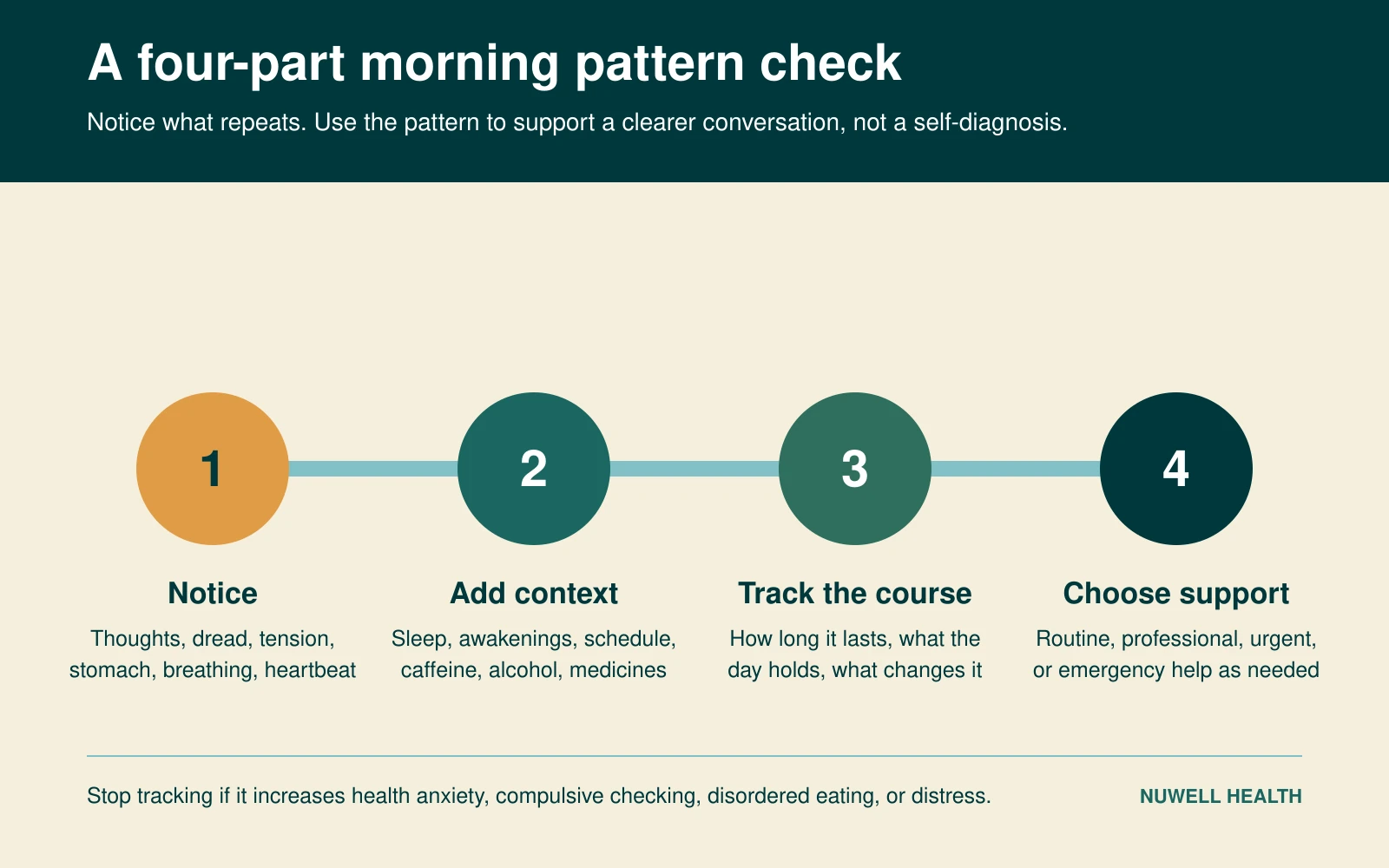
A log should make the pattern easier to explain, not make you more afraid of your body. If tracking increases health anxiety, compulsive checking, disordered eating, or distress, skip it and talk with an appropriate professional instead.
What You Can Do When You Wake Up Anxious
Start your anxious morning with one small action
Before solving the whole day, orient to the next few minutes. Sit up if comfortable, place your feet on the floor, and name what you notice without diagnosing it: “My heart is beating fast, and I’m having anxious thoughts.” Then choose one manageable action, such as opening the curtains, drinking water, washing your face, or getting dressed.
This is not a cure. It is a way to reduce the number of decisions you are asking your mind to make while it feels overloaded.
Try gentle, unforced breathing or grounding
NIMH’s My Mental Health: Do I Need Help? lists meditation and breathing exercises among activities that may help when symptoms are mild and short-term. Keep the breath comfortable rather than forcing long holds or very deep inhales. You might also name five things you can see, four you can feel, and three you can hear.
If focusing on your breath makes you more anxious, choose an external grounding activity instead. Responses vary, and a counselor can help you choose strategies that fit you.
Protect the transition into the day
When possible, avoid turning the first minute awake into an immediate review of messages, news, and every unfinished task. Write down the first necessary step and what can wait. If caregiving, work, or disability limits your control over the morning, the goal is not a perfect routine. Look for one realistic adjustment that reduces avoidable pressure.
Review sleep and stimulants without self-prescribing
Notice whether anxiety is stronger after short or interrupted sleep, schedule changes, afternoon or evening caffeine, alcohol, or a new medicine. NIMH notes that getting enough sleep and reducing caffeine can reduce anxiety symptoms when paired with standard care, though they cannot replace treatment. Make medication changes only with the prescribing clinician, and get guidance before cutting back on alcohol or other substances if stopping could cause withdrawal.
Let faith be support, not a test
If faith is meaningful to you, a short prayer, quiet reflection, or a familiar Scripture passage such as Psalm 46:1 (“God is our refuge and strength, a very present help in trouble”) may help you begin the day with steadiness and connection. This is a faith-informed reflection, not a medical or psychological treatment. Morning anxiety is not evidence of weak faith, and spiritual practice should not replace counseling, medication, medical care, or crisis support.
When to Seek Help for Morning Anxiety
Talk with a primary-care or mental-health professional when you wake up anxious most mornings, or when morning anxiety is recurring, worsening, difficult to control, or interfering with sleep, work, relationships, eating, driving, or your ability to start the day. Professional assessment is also appropriate when the pattern began after a medicine change; occurs with panic attacks, persistent low mood, nightmares, or substance use; or comes with new physical symptoms.
Treatment for an anxiety disorder may include psychotherapy, medication, or both. Lifestyle practices can support care, but they do not replace it. Do not stop counseling or change prescribed medication because a natural or whole-person option sounds promising.
How Whole-Person Support May Fit
When you wake up anxious, it can help to have care that keeps both physical and emotional health in view. Your primary-care clinician can evaluate medical concerns. A counselor, psychologist, psychiatrist, or other qualified mental-health professional can assess anxiety, mood, trauma, and patterns of thought and behavior. Sleep care or other specialty care may also be important.
NuWell’s mental-health-informed natural health support may complement that care by helping you organize sleep, stress, nourishment, digestion, energy, and daily routines. Root-cause care means exploring possible contributing factors; it does not promise that one hidden cause will be found. You can also learn why NuWell takes a connected approach.
Frequently Asked Questions
Why do I wake up anxious for no obvious reason?
You may notice physical arousal before a clear thought appears, or the trigger may not be obvious. Sleep disruption, anticipated stress, an anxiety or mood condition, caffeine or alcohol, medicines, and physical health can all be relevant. Timing alone cannot identify the cause. A repeating or disruptive pattern deserves a professional conversation.
Is morning cortisol causing my anxiety?
Cortisol commonly rises in the first 30 to 45 minutes after waking as part of a normal daily rhythm, but that does not prove it is causing your anxiety or that you have a hormone disorder. Research on the cortisol awakening response and stress is mixed, and symptoms alone cannot diagnose a cortisol problem.
Can morning anxiety happen even when I sleep enough?
Yes. Time in bed does not guarantee uninterrupted or restorative sleep, and anxiety may also relate to anticipated stress, mental health, medicines, substances, or physical health. If you wake unrefreshed, snore or gasp, or struggle with daytime sleepiness, discuss the pattern with a healthcare professional.
When should I get help for morning anxiety?
Seek professional help when the pattern is recurring, worsening, hard to control, or affecting daily life. Seek emergency care for severe or potentially life-threatening physical symptoms. In the United States, call or text 988 for suicidal thoughts or urges to hurt yourself, and call 911 for immediate danger.
Can NuWell Health help with morning anxiety?
NuWell offers non-clinical, whole-person natural health support that can complement your medical and mental-health care by looking at sleep, stress, nourishment, and daily routines together. NuWell does not diagnose or treat anxiety disorders and does not replace counseling, psychiatric care, or emergency services.
Sources
- National Institute of Mental Health. Generalized Anxiety Disorder: What You Need to Know. Accessed October 19, 2026.
- MedlinePlus. Anxiety. U.S. National Library of Medicine. Accessed October 19, 2026.
- Stalder T, Oster H, Abelson JL, et al. The Cortisol Awakening Response: Regulation and Functional Significance. Endocrine Reviews. 2025;46(1):43–59.
- Wesarg-Menzel C, Marheinecke R, Staaks J, Engert V. Associations of diurnal cortisol parameters with cortisol stress reactivity and recovery: A systematic review and meta-analysis. Psychoneuroendocrinology. 2024;163:106976.
- National Heart, Lung, and Blood Institute. Sleep Deprivation and Deficiency: Healthy Sleep Habits. Accessed October 19, 2026.
- National Institute of Mental Health. My Mental Health: Do I Need Help? Revised 2025. Accessed October 19, 2026.