
Why Lifestyle Medicine Is the Future of Whole-Person Health
Lifestyle medicine is an evidence-based medical specialty that uses therapeutic lifestyle changes — in nutrition, physical activity, sleep, stress management, social connection, and substance avoidance — to treat, prevent, and even reverse chronic diseases like type 2 diabetes, heart disease, and obesity.
Here’s a quick summary of what it covers:
| Pillar | What It Means |
|---|---|
| Optimal Nutrition | Whole foods, mostly plants, minimally processed |
| Physical Activity | At least 150 minutes of moderate movement per week |
| Restorative Sleep | 7–9 hours of quality sleep nightly |
| Stress Management | Building healthy coping skills and resilience |
| Social Connection | Meaningful relationships and a sense of purpose |
| Risky Substance Avoidance | Reducing or eliminating alcohol, tobacco, and other harmful substances |
The numbers behind chronic disease are hard to ignore. Six in ten Americans live with at least one chronic condition. Nearly $4.5 trillion is spent on healthcare every year in the U.S. — and more than 80% of that spending is tied to conditions rooted in poor lifestyle choices.
Yet the medical system largely focuses on managing those conditions, not eliminating their causes.
That’s the gap lifestyle medicine fills. Instead of asking “What drug treats this symptom?”, it asks “What’s causing this in the first place?”
As one physician put it: “Everyone’s chasing the latest wellness edge. But none of it matters if you don’t have the basics down first — eating mostly whole foods, moving your body regularly, prioritizing sleep, connecting with people you care about, managing stress in sustainable ways. These are the fundamentals. The behaviors that actually create health.” — Rak Jotwani, MD, DipABLM
This guide walks you through everything you need to know — from what lifestyle medicine is, to how to start applying it in your own life.
I’m Stephen A. Luther, MS, MEd, LPC, a Licensed Professional Counselor with over 25 years of experience helping individuals find root-cause, whole-person healing through integrated mind-body-spirit approaches — the same principles that sit at the heart of lifestyle medicine. Throughout this guide, I’ll connect the clinical evidence to practical, faith-honoring steps you can actually use.
What is Lifestyle Medicine and how does it define health?

At its core, lifestyle medicine is a formal medical specialty that utilizes evidence-based, therapeutic interventions as a primary modality to treat chronic conditions. While traditional medicine often waits for a disease to manifest and then manages it with pharmaceuticals, lifestyle medicine focuses on the “why” behind the illness. It defines health not merely as the absence of disease, but as a state of whole-person flourishing across the mind, body, and spirit.
This approach is highly scientific. It isn’t “alternative” medicine in the sense of being unproven; rather, it is the clinical application of lifestyle behaviors that have been shown to impact up to 80% of chronic diseases. By focusing on Lifestyle & Preventive Health, we can shift the healthcare paradigm from “sick care”—which is reactive and costly—to “health restoration.”
According to the Overview of Lifestyle Medicine, contemporary medicine often acts as “end-stage care,” dealing with complications after they arise. In contrast, we view the body as a divinely designed system capable of remarkable healing when given the right environment. This aligns closely with the principles of Naturopathic Medicine, where the goal is to support the body’s innate wisdom and address the root causes of dysfunction.
The Evidence Supporting Lifestyle Medicine
You might wonder if changing your diet or sleeping more can actually rival the power of modern drugs. The research says yes. In many cases, lifestyle interventions have been shown to outperform standard pharmaceutical treatments. For example, studies have demonstrated that intensive lifestyle changes can actually reverse coronary artery disease—widening the arteries without surgery.
Other landmark research, such as the EPIC-Potsdam study, found that individuals who adhered to four simple factors—maintaining a BMI under 30, exercising 3.5 hours a week, eating a plant-based diet, and never smoking—saw a staggering 78% reduction in their risk for chronic disease.
As detailed on Wikipedia’s entry for Lifestyle Medicine, this field is now recognized globally by major medical bodies. It provides a sustainable solution for a healthcare system in crisis, where 62% of physicians report burnout because they feel they are merely putting “band-aids” on symptoms. By choosing Roots Over Remedies, both patients and providers find a more fulfilling and effective path to lasting wellness.
The Six Foundational Pillars of Health
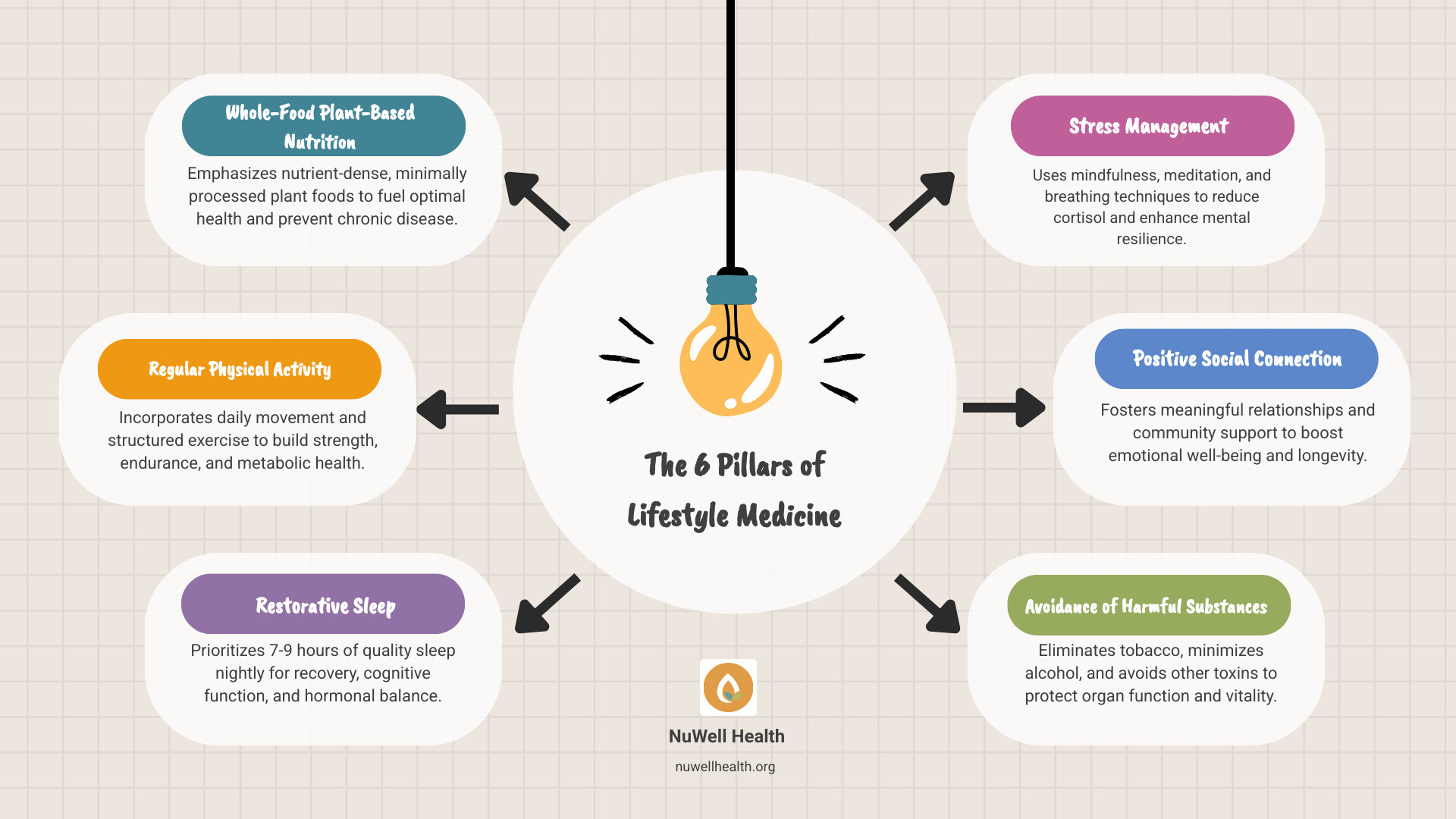
To practice lifestyle medicine, we focus on six interconnected pillars. Think of these as the legs of a stool; if one is missing, the whole structure becomes unstable.
- Optimal Nutrition: We advocate for a whole-food, plant-predominant eating pattern. This means filling your plate with minimally processed vegetables, fruits, whole grains, legumes, nuts, and seeds.
- Physical Activity: Movement is life. We aim for at least 150 minutes of moderate aerobic activity per week, plus strength training.
- Restorative Sleep: Most adults need 7 to 9 hours of quality sleep. Sleep is when the body resets, repairs tissue, and clears toxins from the brain.
- Stress Management: Chronic stress fuels inflammation. We help patients develop healthy coping mechanisms to improve resilience.
- Social Connection: We are created for community. Meaningful relationships and a sense of purpose are scientifically linked to lower mortality rates.
- Avoidance of Risky Substances: Eliminating tobacco and moderating or eliminating alcohol is essential to prevent long-term cellular damage.
These pillars aren’t just “good advice”—they are clinical prescriptions. The American College of Lifestyle Medicine emphasizes that when these six areas are addressed together, they work in synergy. For instance, better sleep leads to better food choices, and regular exercise helps manage stress.
Addressing the Root Causes of Chronic Disease
Why do these pillars work? Because they target the biological “soil” in which chronic disease grows: systemic inflammation and insulin resistance.
| Feature | Conventional Medicine | Lifestyle Medicine |
|---|---|---|
| Primary Goal | Symptom management | Root-cause resolution |
| Treatment Tool | Pharmaceuticals / Surgery | Lifestyle prescriptions |
| Patient Role | Passive recipient | Active partner |
| Focus | Specific organs/systems | Whole-person health |
| Side Effects | Often high/complex | Minimal / “Positive” side effects |
When we ignore these pillars, we invite Chronic Pain and Inflammation into our lives. High-sugar diets and sedentary lifestyles lead to insulin resistance, which is the precursor to type 2 diabetes and heart disease. Lifestyle medicine clears these metabolic roadblocks, allowing the body to return to its natural state of balance.
Practical Steps for Lasting Change
Knowing what to do is one thing; doing it is another. We understand that behavior change is the hardest part of medicine. That’s why we use “patient-driven goal setting.” Instead of us telling you what to do, we work together to find what is sustainable for your life.
One of the most effective tools we use is SMART goals:
- Specific: Instead of “eat better,” try “add one cup of berries to my breakfast.”
- Measurable: “Five days a week.”
- Achievable: Don’t try to run a marathon tomorrow if you haven’t walked a mile today.
- Relevant: Does this goal matter to your health journey?
- Time-bound: “I will try this for the next two weeks.”
Whether you are looking for Weight Management or simply more energy, starting small is the key. We often use “motivational interviewing,” a conversational style that helps you find your own internal reasons for change, rather than relying on outside pressure.
Integrating Lifestyle Medicine Principles into Daily Life
At NuWell Health, we believe that true health is a mind-body-spirit connection. From a Christian perspective, we recognize that our bodies are “temples” (1 Corinthians 6:19). This means that taking care of our physical health is an act of stewardship and worship.
When we talk about social connection, we aren’t just talking about “networking.” We are talking about purposeful living and community support. Finding your “why”—your God-given purpose—can be as powerful for your heart health as any medication. This holistic view ensures that we aren’t just adding years to your life, but “life to your years.”
One of the greatest benefits of this approach is the fewer side effects. While medications are sometimes necessary and we work alongside your traditional doctors, lifestyle changes usually only have “positive” side effects—like better mood, clearer skin, and improved digestion. You can read more about Why Your Holistic Mind-Body-Spirit Connection Matters to see how these elements weave together.
Frequently Asked Questions about Lifestyle Medicine
Can lifestyle medicine reverse chronic conditions like type 2 diabetes?
Yes, in many cases, it can. The American College of Lifestyle Medicine has launched initiatives like “Project Remission” specifically for type 2 diabetes. By aggressively addressing nutrition (moving toward whole, plant-based foods) and increasing physical activity, many patients can achieve blood sugar levels in the normal range and, under medical supervision, reduce or eliminate their need for medication.
How does lifestyle medicine complement traditional medical care?
It is not an “either/or” situation. Lifestyle medicine is an adjunctive specialty. You can keep your existing primary care doctor and specialists. We provide the intensive education and support for lifestyle changes that traditional 15-minute doctor visits often can’t cover. We document everything in your health record so your entire care team is on the same page.
Why is lifestyle medicine essential for sustainable healthcare in 2026?
The current trajectory of healthcare spending is unsustainable. With 80% of costs tied to preventable lifestyle conditions, we simply cannot “medicate our way” out of this crisis. In April 2026, we are seeing a massive shift toward “value-based care,” where providers are rewarded for actually making patients healthier, not just seeing more patients. Lifestyle medicine is the foundation of this new, sustainable model.
Conclusion
The journey to health doesn’t have to be a lonely or confusing one. By focusing on the root causes and embracing the six pillars of lifestyle medicine, you are taking back control of your future. At NuWell Health, we are dedicated to helping you achieve a longer “health span”—the portion of your life spent in good health, not just the total number of years you live.
We invite you to move from being a passive patient to an empowered self-healer. Whether it’s through better nutrition, restorative sleep, or a stronger connection to your community and faith, every small step counts.
Are you ready to experience holistic restoration? Start your journey toward a vibrant, purposeful life today.
Visit us to learn more: https://nuwellhealth.org/
This article was researched with AI and heavily edited by Stephen Luther for accuracy and relevance.
Stephen Luther is the Executive Director and Founder of Grace Christian Counseling, Grace Recovery Services, WPA Counseling, NuWell Online Counseling and Coaching, and NuWell Health. He holds a Master’s degree in Education from the University of Georgia and a Master’s degree in Marriage and Family Therapy from Duquesne University. He is a licensed professional counselor in Pennsylvania.
Since 1997, Steve has been helping children, adolescents, and adults overcome a wide range of emotional and relational challenges. He specializes in working with hurting families, including those with foster, adopted, or traumatized children. Steve uses Attachment-Based Therapy, Splankna Healing, and Therapeutic Parent Coaching to support healing and restoration.
This guide is for educational and spiritual encouragement and is not a substitute for personalized professional counseling. If you are in crisis, please reach out for immediate help.