

Why Natural Health for Mental Health Is Worth Taking Seriously
Natural health for mental health refers to evidence-based, non-prescription approaches — like nutrition, movement, therapy, and herbal support — that work with your body’s own systems to improve mood, reduce anxiety, and build emotional resilience.
These aren’t fringe ideas. A review of 41 studies with nearly 3,000 patients found CBT significantly outperformed placebo for anxiety. An analysis of over 12,000 patients found mindfulness practices as effective as conventional care for depression. And spending just two hours per week in nature has been shown to significantly increase well-being.
Yet millions of people dealing with stress, anxiety, or depression still don’t know these options exist — or don’t know how to use them safely.
That’s especially frustrating if you’ve tried conventional medication and run into side effects, limited results, or just want a more whole-person approach to your mental health.
This guide breaks down what actually works, what the science says, and how to get started safely.
Defining Natural Health for Mental Health
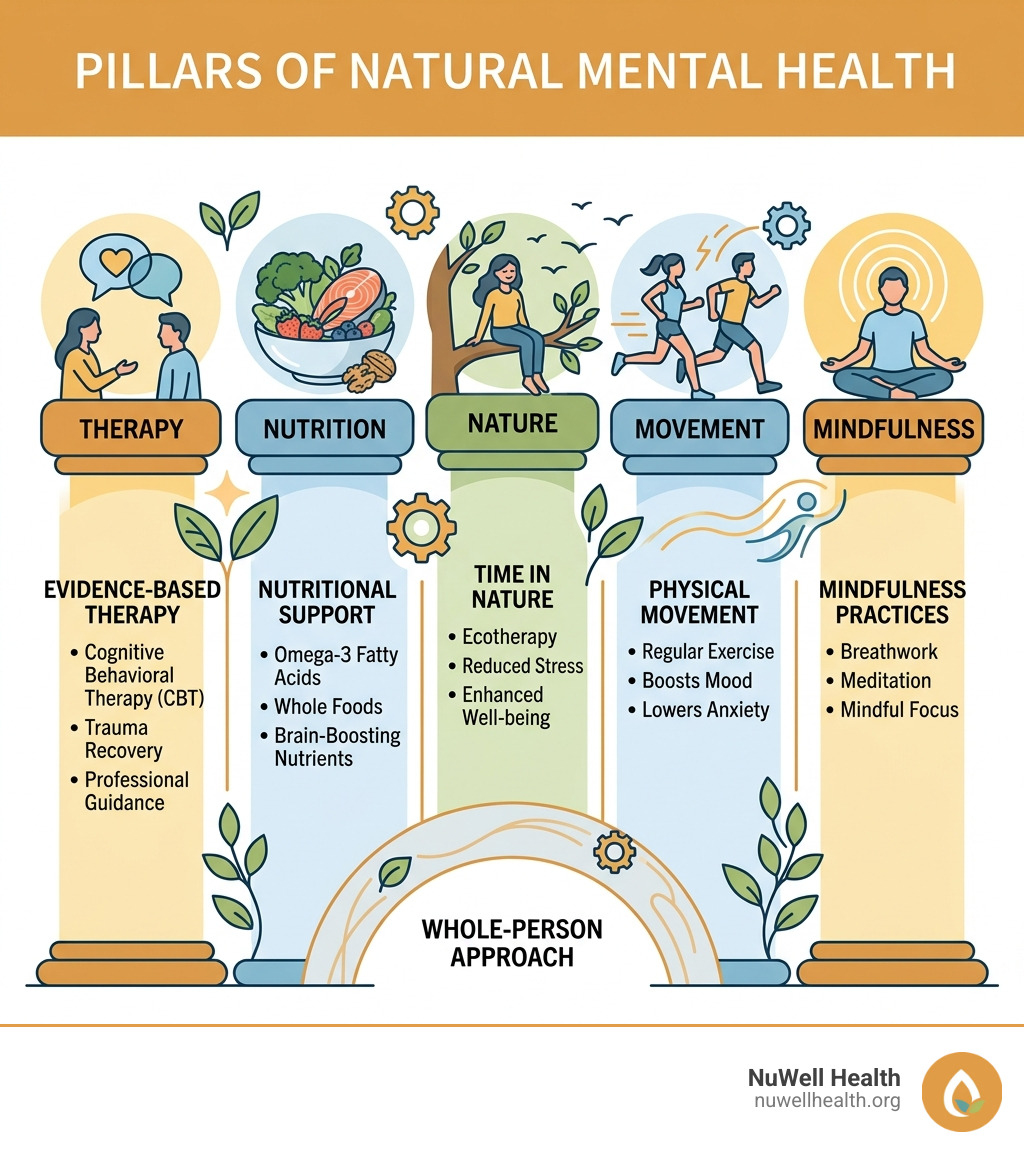
When we talk about Natural Health for Mental Health, we aren’t talking about “miracle cures” found in unverified internet corners. We define “natural” as non-prescription treatments that leverage the body’s innate biology, lifestyle adjustments, and psychological tools to foster wellness.
However, a critical distinction we must make is between “natural” and “evidence-based.” Just because a root grows in the ground doesn’t mean it’s safe or effective for your brain chemistry. Evidence-based natural health relies on clinical validation—studies, peer-reviewed journals, and historical data that prove a treatment actually works.
It is also important to understand the FDA regulation gaps. In the United States, the FDA does not regulate supplements and herbal remedies with the same rigor as pharmaceutical drugs. This means the burden of quality control often falls on the consumer and the practitioner. We look for clinical validation to bridge this gap, ensuring that some “natural” therapies may be safe, effective for mental health when applied correctly.
At NuWell Health, we view this through the lens of naturopathic medicine, which prioritizes the least invasive intervention first and seeks to treat the whole person rather than just masking a symptom. This distinction is vital because it moves us away from a “pill for an ill” mentality and toward a sustainable, preventive lifestyle.
Evidence-Based Psychological and Lifestyle Interventions
One of the most powerful tools in Natural Health for Mental Health isn’t a supplement at all—it’s how we train our brains to process information.
Cognitive Behavioral Therapy (CBT) and the Unified Protocol
CBT is the “gold standard” of natural psychological intervention. With over 2,000 studies supporting its efficacy, CBT helps individuals identify “Automatic Negative Thoughts” (ANTs) and reframe them. Research has shown that app-based CBT can be just as effective as in-person therapy for depression.
Furthermore, the “Unified Protocol” is a transdiagnostic form of CBT that works across multiple conditions, such as anxiety and eating disorders, by focusing on how we regulate emotions. This highlights the profound mind-body connection in mental health, where changing a thought pattern can physically lower stress hormones in the body.
Relaxation Techniques and Music Medicine
We often underestimate the power of physical relaxation. Our mind-body connection allows us to “reset” the nervous system through specific actions:
- Diaphragmatic Breathing: Inhaling deeply through the nose to engage the diaphragm and exhaling slowly through the mouth. This signals the parasympathetic nervous system to “rest and digest.”
- Progressive Muscle Relaxation (PMR): Tensing and then releasing muscle groups one by one to physically discharge stored stress.
- Music Medicine: This isn’t just “listening to tunes.” Analysis of 55 studies showed that active music engagement significantly reduces depression symptoms. Harp music, specifically, has been noted for its healing properties in clinical settings.
The Power of Nature for Mental Health
Nature is a biological necessity, not a luxury. Psychologists use the term “soft fascination” to describe how natural environments engage our attention without draining our mental energy. Unlike a pinging smartphone, a rustling forest allows the brain to enter a state of “attention restoration.”
The “120-minute rule” is a science-backed benchmark: spending just 2 hours per week in nature—whether in one block or several short walks—significantly boosts feelings of well-being. This exposure helps regulate our circadian rhythm through natural light and has been proven to lower cortisol, the body’s primary stress hormone. You can learn more about how nature can improve your mental health and why it serves as a natural boost for your well-being.
Nutritional Psychiatry and Herbal Support
What we put on our plates directly dictates how we feel. Nutritional psychiatry is a growing field that explores how the gut-brain axis influences our mood. Your gut produces a significant portion of your neurotransmitters, including serotonin.
| Supplement | Potential Benefit | Evidence Level |
|---|---|---|
| Omega-3s (EPA/DHA) | Reduces inflammation; supports ADHD & Depression | High (93% of Americans are deficient) |
| St. John’s Wort | Mild-to-moderate depression relief | High (Comparable to some SSRIs) |
| Saffron | Improves mood; reduces anxiety | Emerging (Studies show parity with Prozac) |
| Magnesium | Calms the nervous system; aids sleep | High (The “relaxation mineral”) |
| Vitamin D | Regulates mood; supports immune function | High (Deficiency linked to depression) |
| B-Complex | Neurotransmitter production (B12/Folate) | High (Crucial for brain energy) |
Key Nutrients and Their Impact
- Omega-3 Fatty Acids: DHA makes up about 20% of the fat in your brain. Supplementing with high-quality fish oil (look for ≥60% EPA for depression) is one of the most effective ways to support brain health.
- Probiotics: By healing the gut microbiome, we can reduce systemic inflammation that often manifests as “brain fog” or low mood.
- Magnesium and Zinc: These minerals act as cofactors for hundreds of enzymatic reactions in the brain. Magnesium, in particular, is an impactful integrative treatment for anxiety and ADHD.
Integrating Natural Health for Mental Health Safely
“Natural” does not mean “risk-free.” For instance, St. John’s Wort is highly effective but can cause Serotonin Syndrome if taken with prescription SSRIs. It can also interfere with birth control and blood thinners.
We always recommend looking for the USP-DSVP verification mark on supplements to ensure what’s on the label is actually in the bottle. Because everyone’s biology is unique, personalized care plans are essential. We believe in working with a nutritionally informed professional to navigate these interactions and ensure your mind-body-spirit connection is supported safely.
Addressing Root Causes: Trauma and Emotional Wellness
At NuWell Health, we don’t just want to manage symptoms; we want to get to the bottom of emotional pain and trauma. True Natural Health for Mental Health requires looking at the “hidden roots”—childhood experiences, unresolved grief, or generational patterns.
Advanced Therapeutic Tools
- EMDR Therapy: Eye Movement Desensitization and Reprocessing is a non-drug treatment that helps the brain “reprocess” traumatic memories. Statistics show that 84% to 90% of single-event trauma victims find relief from PTSD symptoms after just a few 90-minute sessions.
- Neurofeedback: This is a non-invasive way to “retrain” brainwave activity, helping with anxiety and ADHD by teaching the brain to stay in a calm, focused state.
- Gratitude Writing: Keeping a daily journal has been scientifically linked to better sleep, healthier emotions, and stronger social bonds.
Christian Spiritual Integration
We believe that spiritual health is inseparable from mental health. When we integrate spirituality, we do so from a Christian perspective, focusing on the power of prayer, meditation on Scripture, and the peace that comes from a relationship with God. This provides a foundation of hope that complements psychological tools. By focusing on mental health and emotional wellness as a whole, we empower individuals to walk in the fullness of who they were created to be.
Frequently Asked Questions about Natural Mental Health
Can natural treatments replace conventional medication for mental health?
In many mild-to-moderate cases, natural treatments like exercise, CBT, and specific supplements can be as effective as medication. However, this should never be a DIY project. For severe or treatment-resistant depression, natural therapies often work best as a complement to conventional care. Any tapering of medication must be done under strict clinical supervision to avoid withdrawal or rebound symptoms.
How long does it take to see results from natural therapies?
It depends on the modality. Exercise can provide an immediate mood boost due to endorphin release. Meditation has shown significant results in just 10 minutes a day over 30 days. Supplements, however, often require a “loading period” of several weeks to reach therapeutic levels in the blood. Consistency is the key—natural health is a marathon, not a sprint.
Are natural supplements safe to take with antidepressants?
Some are, and some are definitely not. L-theanine is generally considered safe and can help with sleep, but St. John’s Wort and SAMe carry high risks of drug interactions. Always consult a healthcare provider. We prioritize third-party testing to ensure our recommendations have the lowest possible side-effect profiles.
Conclusion
The journey to wellness isn’t found in a single “wonder drug,” but in the intentional cultivation of a Natural Health for Mental Health lifestyle. By addressing the root causes of our distress—whether they be nutritional, psychological, or spiritual—we build a foundation of holistic resilience.
At NuWell Health, our mission is to empower you with the tools for self-care, moving beyond symptom management toward a life of vitality. Whether it’s through the restorative power of nature, the precision of nutritional psychiatry, or the deep healing of trauma-informed therapy, we are here to support your mind, body, and spirit.
This article was researched with AI and heavily edited by Stephen Luther for accuracy and relevance.
Stephen Luther is the Executive Director and Founder of NuWell Health, along with its sister programs Grace Christian Counseling, Grace Recovery Services, WPA Counseling, and NuWell Online Counseling and Coaching.
He holds a Master’s degree in Education from the University of Georgia and a Master’s degree in Marriage and Family Therapy from Duquesne University. He is a licensed professional counselor in Pennsylvania.
With over 25 years of experience, Steve specializes in whole-person healing that integrates clinical excellence with faith-honoring care. At NuWell Health, he and his team focus on helping individuals and families overcome emotional, relational, and physical challenges through a holistic mind-body-spirit approach, including attachment-based therapy, trauma-informed care, and practical strategies for lasting restoration.
This guide is for educational and spiritual encouragement and is not a substitute for personalized professional counseling. If you are in crisis, please reach out for immediate help.