

Why Self-Care Empowerment Is the Foundation of Lasting Well-Being
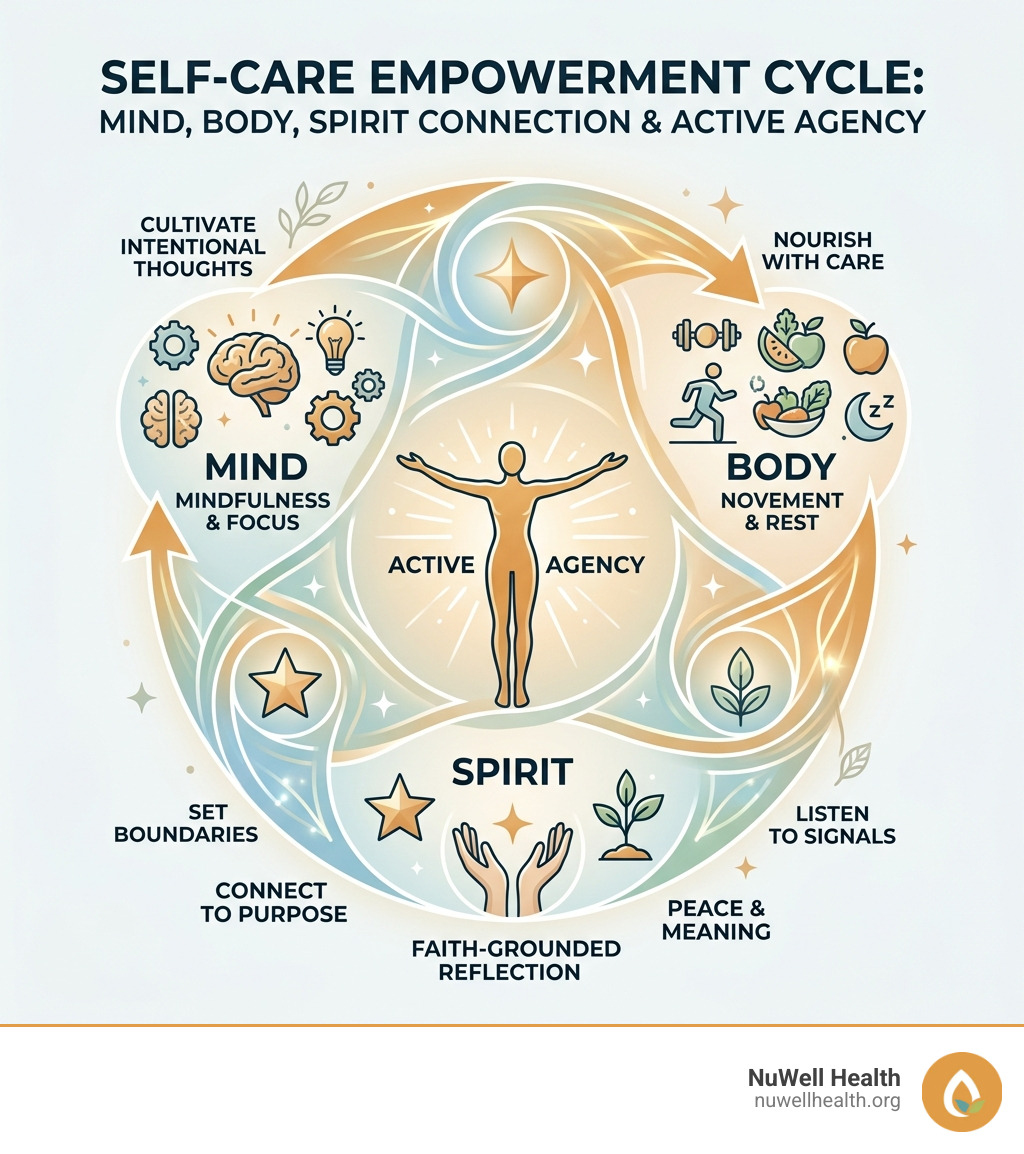
Self-care empowerment is the active, intentional process of taking ownership of your physical, mental, emotional, and spiritual health — so you can thrive, not just survive.
Here is a quick overview of what it means and why it matters:
- What it is: Taking deliberate actions to nurture your whole self — mind, body, and spirit
- Why it matters: Empowers you to manage your health, set boundaries, and build resilience
- Who it’s for: Anyone feeling burned out, overwhelmed, or stuck in a cycle of reactive health decisions
- How it works: Through consistent, personalized practices like mindfulness, journaling, boundary-setting, and faith-grounded reflection
- The result: Greater confidence, better health outcomes, and a stronger sense of personal agency
In our world, it is easy to put everyone else’s needs first. Many people push through exhaustion, skip rest, and manage symptoms without ever asking why they keep returning. This is exactly where most people find themselves — managing symptoms rather than truly healing.
Self-care is more than bubble baths or occasional breaks. It is a process of increasing your strengths and developing genuine influence over your circumstances. Research recognizes individuals who practice self-care as active agents in their own health — not passive recipients waiting for someone else to fix them.
At NuWell Health, we have found that the clients who experience the most lasting transformation are those who move from doing self-care occasionally to genuinely owning it as a daily commitment.
I’m Stephen A. Luther, MS, MEd, LPC — a Licensed Professional Counselor with over 25 years of experience helping individuals and families pursue whole-person healing through mind-body-spirit approaches, and self-care empowerment sits at the heart of that work. In the sections ahead, we’ll walk through exactly how to build that foundation in a way that is practical, faith-honoring, and built to last.
Defining Self-Care Empowerment in 2026
As we navigate the landscape of 2026, the definition of self-care has evolved. According to the World Health Organization (WHO), self-care is the ability of individuals, families, and communities to promote health, prevent disease, maintain health, and cope with illness with or without the support of a healthcare provider. But when we add the layer of empowerment, it becomes something much more dynamic.
Self-care empowerment is about active agency. It is the shift from being a passenger in your own life to being the driver. In our clinical experience at NuWell Health, having guided thousands of individuals through this transition, we see this as a reclamation of personal power. It’s the realization that you have the right and the responsibility to protect your peace and your physical vitality.
This empowerment isn’t just a “feeling”; it is a multifaceted process. As noted in research on discovering self-empowerment, this journey involves four dimensions:
- Cognitive: Developing a growth mindset and challenging negative self-talk.
- Emotional: Learning to regulate your feelings and practicing self-compassion.
- Behavioral: Taking actions that align with your long-term goals.
- Social: Surrounding yourself with a supportive network that honors your boundaries.

At its core, empowering yourself is a radical act. In a world that often measures your worth by your productivity, choosing to rest or say “no” is a declaration of your inherent worth. We believe that you are a creation of immense value, and taking care of that creation is not selfish—it is stewardship.
Why Self-Care Empowerment is a Strategic Necessity
For many, especially women in professional roles, self-care is often viewed as a luxury to be squeezed in after everything else is done. However, empowering women to prioritize their well-being is actually a strategic necessity for success.
When you are empowered through self-care, your professional and personal life changes in several key ways:
- Enhanced Decision-Making: A well-rested mind can process complex information more effectively, leading to clearer choices.
- Increased Creativity: Innovation requires mental “white space.” Constant stress kills the imagination; self-care revives it.
- Burnout Prevention: By recognizing the early signs of stress—like chronic fatigue or irritability—you can pivot before a total collapse occurs.
- Resilience: You don’t just bounce back from challenges; you “bounce forward,” using the energy you’ve preserved to navigate obstacles with grace.
The Holistic Connection: Mind, Body, and Spirit
At NuWell Health, we don’t believe in band-aid solutions. We focus on why your holistic mind-body-spirit connection matters. If you only treat the symptom, the root cause remains, ready to flare up again.
Natural health and mental health are inextricably linked. For example, research shows that women are more prone to stress-related weight gain than men. This isn’t just about willpower; it’s about cortisol and hormonal shifts that affect metabolism and hunger cues. Furthermore, women with higher stress levels often find it more difficult to conceive, and they experience higher rates of tension headaches, depression, and anxiety.

Empowerment means understanding these biological realities. It means choosing roots over remedies. Instead of just reaching for a pill for a headache, an empowered individual asks: “Am I hydrated? Have I set a boundary at work today? Am I nourishing my body with anti-inflammatory foods?”
Integrating Faith into Your Self-Care Empowerment Journey
For many of our clients, true empowerment is incomplete without spiritual vitality. We view self-care through a Christian lens, where the goal is to cleanse your soul and find rest in your Creator.
This isn’t about “new age” practices; it’s about prayerful reflection and soul care. It’s recognizing that your body is a temple. When we integrate faith into self-care empowerment, we find a deeper “why.” We take care of ourselves so we can better love our neighbors, serve our families, and fulfill our purpose. Spending time in the Word or in quiet prayer isn’t just another task on a checklist—it’s the fuel that makes all other forms of self-care possible.
Practical Techniques for Daily Empowerment
How do you move from the theory of empowerment to the practice of it? It starts with small, consistent actions.
One of the most effective tools we recommend at NuWell Health is journaling. This isn’t just about recording what you did today; it’s about getting to the bottom of emotional pain and trauma. Journaling allows you to uncover patterns in your thinking and provides a safe space for emotional processing.
Another pillar is the mind-body connection in mental health. Techniques like mindfulness and deep breathing can be practiced anywhere—even during a stressful commute. These practices signal to your nervous system that you are safe, lowering your heart rate and reducing anxiety.
Passive Habits vs. Empowered Choices
To truly understand self-care empowerment, we must distinguish between “going through the motions” and making active choices.
| Feature | Passive Self-Care | Empowered Self-Care |
|---|---|---|
| Motivation | Guilt or “shoulds” | Internal values and “why” |
| Boundary Setting | Saying yes to avoid conflict | Saying no to protect energy |
| Consistency | Sporadic (only when stressed) | Daily (preventive lifestyle) |
| Focus | Numbing (scrolling, junk food) | Nurturing (movement, nutrition) |
| Goal | Temporary relief | Long-term resilience |
As the team at Self-Care Empowered suggests, establishing accountability systems—whether through a coach or a dedicated friend—can help bridge the gap between knowing what to do and actually doing it.
Navigating Obstacles: From Guilt to Consistency
If self-care were easy, everyone would be doing it. The reality is that we face significant hurdles: time constraints, financial limits, and the most common one—guilt.
At NuWell Health, we often see women struggling with the “self-sacrifice” narrative. They feel that taking 15 minutes for themselves is stealing from their children or their employer. We like to use the 3A Framework to overcome this:
- Awareness: Recognize the benefits of self-care and the high cost of neglecting it (like chronic inflammation or burnout).
- Action: Start small. You don’t need a four-hour spa day. You need five minutes of deep breathing or a ten-minute walk.
- Accountability: Use tools like time-blocking to schedule your self-care as if it were a meeting with a high-profile client.
In our clinical work at NuWell Health, we frequently see busy women — especially mothers and professionals — caught in the “self-sacrifice” narrative. They feel guilty for taking even 15 minutes for themselves, believing it steals time or energy from their family or work. When they begin to challenge this belief through small, consistent empowered practices, many report feeling lighter, more present with their loved ones, and surprisingly more effective in their roles — not less.
Remember the “6-week rule”: Research indicates it takes a minimum of six weeks of regular practice to develop a habit that becomes part of a lifestyle and preventive health routine. If you miss a day, don’t quit. Forgive yourself and resume the next day. Empowerment is about progress, not perfection.
Building Resilience Through Professional and Personal Boundaries
Boundaries are the “fences” that keep your garden of well-being safe. Without them, other people’s demands will quickly overgrow your personal space. Setting boundaries is an essential skill for mental health and emotional wellness. At NuWell Health, we have observed that clients who successfully implement these boundaries report a significant reduction in physical tension and a renewed sense of purpose.
In a professional context, this might mean:
- Turning off email notifications after 6:00 PM.
- Communicating your limits on how many projects you can take on.
- Delegating tasks that others can handle.
In a personal context, it might involve:
- Asking for help with household chores.
- Saying no to social events when you are exhausted.
- Being honest about your emotional capacity with friends.
When you fail to set boundaries, the result is often physical. Chronic pain and inflammation are frequently exacerbated by the stress of over-commitment. When pain steals joy, it becomes even harder to care for yourself, creating a vicious cycle.
By practicing self-compassion and clear communication, you build resilience. You learn that your “no” to others is a “yes” to your own health and longevity.
At NuWell Health, we have observed that clients who learn to set healthy personal and professional boundaries experience measurable improvements — reduced physical tension, lower inflammation markers, better sleep, and greater emotional resilience. What starts as saying “no” to one extra commitment often creates space for genuine restoration and prevents the cycle of burnout and chronic overwhelm.
Frequently Asked Questions about Self-Care Empowerment
What is the difference between self-care and self-care empowerment?
Self-care is the act itself (e.g., taking a walk), while self-care empowerment is the mindset and agency behind it. At NuWell Health, we define empowerment as the process of understanding why you are doing it, setting boundaries to make it happen, and taking full responsibility for your well-being rather than waiting for external permission.
How long does it take to turn a self-care practice into a permanent habit?
It takes at least six weeks of consistent practice for a new behavior to become a semi-automatic part of your lifestyle. During this time, accountability and scheduling are crucial to ensure you don’t revert to old patterns.
Can self-care empowerment help with physical health issues like chronic inflammation?
Yes. By managing stress through empowered choices, you lower the production of inflammatory markers in the body. In our clinical work at NuWell Health, we frequently see patients experience reduced pain levels once they commit to an empowered self-care routine. Furthermore, an empowered approach to health often leads to better nutrition and sleep, both of which are critical for managing inflammation and chronic pain.
Conclusion
The journey toward self-care empowerment is not a destination you reach and then forget. It is a lifelong journey of self-discovery, stewardship, and growth. Whether you are navigating the pressures of a career, the demands of a family, or the challenges of a chronic health condition, you have the power to make choices that serve your well-being.
At NuWell Health, we’ve seen how powerful this shift can be. Through our work in holistic wellness, we know people are looking for practical tools, clear guidance, and lasting support to help them take ownership of their health and their lives.
You don’t have to do this alone. Building a support system is a vital part of sustaining your progress. We invite you to explore our resources, from understanding what naturopathic medicine is to finding strategies for mental health and emotional wellness.
Your health is in your hands. Take that first step today—whether it’s five minutes of prayer, writing one sentence in a journal, or finally saying “no” to a draining commitment. You are worth the effort.
For more information on how to start your journey, visit us at https://nuwellhealth.org/.
This article was researched with AI and heavily edited by Stephen Luther for accuracy and relevance.
Stephen Luther is the Executive Director and Founder of NuWell Health, along with its sister programs Grace Christian Counseling, Grace Recovery Services, WPA Counseling, and NuWell Online Counseling and Coaching.
He holds a Master’s degree in Education from the University of Georgia and a Master’s degree in Marriage and Family Therapy from Duquesne University. He is a licensed professional counselor in Pennsylvania.
With over 25 years of experience, Steve specializes in whole-person healing that integrates clinical excellence with faith-honoring care. At NuWell Health, he and his team focus on helping individuals and families overcome emotional, relational, and physical challenges through a holistic mind-body-spirit approach, including attachment-based therapy, trauma-informed care, and practical strategies for lasting restoration.