

What You Need to Know Before Choosing a Food Sensitivity Screening
Food sensitivity screening helps identify foods that may be triggering uncomfortable — but not life-threatening — symptoms like bloating, fatigue, headaches, or brain fog.
Here is a quick comparison of your main options:
| Screening Method | What It Tests | Best For | Reliability |
|---|---|---|---|
| IgE Blood Test | Immediate allergy antibodies | True food allergies | High (clinically validated) |
| IgG Blood Test (at-home) | Delayed sensitivity antibodies | Guiding elimination diets | Debated by medical organizations |
| Elimination Diet | Symptom response to food removal | Identifying triggers | High when done with a provider |
| Skin Prick Test | IgE immune response | Confirming allergies | High (done in clinic) |
| Oral Food Challenge | Real-time food tolerance | Gold standard diagnosis | Highest (medical supervision required) |
| Hair/Bioresonance Test | Not clinically defined | Not recommended | Low — not scientifically validated |
It is very common to feel like certain foods are causing problems — and you are probably right to pay attention to that. But not all screening tools are created equal, and choosing the wrong one can lead to unnecessary food restrictions or missed diagnoses.
An estimated 32 million Americans live with food allergies. Many more experience food sensitivities or intolerances that never show up on a standard allergy test. That gap between what people feel and what standard tests detect is exactly why the food sensitivity screening market has exploded — and why it can be so confusing to navigate.
At NuWell Health, our experience with thousands of clients has shown that the most important first step is understanding what kind of reaction your body is having, because that determines which screening approach actually makes sense for you.
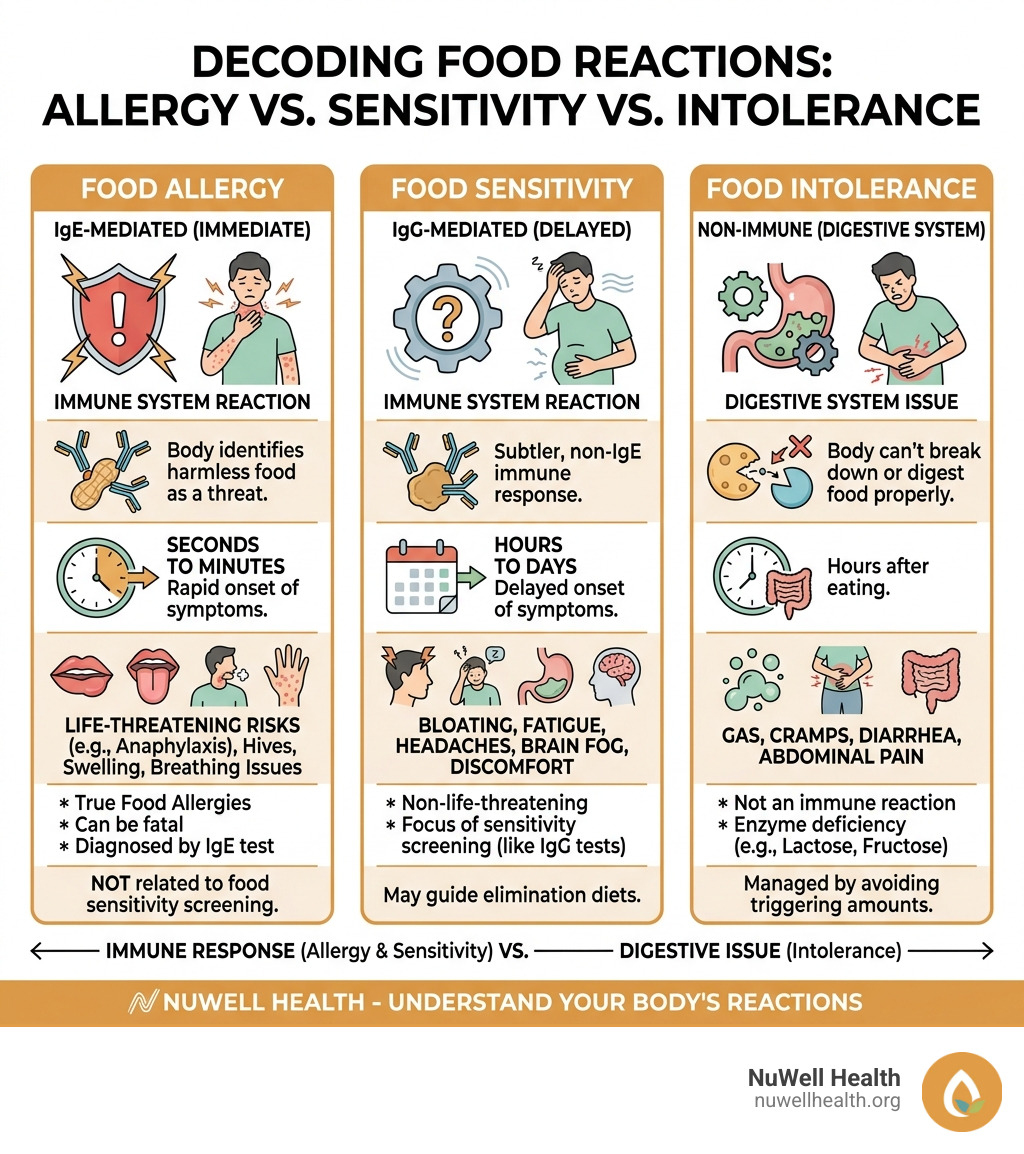
Decoding the Difference: Food Allergy vs. Food Sensitivity

When we talk about adverse reactions to food, we aren’t just splitting hairs over vocabulary. The biological pathways involved are fundamentally different. A true food allergy is an immune system overreaction involving IgE antibodies. These are the “immediate responders.” When someone with a peanut allergy eats a nut, their IgE antibodies trigger a massive release of chemicals, potentially leading to anaphylaxis—a life-threatening emergency.
Research shows that 32 million Americans suffer from food allergies, and these numbers are rising. The most common culprits in adults are shellfish, milk, peanuts, and tree nuts. Because of the risk involved, diagnosing a true allergy is a serious medical process.
On the other hand, a food sensitivity (often linked to IgG antibodies) is more like a “delayed conversation” between your gut and your immune system. These reactions aren’t life-threatening, but they can be life-disrupting. While an allergy happens in minutes, a sensitivity reaction might not show up for 3 to 72 hours. This delay is exactly why it’s so hard to figure out if it was the almond milk from breakfast or the soy sauce from yesterday’s dinner that caused your current flare-up.
For more detailed insights into how these reactions differ, you can explore our guide on Allergies And Food Sensitivity.
Understanding Common Symptoms
Because food sensitivities involve a systemic immune response, the symptoms are often “extraintestinal”—meaning they happen outside the gut. At NuWell Health, we see patients who have spent years chasing symptoms without realizing their fork was the culprit. Common signs include:
- Digestive Distress: Bloating, gas, diarrhea, or abdominal pain.
- Neurological Issues: Migraines, chronic headaches, and the “brain fog” that makes it hard to focus.
- Energy Levels: Feeling heavy, tired, or sluggish shortly after meals.
- Skin Conditions: Eczema, acne, or unexplained rashes.
- Systemic Inflammation: Joint pain or mood swings.
The Science of IgG and IgE in Food Sensitivity Screening

To understand food sensitivity screening, we have to look at the technology used in the lab. Most modern tests use ELISA (Enzyme-Linked Immunosorbent Assay) or microarray technology. These methods measure the “reactivity” of your blood against specific food extracts.
When your blood is exposed to, say, a milk protein on a testing plate, the lab looks for how many antibodies bind to that protein.
- IgE Testing: Measures the antibodies responsible for immediate, high-risk reactions.
- IgG Testing: Measures the antibodies that signify a delayed response.
Many commercial tests provided by clinical laboratories provide a Class 0-3 scale. A “Class 0” means no reactivity, while a “Class 3” indicates high reactivity. Some comprehensive panels test responses to over 250 food extracts, while other high-complexity profiles may cover up to 286 different triggers, including novel foods like spirulina or exotic spices. In our practice at NuWell Health, we’ve seen how these high-complexity profiles can pinpoint hidden triggers in even the cleanest diets.
Understanding these levels is the first step in identifying potential autoimmune triggers that may be keeping your body in a state of constant high alert.
The Limitations of Standard IgG-Based Screening
At NuWell Health, we have found that while IgG testing provides a snapshot of immune activity, it must be interpreted within a broader clinical context. There is a significant debate in the medical community regarding IgG tests. Organizations like the AAAAI (American Academy of Allergy, Asthma & Immunology) point out that the presence of IgG antibodies can actually be a sign of oral tolerance.
In other words, your body might produce IgG antibodies simply because you eat a certain food frequently. If you eat broccoli every day, you might show high IgG for broccoli, not because you are sensitive to it, but because your immune system has “memorized” it. This is why we caution against “automated results.” Simply cutting out every food that shows up as “yellow” or “red” on a report can lead to over-restriction and nutritional deficiencies. Professional guidance is essential to ensure you aren’t just treating a piece of paper, but treating your actual body.
Reliable Methods for Food Sensitivity Screening and Diagnosis
If you suspect a food is the root of your digestive issues, you need a reliable roadmap. While at-home kits are popular, they are just one tool in the shed.
| Test Type | How It Works | Reliability for Sensitivities |
|---|---|---|
| Skin Prick Test | Small amount of allergen put into skin | Low (Best for IgE Allergies) |
| IgE Blood Test | Measures blood for allergy proteins | High (For Allergies Only) |
| IgG Blood Test | Measures delayed immune response | Moderate (Best as a guide) |
| Elimination Diet | Removing and reintroducing foods | High (Gold Standard for Sensitivities) |
| Oral Food Challenge | Eating food under medical watch | Highest (For Allergies) |
The “Gold Standard” for food allergies remains the oral food challenge, where a patient consumes increasing amounts of a suspected allergen under strict medical supervision. However, for sensitivities, the process is more about patient observation and data collection.
The Role of Elimination Diets and Food Diaries
At NuWell Health, we believe in getting to the roots over remedies. This is why we often recommend a structured, two-part elimination diet.
- The Elimination Phase: You remove high-reactivity foods (identified by your food sensitivity screening or common triggers like gluten and dairy) for 4 to 6 weeks. This allows the “noise” in your immune system to quiet down.
- The Reintroduction Phase: You carefully add foods back one at a time, usually every 2-3 days, while keeping a detailed food diary.
By tracking your symptoms—everything from your bowel movements to your sleep quality—you can identify exactly which food causes a reaction. This method is free, highly accurate, and teaches you to listen to the signals your body is sending you.
Evaluating Professional Screening vs. Generic At-Home Kits
The market is flooded with “retail kits,” but there is a wide gap in quality. When choosing a food sensitivity screening, look for labs that are CLIA-certified. This certification ensures the lab meets federal standards for accuracy and reliability.
We must also address methods that lack scientific backing. Bioresonance (often using hair samples) and hair analysis for food sensitivities are categorized as alternative methods and are not currently recognized by mainstream medical science as reliable for diagnosing food intolerances. While hair can show heavy metal exposure over time, it does not contain the antibodies (IgG or IgE) necessary to measure an active immune response to food.
Navigating Comprehensive Immune Panels
Choosing between a 96-food panel and a 250+ food extract panel depends on the complexity of your symptoms.
- Basic Panels: Good for those who eat a standard Western diet and want to check common triggers like wheat, soy, and dairy.
- Comprehensive Panels: Better for “adventurous” eaters or those with chronic, unexplained hormone imbalance or inflammatory issues who may be reacting to spices, seeds, or “superfoods.”
The value of high-complexity laboratory testing lies in the precision of the extracts used. However, the risk of “food fear”—where you become afraid to eat anything—is real. This is why professional oversight is vital to prevent you from accidentally starving your body of essential nutrients.
Integrating Food Sensitivity Screening into a Holistic Wellness Plan
Identifying a trigger food is just the beginning. At NuWell Health, our clinical experience has shown that identifying a trigger food is just the beginning. We view the body as a temple that requires careful stewardship. If you are reacting to 20 different foods, our findings suggest the problem likely isn’t the food—it’s your gut barrier.
Leaky gut, or increased intestinal permeability, allows food particles to “leak” into the bloodstream, where the immune system attacks them. This creates a cycle of chronic pain and inflammation.
At NuWell Health, we have found that addressing the gut-brain axis is essential for long-term relief. This includes:
- Root Cause Analysis: Looking at stress, sleep, and even heavy metals root removal to reduce the total toxic load on your body.
- Gut Healing: Using natural protocols to repair the mucus and epithelial layers of the gut.
- Spirituality and Mindset: Approaching healing from a perspective of Christian stewardship, recognizing that a peaceful mind supports a peaceful gut.
Frequently Asked Questions
Is IgG food panel testing scientifically proven?
This is a nuanced “yes and no.” While the technology to measure IgG antibodies is scientifically proven and used in labs worldwide, the interpretation of those antibodies as a “sensitivity” is still debated. Major organizations like the AAAAI argue that IgG is a normal memory response of the immune system. However, many functional medicine practitioners and patients find that using these tests as a “map” for an elimination diet leads to significant symptom improvement. At NuWell Health, we use it as a tool, not a final verdict. Our practitioners have seen that when used as a guide for a personalized elimination plan, these tests can be a catalyst for profound healing.
What is the difference between a food allergy and a food intolerance?
An allergy is an immune system error (IgE). A sensitivity is a delayed immune response (IgG). An intolerance is usually a digestive system error, often caused by an enzyme deficiency. For example, lactose intolerance happens because you lack the enzyme lactase to break down milk sugar. It’s uncomfortable, but your immune system isn’t actually attacking the milk. Histamine sensitivity is another common intolerance where the body can’t break down histamines found in aged cheeses or wine.
Should I use a screening test to change my diet?
A screening test should be the start of a conversation, not the end of it. Use the results to guide a temporary elimination strategy. We don’t want you to stop eating healthy foods forever just because a test came back “yellow.” The goal is to heal the gut so that you can eventually reintroduce those foods and enjoy a diverse, nutrient-rich diet without fear.
Conclusion
At NuWell Health, we believe in a holistic natural health approach that honors the mind, body, and spirit. Food sensitivity screening is a powerful modern tool, but it works best when paired with ancient wisdom: listening to your body, eating whole foods, and focusing on a preventive lifestyle.
At NuWell Health, we have found that true healing begins by addressing the root cause of inflammation rather than just masking symptoms with temporary fixes. By identifying your unique triggers and supporting your gut health, you can move from a state of “reacting” to a state of “thriving.”
If you’re ready to stop guessing and start healing, we invite you to learn more about our approach to Allergies And Food Sensitivity and take the first step toward finding your perfect dietary match.
This article was researched with AI and heavily edited by Jordan Oliver for accuracy and relevance.
Jordan is an author, ordained minister, and online host for His Glory TV, sharing biblically grounded insights on faith, prayer, and spiritual growth. She is the co-founder of Triple-Braided Cord Co., an intercessory prayer and healing ministry inspired by Ecclesiastes 4:12.
Jordan holds a Bachelor’s degree in Communications and Religious Studies from High Point University and is a certified Spiritual Life Coach through iCoachLife in Nashville, Tennessee. Drawing from her ministry, coaching, and academic experience, she creates trustworthy, faith-based content that helps readers grow in their relationship with God. Learn more about Jordan here.