

Food Allergy Testing: What 32 Million Americans Need to Know
Food allergy testing is the process of identifying which foods trigger an immune response in your body — and getting it right can be life-changing.
Here is a quick overview of the main testing options:
| Test Type | What It Measures | Best For |
|---|---|---|
| Skin Prick Test (SPT) | IgE antibody reaction on skin | First-line allergy screening |
| Blood (IgE) Test | Food-specific IgE antibodies in blood | When skin testing isn’t possible |
| Oral Food Challenge | Actual reaction to food eaten in clinic | Gold standard confirmation |
| Component-Resolved Testing | Specific allergenic proteins | Precise risk assessment |
| Basophil Activation Test (BAT) | Immune cell reaction | Equivocal or borderline cases |
Getting tested the right way matters — because the wrong diagnosis can mean years of unnecessary food avoidance, or worse, missing a reaction that could be life-threatening.
An estimated 32 million Americans live with food allergies. Among children, that number is as high as 1 in 13. Yet many people still struggle to get a clear answer about what is actually causing their symptoms.
Some people know immediately which food is the problem. Others experience symptoms — bloating, hives, fatigue, brain fog — that appear hours or even days after eating, making the root cause much harder to pin down.
At NuWell Health, we have found that understanding what is happening in your body is the essential first step toward lasting relief. Whether you are dealing with a true IgE-mediated food allergy or a slower, digestive-type sensitivity, the path forward starts with getting the right test — interpreted by the right professional.
This guide walks you through everything you need to know: how different tests work, which ones are actually reliable, and what to do with your results.
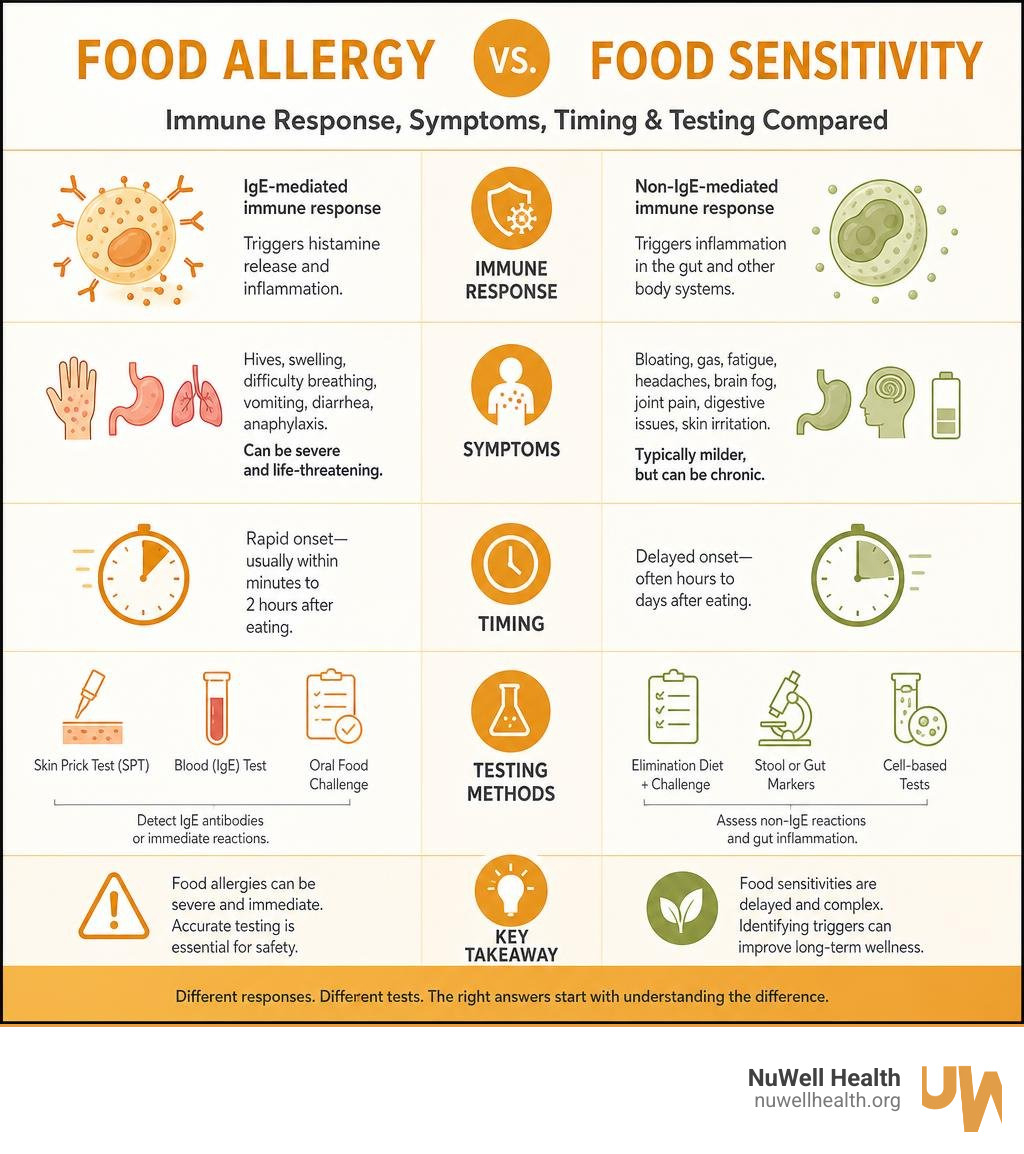
Understanding the Difference: Food Allergy vs. Food Sensitivity

Before scheduling any kind of food allergy testing, it is vital to understand exactly what we are trying to measure. One of the most common mistakes people make is confusing a true food allergy with a food sensitivity or digestive intolerance.
At NuWell Health, we look at the body as an interconnected system. How your immune system reacts to a food is fundamentally different from how your digestive tract processes it.
True Food Allergies (IgE-Mediated)
A true food allergy is an immediate, immune-system-driven reaction. When you have an allergy, your immune system mistakenly identifies a specific food protein as a dangerous invader. In response, it produces Immunoglobulin E (IgE) antibodies.
The next time you eat even a microscopic speck of that food, these IgE antibodies signal your mast cells to release a flood of chemicals, including histamine. This causes rapid, systemic symptoms that typically show up within seconds to two hours. These symptoms can include:
- Hives, swelling, or severe itching
- Abdominal cramps, vomiting, or diarrhea
- Shortness of breath, wheezing, or a tight throat
- Anaphylaxis, a life-threatening drop in blood pressure that requires emergency epinephrine
For a deeper dive into how these immune pathways function, take a look at our A Practical Guide to Allergies and Food Sensitivity.
Food Sensitivities (IgG-Mediated)
A food sensitivity is a completely different mechanism. Instead of IgE, sensitivities are often associated with Immunoglobulin G (IgG) antibodies.
Unlike the immediate storm of an allergy, food sensitivity reactions are delayed. Symptoms can take anywhere from a few hours up to three days (72 hours) to manifest. Because the reaction is slow and low-grade, it is often linked to chronic inflammation, joint pain, fatigue, headaches, and digestive upset.
Because these reactions are slow, identifying the culprit without a structured approach is incredibly difficult. Learn more about how we screen for these delayed reactions in our guide to Allergies and Food Sensitivity.
Food Intolerances (Non-Immune Digestive Issues)
A food intolerance does not involve the immune system at all. Instead, it is usually a mechanical or chemical issue in the gut—most commonly a deficiency in a digestive enzyme.
The classic example is lactose intolerance. If your body does not produce enough of the lactase enzyme, you cannot properly break down the sugar (lactose) in dairy. This leads to fermentation in the colon, causing gas, bloating, and diarrhea.
Furthermore, as we age, our natural production of digestive enzymes naturally declines, meaning you might develop intolerances to foods you used to digest with ease. At NuWell Health, we have found that supporting the body’s natural enzyme production through targeted nutrition and lifestyle adjustments can significantly improve digestive comfort and overall gut health.
The Celiac Disease Distinction
Celiac disease is another distinct category. It is not an IgE allergy, nor is it a simple sensitivity. It is a serious autoimmune disease where the ingestion of gluten leads to direct damage to the small intestine.
If you suspect gluten is causing your symptoms, it is critical to test for celiac disease before eliminating gluten from your diet, as the diagnostic tests rely on the presence of active antibodies triggered by gluten exposure.
The Core Methods of Clinical Food Allergy Testing

When you visit a board-certified allergist, they will use a combination of tools to evaluate your symptoms. However, no test is a magic wand.
According to the Diagnostic evaluation of IgE-mediated food allergy – UpToDate, the foundation of any accurate diagnosis is a detailed clinical history. The test results must always be interpreted in the context of your actual symptoms and “pretest probability.”
Here is how the core diagnostic methods compare:
| Testing Method | How It Works | Sensitivity & Specificity | Turnaround Time | Key Limitations |
|---|---|---|---|---|
| Skin Prick Test (SPT) | Drops of liquid allergen are pricked into the skin’s surface. | High sensitivity (>90%), moderate specificity (~50%). | 15–30 minutes | High rate of false positives; cannot be done during active eczema flare-ups. |
| Serum Specific IgE (Blood Test) | Measures concentration of food-specific IgE antibodies in blood. | Highly sensitive; 95% predictive thresholds exist for major allergens. | 1–2 weeks | Measures sensitization, not necessarily clinical allergy; more expensive than SPT. |
| Oral Food Challenge (OFC) | Patient eats gradually increasing doses of the food under close medical supervision. | The absolute gold standard for accuracy. | 3–4 hours | Risk of severe allergic reaction; can be highly stressful for patients. |
Skin Prick Testing (SPT)
Skin prick testing is the most common first-line tool. A tiny drop of food extract is placed on your forearm or back, and a sterile plastic device gently scratches the very top layer of skin. If you are sensitized, a small, itchy bump (called a wheal) surrounded by redness (flare) will appear within 20 minutes.
While a positive skin prick test is only clinically accurate about 50 percent of the time (meaning false positives are common), a negative skin prick test is incredibly powerful. It is about 95 percent predictive in ruling out a true IgE-mediated food allergy. If the skin test is negative, it is highly unlikely that food is causing an immediate allergic reaction.
At NuWell Health, we have found that understanding these clinical standards helps patients feel more prepared and empowered when discussing testing options with their healthcare providers.
Blood Testing (Serum Specific IgE)
If you have severe eczema, dermographism (where skin swells at the slightest touch), or cannot safely stop taking antihistamines, a blood test is the preferred alternative.
These tests, such as the ImmunoCAP system, measure the exact concentration of food-specific IgE antibodies in your blood. For comprehensive screening, clinics often order a panel like the FOOD6 – Overview: Food Panel, Serum, which screens for a pool of common allergens, or a broader food allergy profile with reflexes to pinpoint exact triggers.
Just like skin tests, a positive blood test shows sensitization (your body has made antibodies), but it does not guarantee you will have an allergic reaction when you eat the food.
Preparing for Your Food Allergy Testing Appointment
To ensure your clinical testing is safe and accurate, proper preparation is essential.
If you are undergoing a skin prick test, you must stop taking antihistamines at least 5 to 7 days prior to your appointment. Antihistamines block the histamine response in your skin, which can lead to a false-negative result.
Additionally, if you are undergoing atopy patch testing (used for delayed, cell-mediated reactions), you may need to stop oral steroids up to a month in advance.
Always keep a detailed food and symptom diary leading up to your visit. Note:
- Exactly what you ate (including ingredients, if known).
- The precise timing of your symptoms (did they start in minutes or hours?).
- The severity and type of symptoms you experienced.
- Any medications you took to resolve the reaction.
Finally, ensure your testing is scheduled in a clinical setting fully equipped with emergency equipment, including oxygen and injectable epinephrine, to manage any unexpected systemic reactions.
The Oral Food Challenge: The Gold Standard
When skin and blood tests are inconclusive, or when we want to confirm if a child has outgrown an allergy, we turn to the absolute gold standard: the Oral Food Challenge (OFC).
An OFC is not something you ever attempt at home. It must be performed in a specialized medical facility under the direct supervision of an allergist.
During the challenge, you are given tiny, gradually increasing doses of the suspected allergen over several hours. Medical staff monitor your vital signs, skin, and breathing after every dose.
If you complete the challenge without a reaction, you can confidently reintroduce the food into your diet. If a reaction begins, the test is stopped immediately, and treatment (such as epinephrine) is administered. This is the most accurate way to separate simple sensitization from a true, dangerous allergy.
Advanced Diagnostics: Component-Resolved Testing and Basophil Activation Testing
In recent years, molecular diagnostics have revolutionized how we look at food allergies. We no longer have to rely solely on whole-food extracts, which can sometimes lead to confusing cross-reactions.
Component-Resolved Diagnostics for Precise Food Allergy Testing
Whole foods are made up of many different proteins, some of which are highly dangerous, while others are completely harmless. Component-resolved diagnostics (CRD) allow us to measure IgE antibodies to specific proteins within a food.
A classic example is peanut allergy. Whole-peanut IgE tests can sometimes return positive results because of cross-reactivity with birch pollen (due to a harmless protein called Ara h 8).
By utilizing CRD, we can test for specific high-risk proteins:
- Ara h 2: A stable protein in peanuts highly associated with severe, systemic anaphylaxis.
- Cor a 14: A high-risk protein for severe hazelnut allergy.
- Ana o 3: A reliable marker for true cashew allergy.
According to the EAACI guidelines on the diagnosis of IgE‐mediated food allergy, using component testing significantly improves diagnostic accuracy, saving patients from unnecessary dietary restrictions.
Basophil Activation Testing (BAT)
The Basophil Activation Test (BAT) is a cutting-edge, flow-cytometry-based blood test. Instead of just measuring the static level of antibodies in your blood, BAT looks at how your actual immune cells (basophils) behave when exposed to the allergen in a laboratory setting.
At NuWell Health, we keep a close eye on these emerging technologies. BAT is incredibly promising for resolving borderline or highly complex cases, and it serves as a valuable tool for tracking whether a patient is successfully developing tolerance during oral immunotherapy (OIT).
The Risks of At-Home Food Sensitivity and Allergy Tests
With the rise of direct-to-consumer health kits, it is incredibly tempting to order an at-home test. You prick your finger, mail in a card, and receive a colorful report telling you to avoid dozens of everyday foods.
However, major allergy and immunology organizations worldwide strongly advise against these tests. Here is why:
The Flaw of IgG Testing
Most commercial at-home “sensitivity” tests measure IgG antibodies. As we discussed earlier, IgG is not an indicator of allergy or inflammation.
In fact, clinical research shows that IgG production is a normal physiological response to eating food. It is actually a marker of immunological exposure and tolerance!
If you eat a lot of almonds, your almond IgG levels will likely be high. This does not mean you are sensitive to almonds; it simply means your immune system recognizes them as a food you regularly consume.
Using an unscientific IgG panel to construct a diet can lead to extreme, unnecessary food restriction.
The Danger of Bioresonance and Hair Testing
Some alternative companies offer hair-sample testing using “bioresonance technology,” claiming to screen for hundreds of food intolerances. There is zero scientific validation for these methods. Hair cannot show immune-mediated food allergies or digestive enzyme deficiencies.
To understand why these alternative tests fall short, read our investigative piece: The Truth About Saliva-Based Food Sensitivity Testing.
The Real-World Consequences
When you blindly eliminate healthy, whole foods based on unscientific test results, you risk:
- Nutritional Deficiencies: Cutting out entire food groups (like dairy, grains, or eggs) without a clinical reason can leave you depleted of vital nutrients.
- Gut Dysbiosis: A diverse diet is the foundation of a healthy gut microbiome. Restricting your diet unnecessarily starves beneficial gut bacteria.
- Loss of Tolerance: Ironically, completely avoiding a food for a long period can sometimes cause your immune system to “forget” how to tolerate it, potentially triggering a real sensitivity or allergy when you try to eat it again.
For a safer, evidence-based approach to identifying sensitivities, check out The Definitive Guide to Food Sensitivity Testing.
Interpreting Results and Next Steps
Once your food allergy testing results are back, the real work begins.
A positive test result without clinical symptoms is just “sensitization,” not an allergy. If your test is positive for wheat, but you eat sourdough bread every morning with zero issues, you do not have a wheat allergy. You should never eliminate a food you are currently tolerating based solely on a test result.

If a true IgE-mediated food allergy is confirmed, the immediate next steps are:
- Strict Avoidance: Learn to read labels meticulously to avoid accidental exposure.
- Epinephrine Carriage: Carry two auto-injectors of epinephrine at all times.
- Emergency Action Plan: Work with your allergist to create a clear plan for school, work, and home.
The NuWell Health Holistic Approach to Food Sensitivities
If your tests rule out a true allergy, but you are still experiencing chronic bloating, fatigue, or joint pain, we look deeper. At NuWell Health, we focus on the root causes of food sensitivities, which often stem from a compromised gut barrier (sometimes called “leaky gut”) or systemic inflammation.
Instead of permanent food elimination, we advocate for a structured, temporary elimination diet. By removing common inflammatory triggers (such as refined sugars, processed dairy, and gluten) for 3 to 6 weeks, we allow the gut lining to rest and heal.
We then guide you through a systematic, step-by-step reintroduction process to identify your true triggers. To learn how to navigate this journey safely, read Everything You Need to Know About Testing Your Gut for Food Sensitivities.
Working with a professional makes all the difference. If you want expert guidance, check out The Ultimate Guide to Finding a Food Sensitivity Specialist and Food Sensitivity Screening: A Guide to Finding Your Perfect Match.
Frequently Asked Questions About Food Allergy Testing
What is the gold standard for food allergy testing?
The absolute gold standard for confirming or ruling out a food allergy is the Oral Food Challenge (OFC). During this test, a patient consumes gradually increasing amounts of the suspected food under strict medical supervision in a clinical setting equipped to handle severe allergic reactions.
Can you outgrow a food allergy, and how is it tested?
Yes, many children outgrow allergies to milk, egg, soy, and wheat, though allergies to peanuts, tree nuts, and shellfish are more commonly lifelong. To determine if an allergy has been outgrown, an allergist will monitor the patient’s specific IgE levels over time. When antibody levels drop significantly, they may recommend a supervised Oral Food Challenge to confirm tolerance.
Why are at-home IgG food sensitivity tests considered unreliable?
At-home IgG tests are unreliable because IgG antibodies are a marker of food exposure and natural immune tolerance, not an allergic reaction or sensitivity. High IgG levels simply mean you have eaten that food recently, and restricting your diet based on these results can lead to unnecessary nutritional deficiencies.
Conclusion
Navigating food allergy testing can feel overwhelming, but you do not have to do it alone. Understanding the difference between a true, immediate allergy and a delayed digestive sensitivity is the first step toward reclaiming your health and vitality.
At NuWell Health, we believe that your body is a temple, and taking care of your health is a profound act of stewardship. Through our clinical experience working with thousands of patients, we have found that true healing begins by addressing the whole person—mind, body, and spirit—prioritizing natural, human-centered health solutions over industrial or agricultural dietary models. We are dedicated to helping you discover the root causes of your symptoms, using safe, natural, and evidence-based approaches that minimize side effects and empower you to live life to the fullest.
If you are ready to stop guessing and start healing, we invite you to explore our comprehensive resources on Allergies and Food Sensitivity and partner with us on your journey to lasting wellness.
This article was researched with AI and heavily edited by Jordan Oliver for accuracy and relevance.
Jordan is an author, ordained minister, and online host for His Glory TV, sharing biblically grounded insights on faith, prayer, and spiritual growth. She is the co-founder of Triple-Braided Cord Co., an intercessory prayer and healing ministry inspired by Ecclesiastes 4:12.
Jordan holds a Bachelor’s degree in Communications and Religious Studies from High Point University and is a certified Spiritual Life Coach through iCoachLife in Nashville, Tennessee. Drawing from her ministry, coaching, and academic experience, she creates trustworthy, faith-based content that helps readers grow in their relationship with God. Learn more about Jordan here.