

Why Connecting Mind, Body, and Spirit Is the Key to True Wellness
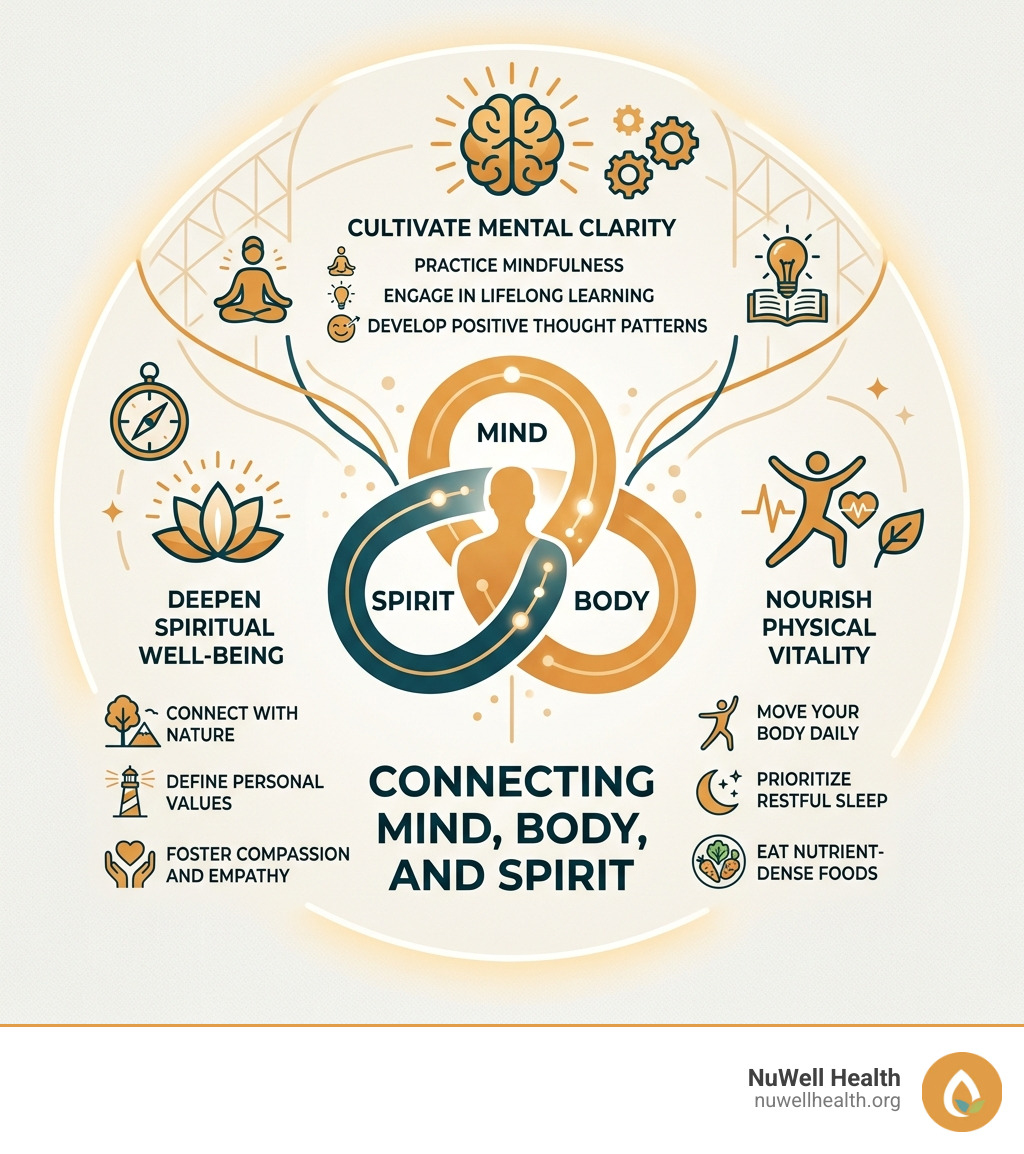
Connecting mind, body, and spirit means treating yourself as a whole person — not just a set of symptoms to manage.
Here is a quick overview of what that looks like in practice:
| Dimension | What It Includes | Example Practices |
|---|---|---|
| Mind | Thoughts, emotions, mental patterns | Mindfulness, journaling, therapy |
| Body | Physical health, movement, nutrition | Exercise, whole foods, sleep |
| Spirit | Purpose, values, faith, meaning | Prayer, scripture, gratitude, community |
When all three are in balance, you feel more energized, clear-headed, and grounded. When one is out of sync, the others often suffer too.
Most of us have felt this firsthand. Stress piles up at work, and suddenly your shoulders ache and your sleep falls apart. Or a season of physical illness leaves you emotionally drained and spiritually flat. That is not a coincidence — it is the mind-body-spirit connection at work.
Connecting mind, body, and spirit means understanding that your thoughts, physical health, emotions, values, and sense of purpose all affect one another. For centuries, healers approached health this way. After the 17th century, Western medicine often shifted toward treating the body more like a machine made of separate parts. Today, research in areas like psychoneuroimmunology supports a more connected view: what you think, feel, believe, and experience can influence your overall well-being in real, measurable ways.
If you have been chasing relief through medications or quick fixes and still feel “off,” this guide is for you. Real, lasting wellness starts by addressing root causes — and that means looking at the whole picture.
Stephen A. Luther, founder of NuWell Health and Licensed Professional Counselor with over 25 years of experience helping individuals and families explore connecting mind body and spirit, has seen how addressing all three dimensions — not just symptoms — is what leads to genuine, lasting healing.
Understanding the History and Science of Connecting Mind Body and Spirit

To understand why we often feel “fragmented” today, we have to look back at how we got here. Until the 17th century, the vast majority of the world—including the Western world—viewed the human being as a unified whole. If you had a stomach ailment, a physician wouldn’t just look at your digestion; they would ask about your state of mind and your relationship with the Divine.
This changed during the Scientific Revolution. Thinkers began to view the body as a complex machine with replaceable parts. While this led to incredible advances in surgery and trauma care, it created a “Great Divorce” between the physical and the non-physical. The spirit was relegated to the church, the mind to philosophy, and the body to the clinic.
In April 2026, we are seeing a massive shift back toward integration. Modern science is finally catching up to ancient wisdom through the biopsychosocial model, which recognizes that biological, psychological, and social factors all play a role in health. Even more exciting is the field of psychoneuroimmunology. This is a big word for a simple concept: your brain (psyche), your nervous system (neuro), and your immune system (immuno) are constantly talking to each other.
Research from The Integration of Body, Mind, Spirit, and Soul suggests that true health requires us to move beyond reductionist models. At NuWell Health, we believe Why Your Holistic Mind-Body-Spirit Connection Matters because we see that thoughts and beliefs actually create chemical reactions in the body. When you think a stressful thought, your body produces cortisol. When you feel a sense of peace through prayer, your body produces healing hormones. You are one interconnected system.
How the Mind, Body, and Spirit Interact During Stress and Illness
Have you ever noticed that you get a “gut feeling” before your brain even processes a situation? There is a scientific reason for that. Our bodies actually tell our brains what to think about 80% of the time. This bidirectional influence means that physical sensations often precede conscious thoughts.
When we face stress or illness, this connection becomes glaringly obvious. Chronic stress activates the sympathetic nervous system—the “fight or flight” mode. While this is great if you’re being chased by a bear, it’s devastating when it’s triggered by a mortgage payment or a difficult boss. High stress causes muscle tension, headaches, and digestive issues because the body is diverting energy away from “maintenance” (like digestion and immunity) toward “survival.”
The impact of trauma is a powerful example of this. Statistics show that 82% of breast cancer survivors experience symptoms of PTSD. This highlights how medical trauma isn’t just a physical event; it’s a mental and spiritual one too. As noted in The Importance of the Mind-Body-Spirit Connection During Times of Stress and Anxiety, ignoring these connections during recovery can lead to slower healing and increased emotional distress.
We often see this in Mind-Body Connection in Mental Health. If you treat only the brain with medication but ignore a body that is chronically inflamed or a spirit that feels purposeless, the “fix” is often temporary.
| Feature | Balanced State | Imbalanced State |
|---|---|---|
| Mental | Clarity, focus, emotional resilience | Brain fog, racing thoughts, anxiety |
| Physical | Consistent energy, good digestion | Chronic fatigue, tension, inflammation |
| Spiritual | Sense of purpose, peace, connection | Feeling “lost,” hopeless, or disconnected |
Practical Steps for Connecting Mind Body and Spirit Daily
Nurturing your inner self doesn’t require a total life overhaul. It requires small, intentional, and consistent actions. Think of it like a “Holistic Blueprint.” You wouldn’t build a house on a shaky foundation, and you shouldn’t try to build a healthy life without addressing all three pillars.
At NuWell Health, we advocate for Natural Health & Mental Health strategies that empower you to take charge of your own well-being. This starts with a personalized plan that evolves as you do.
Nurturing the Mind for Mental Integration
Your mind is like a garden; if you don’t pull the weeds of negative self-talk, they will eventually take over. Connecting mind body and spirit involves cultivating “mental hygiene.”
- Mindfulness and Presence: We often spend our lives in the “past” (rumination) or the “future” (anxiety). Mindfulness is simply the practice of coming back to the “now.” This can be as simple as taking three deep breaths and noticing five things you can see right now.
- Journaling: This is a powerful tool for Harnessing the power of the mind-body-spirit connection to Improve mental health. When you put your thoughts on paper, you move them from a chaotic internal loop to an external, manageable format. It helps in Getting to the Bottom of Emotional Pain and Trauma by identifying patterns you might otherwise miss.
- Cognitive Reframing: Practice being your own cheerleader. When a critical voice says, “I’m failing,” try reframing it to, “I’m learning a difficult lesson right now.”
Supporting the Body through Physical Integration
The body is the temple of the spirit and the home of the mind. If the house is falling down, it’s hard to focus on the inhabitants.
- Nutrition as Fuel: We believe in “Roots Over Remedies.” This means eating whole, nutrient-dense foods that support brain health and reduce inflammation. If you’re curious about how this works, exploring What is Naturopathic Medicine? can provide insights into how natural substances support the body’s self-healing capacity.
- Mindful Movement: You don’t need to run a marathon. A 10-minute walk after a meal aids digestion and clears the mind. The goal is to “enter the body” through movement, noticing the sensation of your feet on the ground.
- Restorative Sleep: Most adults need 7-9 hours of quality sleep. Sleep is when your brain “washes” itself of metabolic waste and your spirit finds rest. When Pain Steals Joy, sleep is often the first thing to go, creating a cycle of fatigue and low mood.
Cultivating the Spirit: A Christian Perspective on Connecting Mind, Body, and Spirit
At NuWell Health, when we talk about spirituality, we approach it from a Christian perspective. We believe that we are created in the image of God and that our spirits require connection to the Creator to truly thrive.
- Prayer and Meditation: Unlike secular mindfulness, Christian meditation involves filling the mind with God’s truth rather than just emptying it. It’s about “tuning in” to the whispers of the Holy Spirit.
- Scripture and Truth: Immersing yourself in the Word provides a solid foundation for your values. Having a sense of meaning beyond ourselves is a massive predictor of mental health resilience.
- Purpose-Driven Living: We find joy when we live in alignment with our God-given purpose. This often involves community and service. When we focus on Roots Over Remedies, we recognize that a lack of purpose can manifest as physical lethargy or mental depression.
Signs Your Inner Self is Out of Alignment
How do you know when you’ve drifted away from connecting mind, body, and spirit? Your body and mind will usually send you “check engine” lights long before a total breakdown occurs.
- Persistent Mental Fog: Feeling like you’re walking through a cloud or struggling to make simple decisions.
- Chronic Fatigue: Being tired even after a full night’s sleep. This is often a sign that your “spiritual battery” is drained.
- Emotional Numbness or Irritability: Feeling nothing at all, or snapping at loved ones over small inconveniences.
- Physical Tension: Unexplained back pain, jaw clenching, or “knots” in your stomach.
- Lack of Motivation: A sudden loss of interest in things that used to bring you joy or a sense of “What’s the point?”
If you recognize these signs, don’t panic. They are simply invitations to slow down and rebalance. You can explore more about these indicators in our Category: Mind-Body Connection archives.
Frequently Asked Questions about Holistic Alignment
What are the benefits of a mind-body-spirit approach?
The benefits are far-reaching. By connecting mind, body, and spirit, you aren’t just masking symptoms; you are building a more resilient system.
- Improved Stress Management: You learn to calm your nervous system before stress becomes chronic.
- Stronger Immune Function: Positive mental states and spiritual peace have been shown to lower inflammation and boost immunity.
- Greater Self-Awareness: You become an expert on your own “internal GPS,” catching imbalances early.
- Lasting Peace: A sense of purpose and faith provides a “buffer” against the inevitable storms of life.
How do I find a holistic practitioner?
Finding the right guide is crucial. Look for professionals who respect all three dimensions of your being.
- Research Credentials: Look for training, licensure, and experience that match your needs.
- Ask About Their Philosophy: A strong holistic practitioner should explore root causes, not just manage symptoms.
- Read Helpful Resources: Start with What is Naturopathic Medicine? to understand what this kind of care includes.
- Trust Your Intuition: You should feel listened to, respected, and supported throughout your care.
Can I practice this without being religious?
While NuWell Health operates from a Christian worldview, the principles of holistic connection are universal. Every human being has a “spirit”—the part of us that seeks meaning, holds values, and connects with the world. You can nurture this through:
- Nature Connection: Spending time in the “Cathedral of the Outdoors” to find perspective.
- Ethical Living: Acting in alignment with your core values.
- Community: Building deep, meaningful relationships with others.
- Creativity: Expressing your inner self through art, music, or writing.
Conclusion
At NuWell Health, we believe that you were designed for wholeness. Connecting mind body and spirit isn’t a “New Age” fad; it is a return to a more ancient, effective, and respectful way of caring for the human person.
True healing isn’t a straight line, and it isn’t something that happens overnight. It is a journey of reclaiming your health by addressing the root causes of your distress—whether those roots are nutritional, emotional, or spiritual. Our mission is to provide you with fewer side effects and more empowerment through a preventive lifestyle focus.
You don’t have to navigate this journey alone. Whether you are dealing with chronic pain, anxiety, or a sense of spiritual disconnection, there is a path forward that honors all of who you are.
Ready to take the next step toward alignment? Explore our resources on holistic care or visit nuwellhealth.org to learn more about our whole-person approach to wellness. Your journey to reconnecting your inner self starts today.
This article was researched with AI and heavily edited by Stephen Luther for accuracy and relevance.
Stephen Luther is the Executive Director and Founder of NuWell Health, along with its sister programs Grace Christian Counseling, Grace Recovery Services, WPA Counseling, and NuWell Online Counseling and Coaching.
He holds a Master’s degree in Education from the University of Georgia and a Master’s degree in Marriage and Family Therapy from Duquesne University. He is a licensed professional counselor in Pennsylvania.
With over 25 years of experience, Steve specializes in whole-person healing that integrates clinical excellence with faith-honoring care. At NuWell Health, he and his team focus on helping individuals and families overcome emotional, relational, and physical challenges through a holistic mind-body-spirit approach, including attachment-based therapy, trauma-informed care, and practical strategies for lasting restoration.
This guide is for educational and spiritual encouragement and is not a substitute for personalized professional counseling. If you are in crisis, please reach out for immediate help.