

If you want to repair stomach lining naturally, it helps to know what the stomach lining is, what usually irritates it, and where natural support fits. This guide covers the warning signs that need care right away, why the cause matters, a few low-risk comfort measures, and how NuWell’s whole-person approach can complement medical care.
What People Mean by the Stomach Lining
The stomach lining is the inner layer of the stomach wall. According to the National Institute of Diabetes and Digestive and Kidney Diseases (NIDDK), gastritis means the lining is inflamed, while gastropathy means the lining is damaged with little or no inflammation. An ulcer is a deeper sore in the lining of the stomach or the first part of the small intestine.
These terms are not interchangeable, and symptoms cannot tell you which one is present. NIDDK notes that most people with gastritis or gastropathy have no symptoms. Others notice upper-abdominal pain or discomfort, nausea or vomiting, loss of appetite, or feeling full too soon during a meal. However, the same symptoms can also come from reflux, gallbladder problems, medicine side effects, and other concerns. NuWell’s guide to constant stomach issues and their causes covers that wider picture.
If burning behind the breastbone or regurgitation is your main concern, NuWell’s guide to self-care for acid reflux addresses that pattern. If early fullness and reflux happen together, the article on reflux and slow digestion may be a closer match.
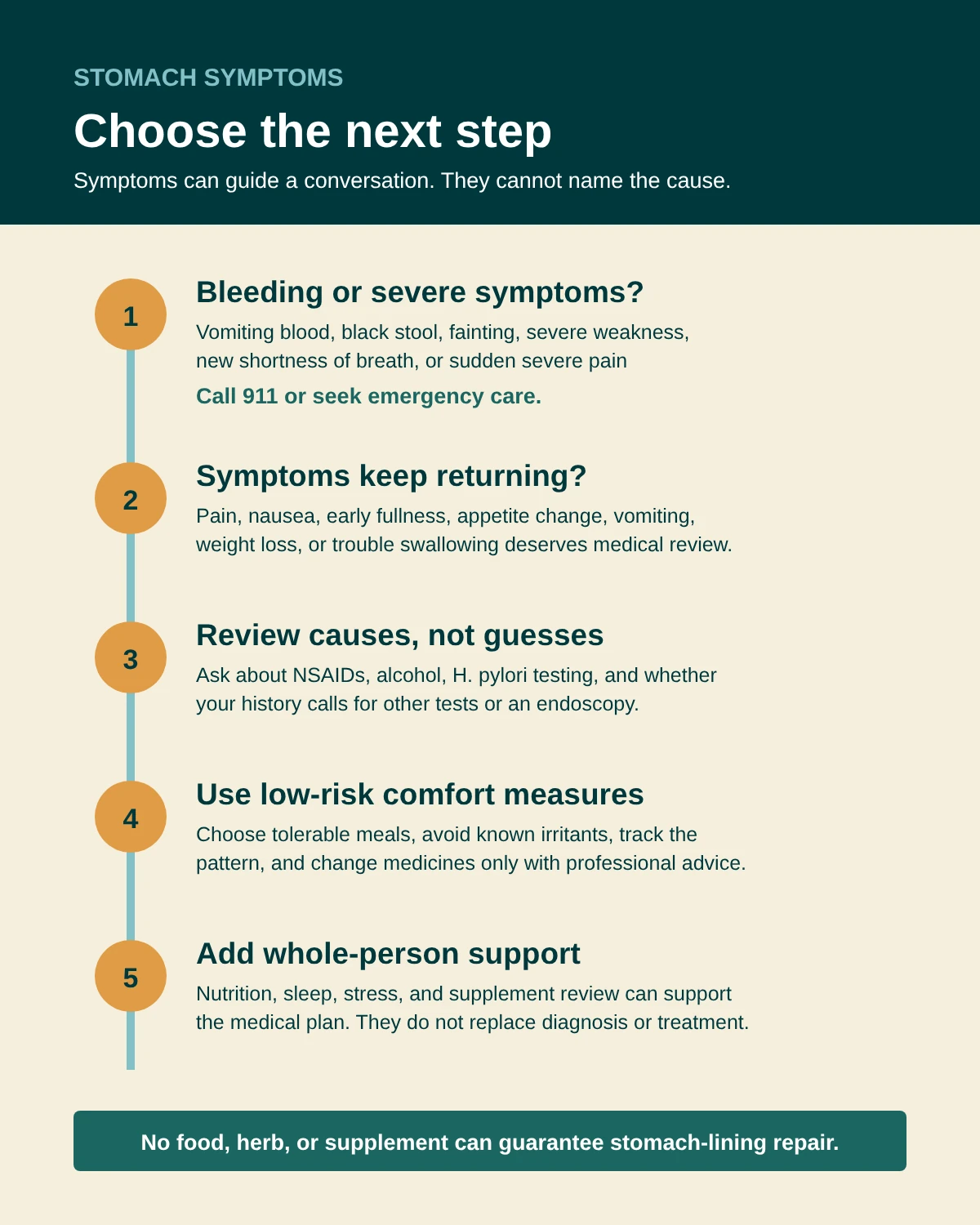
When to Get Urgent or Medical Help
The U.S. Food and Drug Administration warns that aspirin and other NSAIDs can cause stomach bleeding, so these warning signs matter even if you otherwise feel well.
- Stomach pain, nausea, or early fullness that keeps returning
- Ongoing vomiting
- Trouble or pain with swallowing
- Unexplained weight loss or a lasting loss of appetite
- Pain that is getting worse
- Regular use of aspirin, ibuprofen, naproxen, or another NSAID along with stomach symptoms
Can You Repair Stomach Lining Naturally? Why the Cause Matters
In short, healthy routines can support comfort, but they cannot stand in for finding out what is irritating the lining. The causes below need different responses, and some need medical treatment.
H. pylori needs testing and medical treatment
H. pylori is a bacterium that can cause gastritis and peptic ulcers. To check for it, a clinician may use a breath test, a stool test, or an endoscopy with biopsy, depending on your situation (NIDDK). When infection is found, treatment usually combines two or more antibiotics with an acid-reducing medicine, and testing at least four weeks afterward checks whether the infection is gone (NIDDK). The American College of Gastroenterology’s 2024 guideline also calls for this test of cure.
Cabbage juice, honey, probiotics, mastic gum, and similar products are not substitutes for H. pylori treatment. The evidence for them is not strong enough to promise that they clear the infection or heal an ulcer, and delaying effective treatment lets the infection and its complications continue.
NSAIDs can irritate the stomach and raise bleeding risk
Long-term use of ibuprofen, naproxen, aspirin, and other NSAIDs can damage the stomach lining. The FDA lists factors that raise bleeding risk: being 60 or older, a past ulcer or bleeding problem, taking a blood thinner or a steroid such as prednisone, taking more than one NSAID-containing product, and having three or more alcoholic drinks a day. Some antacids also contain aspirin, so check the active ingredients on every label.
Do not stop prescribed aspirin or another medicine on your own. Ask the prescriber or a pharmacist to review everything you take. A doctor may suggest stopping the NSAID, lowering the dose, switching to a different pain medicine, or adding a medicine that protects the stomach (NIDDK).
Alcohol, bile reflux, and autoimmune gastritis need different responses
Alcohol can irritate the stomach lining. In addition, bile reflux, the backward flow of bile from the small intestine into the stomach, is another cause. In autoimmune gastritis, the immune system attacks healthy cells in the stomach lining, and NIDDK notes it can interfere with absorbing vitamin B12 and iron, which can lead to anemia. A single supplement plan cannot safely cover all of these possibilities.
Low-Risk Ways to Support Comfort While You Seek Answers
If you hope to repair stomach lining naturally, think of these habits as support for comfort and for your medical care, not as a cure.
Keep meals simple and notice your own triggers
There is no single proven diet that heals the stomach lining. NIDDK’s treatment guidance focuses on the cause and mentions diet changes mainly when gastritis is linked to celiac disease or food allergies. Even so, many people feel better with smaller meals, slower eating, and foods they tolerate well. Spicy, acidic, fried, or high-fat foods bother some people and not others, so treat your own pattern as a clue, not as proof of damage. Keep enough variety in your meals rather than cutting out many foods at once.
If alcohol reliably makes symptoms worse, avoid it while you seek care. If coffee, carbonated drinks, or a certain meal seems to cause discomfort, cut back for a short time and watch what happens. Food changes may ease symptoms, but they do not remove H. pylori or treat a bleeding ulcer.
Review medicines without changing them alone
Write down every prescription, over-the-counter medicine, vitamin, herb, and supplement you use, with the dose on the label and how often you take it. Then bring the list to a clinician or pharmacist. That is safer than guessing which product is causing irritation or stopping an important medicine without guidance.
Support sleep and stress without blaming stress
Stress can affect appetite, sleep, muscle tension, and how strongly discomfort is felt. A short breathing practice, a calmer meal setting, counseling, or prayer may help you cope, if those fit your beliefs and needs. Stress support does not mean your symptoms are “all in your head,” and it does not replace medical evaluation. NuWell’s mental-health-informed natural health support can sit alongside medical and mental-health care.
Be Cautious With Supplements Marketed for Stomach Repair
Many online plans that promise to repair stomach lining naturally list cabbage juice, L-glutamine, zinc carnosine, aloe, licorice, mastic gum, turmeric, and honey, sometimes with exact doses. NuWell does not recommend a stomach-repair supplement protocol. Evidence varies by product and condition, and product quality, side effects, allergies, pregnancy, kidney or liver disease, and medicine interactions all change the risk.
“Natural” does not mean harmless. The National Center for Complementary and Integrative Health warns that licorice containing glycyrrhizin can cause serious effects, especially in people with high blood pressure, that large amounts are unsafe in pregnancy, and that interactions with corticosteroids have been reported. Similarly, probiotics are not interchangeable; results for one strain or condition do not apply to every product. NIDDK advises talking with your doctor before using dietary supplements or complementary approaches for gastritis.
Still, food can be part of supportive care. Yogurt, oatmeal, cooked vegetables, or other gentle foods may feel comfortable for some people, but they are not a repair protocol. Choose foods based on tolerance, nutrition needs, allergies, and any guidance you have for a medical condition.
Track the Pattern for One to Two Weeks
Whether you are trying to repair stomach lining naturally or waiting for test results, a short record can make a medical visit more useful. It should help you notice the pattern, not turn every meal into a test.
For one to two weeks, note:
- The time, location, and type of discomfort: burning, aching, nausea, early fullness, or bloating.
- Meals, alcohol, caffeine, and tobacco near the episode.
- Prescription and over-the-counter medicines, especially aspirin or other NSAIDs.
- Vomiting, stool color, trouble swallowing, appetite change, or weight change.
- What helped, what made it worse, and how long it lasted.
A symptom log can organize your story for a clinician; it cannot diagnose gastritis, an ulcer, H. pylori, or a food intolerance. If tracking food could intensify an eating disorder, health anxiety, or preoccupation with food, skip the log and speak directly with an appropriate professional instead.
How NuWell Can Complement Medical Care
A medical clinician or gastroenterology professional should evaluate symptoms that may involve gastritis, an ulcer, H. pylori, bleeding, or another condition. For people who want to repair stomach lining naturally, NuWell’s role is complementary. Through the NuWell Method, a practitioner can look at nutrition, daily routines, stress, sleep, supplement use, existing test results, and the care you already receive. NuWell’s whole-person digestive health support is built for that kind of collaboration, and recommendations stay within each practitioner’s professional role.
Frequently Asked Questions
Can the stomach lining repair itself naturally?
The stomach lining can recover from some forms of irritation, but recovery depends on the cause and how severe it is. H. pylori, NSAID-related injury, autoimmune gastritis, bleeding, and ulcers need different care. Symptoms alone cannot show whether the lining has healed.
What foods help repair the stomach lining?
No food has been proven to repair every stomach-lining problem. Smaller meals and foods you tolerate may ease discomfort. A balanced diet supports general health, but food does not replace testing or treatment for H. pylori, an ulcer, bleeding, or another condition.
Are L-glutamine, zinc carnosine, or licorice safe for stomach repair?
Evidence and safety vary by product, dose, and your health history, and some products interact with medicines or affect blood pressure. Talk with a doctor or pharmacist who knows your history before using any supplement for ongoing stomach symptoms.
Should I stop ibuprofen or aspirin if my stomach hurts?
Do not stop prescribed aspirin or another medicine on your own. Ask a prescriber or pharmacist to review all NSAID-containing products and your bleeding risk. Call 911 or seek emergency care for vomiting blood, black or bloody stool, or feeling faint.
How do I know if I have H. pylori?
Symptoms cannot confirm H. pylori. A clinician may use a breath test, stool test, or biopsy, depending on your history and current medicines. If H. pylori is treated, follow-up testing is used to confirm that the infection is gone.
Have broader questions about how NuWell works? Visit NuWell’s frequently asked questions.
Sources
- Definition & Facts of Gastritis & Gastropathy. National Institute of Diabetes and Digestive and Kidney Diseases (NIDDK).
- Symptoms & Causes of Gastritis & Gastropathy. NIDDK.
- Diagnosis of Gastritis & Gastropathy. NIDDK.
- Treatment of Gastritis & Gastropathy. NIDDK.
- Chey WD, Howden CW, Moss SF, Morgan DR, Greer KB, Grover S, Shah SC. ACG Clinical Guideline: Treatment of Helicobacter pylori Infection (guideline highlights). American Journal of Gastroenterology. 2024.
- U.S. Food and Drug Administration. Warning: Aspirin-Containing Antacid Medicines Can Cause Bleeding.
- National Center for Complementary and Integrative Health. Licorice Root.