

Why a Holistic Weight Reduction Plan Is the Secret Sauce to Sustainable Wellness
A holistic weight reduction plan addresses far more than calories in and calories out — it treats the whole person: body, mind, and spirit.
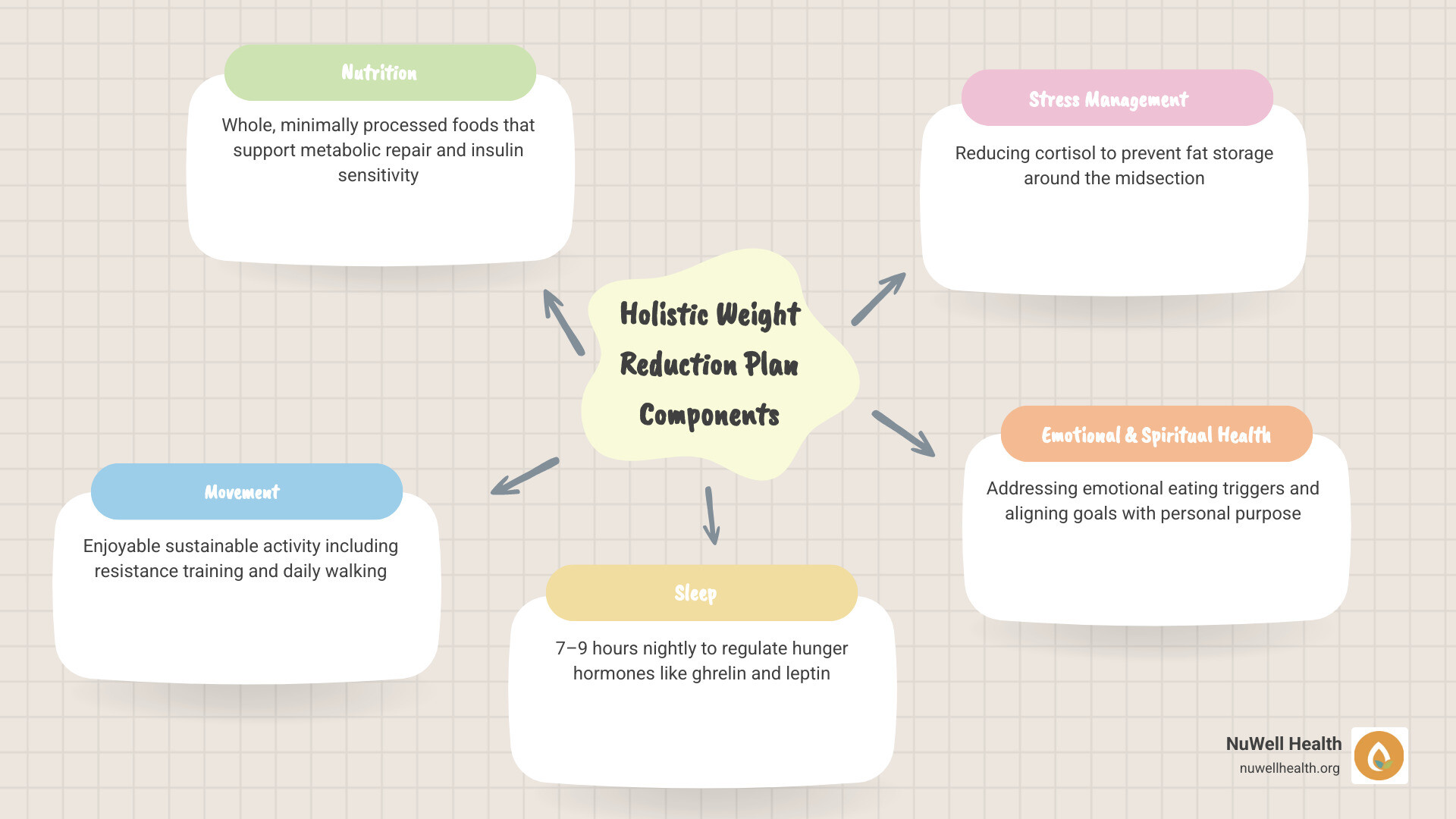
Quick answer — what does a holistic weight reduction plan include?
- Nutrition — whole, minimally processed foods that support metabolic repair
- Movement — enjoyable, sustainable activity including resistance training and daily walking
- Sleep — 7–9 hours nightly to regulate hunger hormones like ghrelin and leptin
- Stress management — reducing cortisol to prevent fat storage around the midsection
- Emotional health — identifying and addressing the root causes of emotional eating
- Mindset — building self-awareness and breaking negative thought patterns
- Spiritual grounding — aligning your health goals with your values and sense of purpose
Most people trying to lose weight have done everything they were told to do. Cut calories. Hit the gym. Follow the latest plan. And still felt stuck.
That frustration is real — and it makes sense. Traditional approaches tend to treat weight as a simple math problem. But the body is not a calculator. It is a complex system shaped by hormones, habits, sleep, stress, emotions, and even how connected you feel to your own purpose.
Research backs this up. Standard behavioral weight-loss interventions produce an average loss of 7–10% of body weight at one year — but within two years after treatment, most people regain one third to two thirds of that weight. Quick fixes don’t hold.
At NuWell Health, we have found that when people stop chasing a number on the scale and start addressing the root causes of weight gain, something shifts. Sustainable progress becomes possible — not through willpower alone, but through a system that supports the whole person.
This guide walks you through exactly how a holistic approach works, what the evidence says, and how you can start implementing it today.
Understanding the Holistic Weight Reduction Plan vs. Traditional Methods
When we talk about a holistic weight reduction plan, we are looking at a fundamental shift in how we view the human body. Traditional methods often rely on pharmacological “band-aids” or aggressive calorie restriction. While these might move the scale temporarily, they often neglect the root causes of weight gain, such as insulin resistance, chronic inflammation, or dysregulated nervous systems.
Pharmacological approaches, such as GLP-1 receptor agonists, can be effective for initial weight reduction (sometimes 15-20% of body weight). However, these medications often come with side effects like nausea and, more importantly, a high risk of weight regain once the medication is stopped. In contrast, a holistic approach focuses on metabolic repair and lifestyle integration.
At NuWell Health, we have found that the “secret sauce” isn’t a magic pill; it’s the synergy of multiple lifestyle pillars working together. When you fix the underlying metabolic dysfunction, weight loss becomes a natural side effect of a healthy body rather than a forced outcome of deprivation.

Holistic Strategies vs. Pharmacological Approaches
| Feature | Holistic Weight Reduction Plan | Pharmacological/Medical Approach |
|---|---|---|
| Primary Focus | Whole-person wellness & root causes | Symptom management (appetite suppression) |
| Methodology | Nutrition, sleep, stress, & movement | Medication or surgical intervention |
| Side Effects | Improved energy, mood, and sleep | Nausea, muscle loss, digestive issues |
| Longevity | High; builds sustainable life habits | Variable; often requires lifelong medication |
| Cost | Investment in food and lifestyle | Monthly prescription or surgery costs |
| Emotional Aspect | Addresses emotional eating/mindset | Often ignores psychological triggers |
Recent scientific research on multifaceted lifestyle programs shows that combining dietary advice with time-restricted eating and specific fiber supplementation can produce clinically significant weight loss (about 11 lbs in just 4 weeks) while improving liver and kidney markers. This proves that the body responds powerfully when we support its natural pathways.
Nutrition and Metabolic Repair in a Holistic Weight Reduction Plan
The goal of nutrition in a holistic framework isn’t just “eating less.” It’s about metabolic repair. We focus on restoring insulin sensitivity so your body can actually access and burn stored fat.
- Protein Prioritization: We recommend 1.2 to 1.6 grams of protein per kilogram of body weight. Protein has the highest thermic effect of food and is essential for preserving lean muscle mass—the engine of your metabolism.
- Whole Food Logic: If it comes from a box and has 20 ingredients, your body likely doesn’t recognize it as fuel. We focus on single-ingredient foods that are high in fiber and low in added sugars.
- Insulin Anchoring: By pairing complex carbohydrates with healthy fats and proteins, we prevent the “insulin spikes” that signal the body to store fat.
At NuWell Health, we see weight management as a way to nourish the body back to health. A balanced Mediterranean-style plate—rich in colorful vegetables, healthy fats like olive oil, and clean proteins—is a cornerstone of this approach.

The Role of Movement and Sleep in Your Holistic Weight Reduction Plan
Movement is more than just burning calories during a workout. In a holistic weight reduction plan, we emphasize two specific types of activity:
- Resistance Training: Muscle is “longevity tissue.” It burns three times more calories at rest than fat tissue. We suggest 2–3 sessions per week to keep your metabolic fire burning.
- NEAT (Non-Exercise Activity Thermogenesis): This includes walking, gardening, or taking the stairs. NEAT can account for an extra 350 calories burned per day. A simple 10-15 minute walk after your largest meal can reduce blood glucose spikes by up to 22%.
However, you cannot out-train a lack of sleep. Sleep deprivation raises ghrelin (the hunger hormone) by 15% and lowers leptin (the fullness hormone) by 15%. Without 7–9 hours of quality rest, your body remains in a state of “metabolic stress,” making weight loss nearly impossible. Aligning your “circadian anchors”—like getting morning sunlight within 30 minutes of waking—helps regulate the hormones that control your weight. For those new to these concepts, our beginner’s guide to lifestyle medicine is a great place to start.
Integrative Strategies: TCM, Ayurveda, and Metabolic Support
Holistic health often draws from ancient wisdom that has recognized the mind-body connection for millennia. Systems like Traditional Chinese Medicine (TCM) and Ayurveda offer unique tools for weight management.
- Traditional Chinese Medicine: TCM views excess weight as a “dampness” or stagnation in the body’s energy. Practices like acupuncture can help regulate the nervous system and improve digestion, making it easier for the body to release weight.
- Ayurveda: This system categorizes individuals into “doshas” (Vata, Pitta, Kapha). A Kapha-type individual might struggle more with sluggish metabolism and benefit from warming spices like ginger and black pepper, while a Pitta-type might need cooling foods to manage inflammation.
- Metabolic Therapy Stack: Modern integrative medicine often uses natural supplements like Berberine (which supports insulin sensitivity) or Alpha-Lipoic Acid to assist the body’s mitochondrial function.
At NuWell Health, we have observed that integrating these ancient practices with modern metabolic science provides a more comprehensive path for our clients who have previously struggled with conventional methods. Evidence suggests that these “lighter-touch” interventions, when combined with coaching, are highly effective. A research study on holistic care found that participants who integrated spiritual well-being with physical health goals were far more likely to maintain their weight loss over a 42-month period compared to those who focused on diet alone.
Addressing the Mind-Spirit Connection and Emotional Health
You can have the perfect meal plan, but if you are eating to soothe a stressed nervous system, the plan will eventually fail. At NuWell Health, we believe the body won’t release weight if it doesn’t feel safe.
Emotional Eating Triggers About half of adults with obesity report patterns of emotional eating. This isn’t a lack of willpower; it’s a coping mechanism. We help our clients identify whether they are experiencing “stomach hunger” or “heart hunger.” By practicing nervous system regulation—like 4-7-8 breathing or journaling—you can break the cycle of using food to manage stress.
Christian Spiritual Stewardship From our perspective at NuWell Health, your body is a gift to be stewarded. Weight reduction isn’t about vanity; it’s about having the energy and vitality to fulfill your purpose. Integrating prayer and spiritual grounding helps move the focus away from “perfection” and toward “stewardship and grace.” This shift in mindset reduces the shame often associated with weight, which is a major barrier to healing.
For more on how to build these internal routines, see the ultimate guide to self-care empowerment.
Practical Implementation: 20 Actionable Strategies for 2026
Ready to start? Here are 20 evidence-based strategies to weave into your holistic weight reduction plan today. In our work at NuWell Health, we have seen that clients who implement even five of these strategies consistently see more significant long-term success than those who attempt a complete, unsustainable overhaul overnight:
- Hydration Logic: Drink 16 ounces of water with lemon first thing in the morning to wake up your digestive system.
- The 15-Minute Rule: If a craving hits, wait 15 minutes and journal about your current emotion before reaching for food.
- Protein First: Aim for a palm-sized portion of protein at every single meal.
- Fiber Abundance: Fill half your plate with non-starchy vegetables (greens, broccoli, peppers).
- Mindful Eating: Eat at least one meal a day without any screens or distractions.
- Post-Meal Walk: Take a 10-minute stroll after your largest meal to blunt the insulin spike.
- Morning Light: Get 5–10 minutes of natural sunlight within 30 minutes of waking to set your circadian rhythm.
- Resistance Training: Commit to two 30-minute sessions of lifting weights or bodyweight exercises per week.
- The “Belt Test”: Track progress by how your clothes fit and your energy levels, not just the scale.
- Sleep Hygiene: Keep your bedroom cool (below 68°F) and dark for better metabolic recovery.
- Batch Prepping: Grill 3 lbs of protein on Sunday so you always have a healthy option ready.
- Complex Carbs: Swap white bread for sweet potatoes, quinoa, or beans to stabilize blood sugar.
- Identify Triggers: Write down the “why” behind your last three snacks. Were you hungry, or just bored?
- Nature Exposure: Spend 20 minutes in a green space three times a week to lower cortisol levels.
- Consistent Window: Try to eat all your meals within a 10-to-12-hour window (e.g., 8 AM to 7 PM).
- Caffeine Curfew: Stop caffeine by 2 PM to ensure it doesn’t interfere with deep sleep.
- Reframing Thoughts: Replace “I can’t have that” with “I’m choosing to fuel my body with this instead.”
- Habit Stacking: Do five squats every time you wait for the kettle to boil.
- Slow Breathing: Practice 5 minutes of deep belly breathing before dinner to enter “rest and digest” mode.
- Spiritual Grounding: Start your day with a moment of prayer or gratitude to align your health with your values.
Understanding the root causes of your health journey is the first step toward making these habits stick.
Frequently Asked Questions about Holistic Weight Loss
How does a holistic approach benefit metabolic syndrome or diabetes?
A holistic weight reduction plan is specifically designed to improve insulin sensitivity. By focusing on low-glycemic whole foods, high fiber, and post-meal movement, we help the body manage blood sugar naturally. At NuWell Health, we have seen clients significantly improve their markers and even reverse symptoms of metabolic syndrome by addressing these lifestyle pillars. Research shows that even a modest 5% weight loss through lifestyle changes can significantly improve blood pressure and blood sugar levels, often reducing the need for medication.
Is holistic weight loss more effective for long-term maintenance than medication?
Yes. While medications like semaglutide offer rapid results, studies show that weight regain is common once the drug is discontinued because the underlying lifestyle habits haven’t changed. Our experience at NuWell Health confirms that while medications can be a tool, holistic methods focus on “habit automation” and metabolic repair, which are the only ways to ensure the weight stays off for years, not just months.
What are the risks of rapid weight loss versus a gradual holistic plan?
Rapid weight loss (more than 2 lbs per week) often results in significant muscle loss and a “crashed” metabolism. This makes it much harder to maintain the loss later. At NuWell Health, we advocate for a gradual holistic plan (1–2 lbs per week) which preserves lean muscle and allows your hormones to adjust, preventing the “rebound” effect seen with crash diets.
Conclusion
At NuWell Health, we believe that you are more than a number on a scale. You are a complex, beautiful integration of mind, body, and spirit. A holistic weight reduction plan isn’t about the latest fad; it’s about preventive lifestyle medicine that empowers you to take control of your health.
We have found that addressing the spirit—finding your “why” and grounding your journey in grace and purpose—is often the final piece of the metabolic puzzle. When you treat the root causes rather than the symptoms, you don’t just lose weight; you gain a life of vitality and peace.
If you’re ready to move beyond the frustration of yo-yo dieting and embrace a path that honors your whole self, we invite you to explore our holistic weight reduction plan and discover the secret sauce to wellness for yourself.
This article was researched with AI and heavily edited by Jordan Oliver for accuracy and relevance.
Jordan is an author, ordained minister, and online host for His Glory TV, sharing biblically grounded insights on faith, prayer, and spiritual growth. She is the co-founder of Triple-Braided Cord Co., an intercessory prayer and healing ministry inspired by Ecclesiastes 4:12.
Jordan holds a Bachelor’s degree in Communications and Religious Studies from High Point University and is a certified Spiritual Life Coach through iCoachLife in Nashville, Tennessee. Drawing from her ministry, coaching, and academic experience, she creates trustworthy, faith-based content that helps readers grow in their relationship with God. Learn more about Jordan here.