

If you keep asking, “Why am I hungry after eating?” the answer may involve the meal itself, how much you have eaten across the day, sleep, stress, medicines, or a health condition. Hunger after a meal does not prove that you lack willpower, have a blood-sugar problem, or need to cut out a food group. The timing, and the other symptoms that come with it, tell you more.
An occasional return of hunger can be normal. Activity, pregnancy, recovery from illness, and changing needs can all affect appetite. However, hunger that is new, intense, or persistent, or that comes with thirst, frequent urination, unexplained weight loss, or a racing heart, deserves a medical conversation.
Why Am I Hungry After Eating? Start With the Pattern
Hunger and fullness are not simple on-and-off switches. Your brain and digestive system use many signals to track the amount and mix of food in a meal, your energy needs, sleep, stress, medicines, and changes in health. As a result, the same meal may feel satisfying one day and not the next.
Before you label the feeling, notice what “hungry” means for you. It might be a hollow stomach, low energy, shakiness, a strong pull toward a specific food, or the sense that the meal never felt finished. None of those feelings is fake, and each one points to a different question.
You don’t need to prove that the feeling is “real hunger” before you respond to it. Noticing a pattern simply helps you describe what is happening to a medical, nutrition, or mental-health professional.
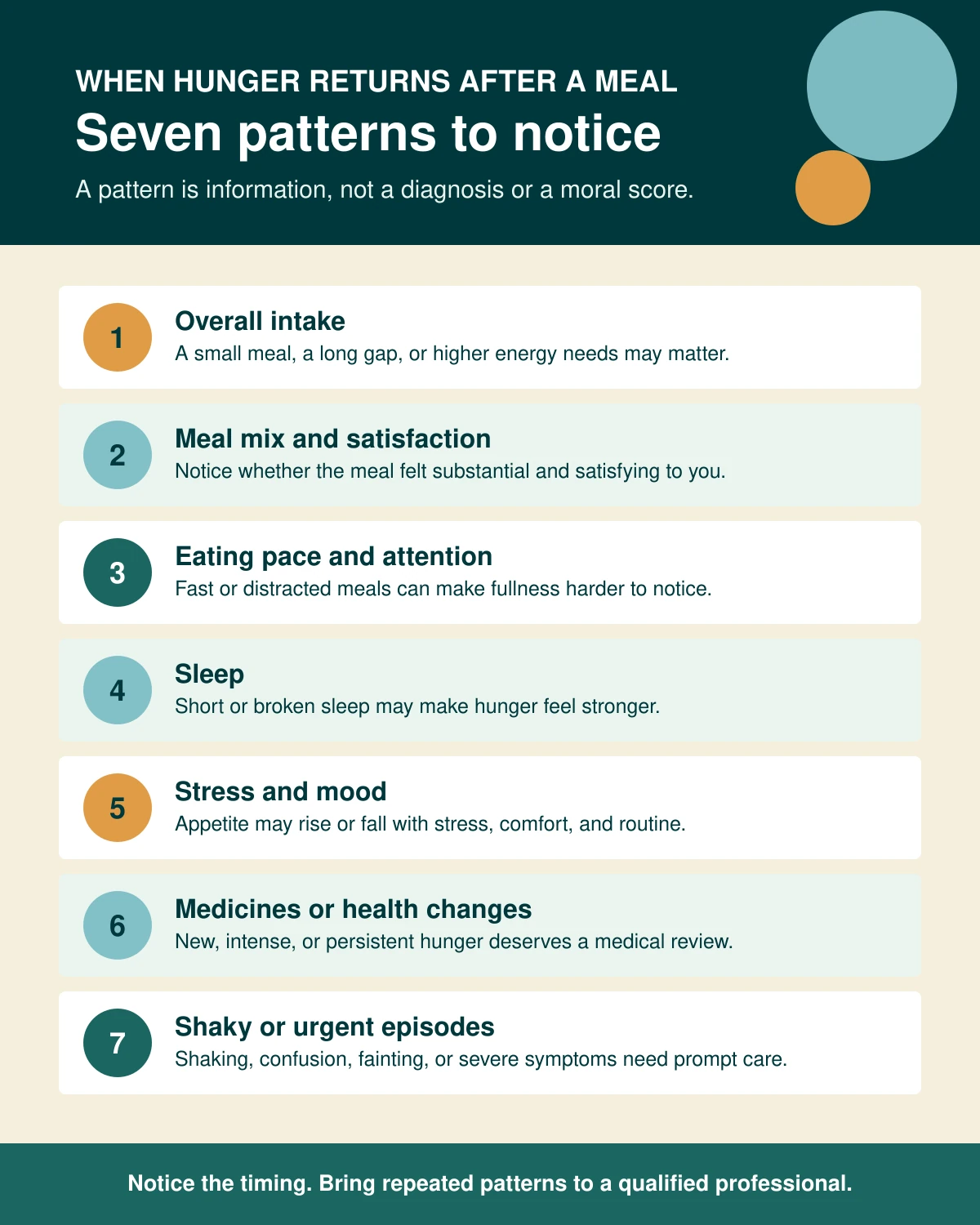
Seven Reasons Hunger May Return After a Meal
1. The meal or the day may not have met your needs
Sometimes the plain answer is that your body needs more food. A small meal, a long gap between meals, a busy day, more activity, or eating less than usual can all leave you hungry again sooner. Restrictive dieting can also raise hunger and make thoughts about food louder.
This is not a cue to calculate a perfect number. Instead, ask whether the meal felt substantial and whether you have eaten enough across the day. People who are pregnant, breastfeeding, healing from illness, training hard, or managing a health condition may have different needs and should get individual guidance.
2. The meal may have been less satisfying for you
Meals differ in how long they keep you satisfied. Protein, fiber-rich foods, carbohydrates, and fats each play a part in nourishment and fullness. A meal made mostly of a quick snack or a drink may not hold you as long as a mixed meal.
That does not mean carbohydrates are bad or that every plate needs a fixed formula. You can simply notice whether adding a food you enjoy from a missing group changes how long you stay full. A registered dietitian can help when allergies, digestive symptoms, diabetes, kidney disease, pregnancy, or a history of disordered eating make general advice too simple.
3. Eating speed and attention may affect when fullness registers
Fullness tends to become clearer as a meal goes on and for a short time afterward. Eating very quickly, or while working, driving, or scrolling, can make it harder to notice taste and satisfaction in the moment.
When your schedule allows, give the meal a little more time. That might mean sitting down, pausing once midway, or checking whether you still want more when the plate is empty. This is about noticing, not a rule to chew a set number of times or ignore hunger until a timer ends.
4. Poor sleep may make appetite feel stronger
Sleep supports the systems that regulate hunger and fullness. A 2019 review of 41 randomized trials found that sleep restriction raised self-reported hunger and led people to eat about 250 more calories a day on average. Even so, it found no strong evidence that sleep loss changed the appetite hormones leptin or ghrelin. A 2026 review also found that effects on appetite were inconsistent from study to study.
So poor sleep may add to hunger or food interest for some people, but it does not explain every episode. If hunger is worse after short or broken sleep, note that and look at the sleep problem on its own. NuWell’s article on feeling tired after sleeping enough covers that side of the pattern. If tired days also bring strong sweet cravings, see why you may crave sugar when tired.
5. Stress, mood, and learned cues can shape appetite
Stress raises appetite for some people and lowers it for others. Food can also become linked to relief, routine, connection, celebration, or comfort. Those links are part of being human, not a moral failure.
If eating feels urgent during stress, notice what happened just before the urge and what else you need besides food. Counseling can help when anxiety, low mood, trauma, binge eating, or body shame is part of the pattern. Similarly, mental-health-informed natural health support can complement counseling and medical care, but it does not replace either one.
6. A medicine or health condition may increase hunger
Some medicines can change appetite. MedlinePlus lists corticosteroids, cyproheptadine, and tricyclic antidepressants as examples. Other medicines can also affect hunger, weight, sleep, or blood glucose. Do not stop or change a medicine on your own; ask the prescriber or pharmacist whether the timing fits a known side effect.
Persistent hunger can also be a sign of diabetes. The National Institute of Diabetes and Digestive and Kidney Diseases (NIDDK) lists “feeling very hungry, even after you have eaten” as a symptom, along with increased thirst, frequent urination, fatigue, blurred vision, sores that do not heal, and frequent infections. Unexplained weight loss can also occur, especially with type 1 diabetes. Symptoms alone cannot diagnose diabetes; a medical professional needs to test for it.
An overactive thyroid can cause weight loss despite an increased appetite, along with a fast or irregular heartbeat, nervousness, sweating or trouble tolerating heat, frequent bowel movements, muscle weakness, or trouble sleeping. Other medical and hormonal causes are possible too, and a clinician can decide which questions and tests fit your history.
7. A shaky episode may need a different kind of assessment
Hunger with shaking, dizziness, confusion, or a fast heartbeat can be a sign of low blood glucose. According to the NIDDK, this is common in people with type 1 diabetes and in people with type 2 diabetes who take insulin or some other diabetes medicines. These symptoms can also overlap with anxiety, medication effects, dehydration, and other concerns.
Don’t assume that every hungry or shaky feeling is “reactive hypoglycemia.” If you have diabetes, follow the low-glucose plan from your care team. If you don’t have diabetes and episodes keep happening, ask a medical professional how to have them checked. NuWell’s guide to how low blood sugar can feel like anxiety explains why symptoms and context both matter.
What You Can Notice Without Starting a Restrictive Diet
A short record for a few days may help you see why you feel hungry after eating. You might note:
- When hunger returns and what the feeling is like.
- What else is happening, such as shakiness, thirst, fatigue, pain, or a racing heart.
- Rough meal timing and whether the meal included foods you find satisfying.
- How long and how well you slept.
- Stress, mood, activity, illness, and menstrual-cycle timing when relevant.
- Medicines or supplements taken near the episode, without changing them.
Bring the pattern to a primary-care professional or registered dietitian. If your main concern is feeling tired after eating rather than hungry, NuWell’s guide to post-meal energy dips covers that question.
Skip the log if tracking could intensify an eating disorder or health anxiety. Likewise, stop detailed food tracking if it leads to fear, guilt, rigid rules, bingeing, purging, or constant body checking, and tell a medical or mental-health professional what is happening. Specialized eating-disorder care may be the right level of support.
When Persistent Hunger Needs Medical Care
Make a medical appointment when hunger is new, unexplained, intense, or persistent, or when it keeps disrupting sleep or daily life. In addition, contact a clinician sooner when hunger comes with any of the signs below.
- Increased thirst or frequent urination
- Weight loss you can’t explain
- Blurred vision, repeated infections, sores that don’t heal, or marked fatigue
- A fast or irregular heartbeat, tremor, heavy sweating, or trouble tolerating heat
- Repeated shaking, dizziness, confusion, or faintness
- A recent medicine or dose change
- Pregnancy, diabetes, or a history of an eating disorder
When to Seek Urgent Help
How NuWell Can Help You Look at the Whole Pattern
Persistent hunger can sit where nutrition, sleep, stress, mood, metabolism, medicines, and daily life meet. NuWell’s whole-person weight and metabolic-health support looks at those pieces together, without treating body size as a moral score.
A NuWell practitioner can help you organize your history, eating patterns, sleep, stress, symptoms, existing results, medicines and supplements, goals, and the care you already receive. Recommendations are personalized. Testing and supplements are not automatic, and NuWell does not diagnose diabetes, thyroid disease, an eating disorder, or any other medical condition.
Looking for root causes here means exploring possible contributing factors, not promising one hidden cause or a specific outcome. NuWell’s non-clinical services complement medical care, counseling, psychiatric care, and nutrition care. Faith or spiritual well-being is included only if you want it, and no particular belief is required.
Frequently Asked Questions
Is it normal to feel hungry soon after eating?
It can happen now and then, especially after a smaller meal, a more active day, a long gap without food, poor sleep, or changing energy needs. Hunger that is new, intense, persistent, or paired with other symptoms deserves a medical conversation.
Does feeling hungry after eating mean I have diabetes?
No. Hunger after eating has many possible explanations. Diabetes can cause increased hunger, especially along with thirst, frequent urination, fatigue, blurred vision, frequent infections, or unexplained weight loss. Only a medical professional can diagnose diabetes, using the right tests.
Should I cut carbohydrates if I am still hungry after a meal?
Not based on this symptom alone. Carbohydrates are a normal source of energy. You may find a mixed meal more satisfying, but the right approach depends on your needs, preferences, medical history, and relationship with food. Avoid cutting out a food group without individual guidance.
Can stress make me feel hungry after eating?
Yes. Stress can push appetite up or down, and it can make food more appealing as comfort, distraction, or routine. If stress-related eating feels urgent, distressing, or hard to control, counseling and appropriate medical or nutrition support can help.
Sources
- Symptoms & Causes of Diabetes. National Institute of Diabetes and Digestive and Kidney Diseases.
- Hyperthyroidism (Overactive Thyroid). National Institute of Diabetes and Digestive and Kidney Diseases.
- Low Blood Glucose (Hypoglycemia). National Institute of Diabetes and Digestive and Kidney Diseases.
- Appetite – increased. MedlinePlus, U.S. National Library of Medicine.
- Effects of sleep restriction on metabolism-related parameters in healthy adults: a comprehensive review and meta-analysis of randomized controlled trials. Zhu B, Shi C, Park CG, Zhao X, Reutrakul S. Sleep Medicine Reviews. 2019;45:18-30.
- Does Sleep Curtailment Stimulate Appetite, Motivation to Eat and Dietary Intake in Humans? Tan SY, et al. Journal of Sleep Research. 2026;35(5):e70358.