

Is a Food Sensitivity Saliva Test Worth It? Here’s What You Need to Know
A food sensitivity saliva test is a non-invasive way to detect immune reactions to specific foods by measuring antibodies — primarily IgE and IgG1 — found in your saliva rather than your blood.
Quick answer for those evaluating saliva-based food sensitivity tests:
- What it tests: IgE (immediate allergic response) and IgG1 (delayed sensitivity response) antibodies in saliva
- How it works: A simple saliva swab collected at home; no needles, no lab visit
- Who it’s for: People with recurring symptoms like bloating, headaches, skin issues, or fatigue after eating
- How accurate is it: Research shows saliva-based ELISA testing can match serum (blood) results for most common food antigens, with no statistically significant difference for 12 of 14 foods tested in one key study
- Key limitation: It is not a diagnostic tool for food allergies, celiac disease, or lactose intolerance — results should guide, not replace, clinical evaluation
- Best next step: Use results to guide a structured elimination diet with the support of a qualified health practitioner
More people than ever are connecting their everyday symptoms — the afternoon brain fog, the stubborn bloating, the skin flare-ups that come and go — to what they’re eating. And with over 220 million people worldwide affected by food sensitivities, that instinct is worth taking seriously.
The challenge? Figuring out which foods are the problem. Traditional blood draws can feel like a barrier, especially for children or anyone who dislikes needles. That’s where saliva-based testing has gained real attention as a gentler, more accessible option.
But does it actually work? At NuWell Health, we have found that clients are often surprised to learn there is meaningful science behind salivary antibody testing — and equally surprised to learn where its limits lie.
This guide walks through both sides honestly.
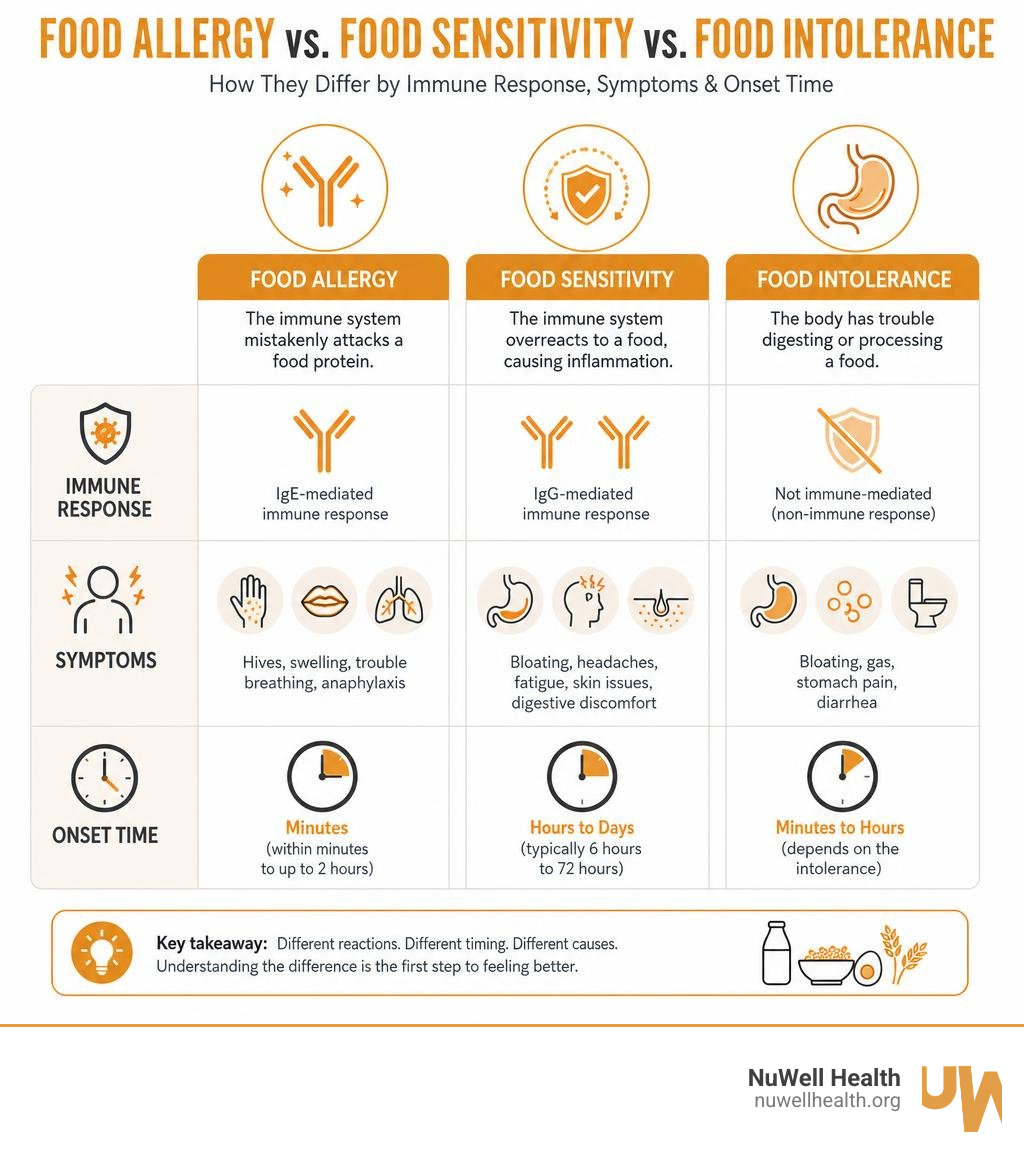
Related content about food sensitivity saliva test:
Understanding the Science Behind a Food Sensitivity Saliva Test

To understand how a food sensitivity saliva test works, we have to look at the immune system of your mouth. Your digestive tract doesn’t start in your stomach; it starts the moment food touches your tongue. Because your mouth is a primary gateway to the outside world, it is heavily guarded by your immune system.
Saliva is far more than just water and digestive enzymes. It is rich in immunoglobulins (antibodies) that serve as your body’s first line of defense. When we talk about food sensitivities, we are looking at how these salivary immunoglobulins react to specific food proteins.
In a healthy system, a process called oral tolerance allows your body to recognize food as harmless fuel rather than a foreign invader. However, when the mucosal barrier of the mouth or gut is compromised, or when the immune system is hyper-reactive, it begins producing antibodies against these everyday foods. A saliva-based test captures these local immune markers, reflecting the state of your mucosal immunity.
How Salivary IgE and IgG1 Detect Food Reactions
When your immune system decides a food protein is an enemy, it deploys specific types of antibodies to fight it. Traditionally, doctors have measured these antibodies in the blood, but modern science has confirmed that they are also present and measurable in your saliva.
Two primary immunoglobulins are analyzed in high-quality saliva panels:
- IgE (Immunoglobulin E): These antibodies are responsible for immediate, classic allergic reactions (Type I hypersensitivity). If you eat a peanut and your throat immediately begins to itch, IgE is at work.
- IgG1 (Immunoglobulin G Subclass 1): These antibodies are associated with delayed hypersensitivity and inflammatory responses. Reactions mediated by IgG1 can take anywhere from 3 to 72 hours to manifest, making them incredibly difficult to pinpoint without testing.
For years, skeptics questioned whether salivary levels of these antibodies matched what was happening deeper in the body. However, landmark research published in PLOS One, titled Detection of serum and salivary IgE and IgG1 immunoglobulins specific for diagnosis of food allergy | PLOS One , demonstrated that the detection of IgE and IgG1 in saliva is remarkably efficient.
The study found no statistical difference between serum (blood) and saliva results for 12 of the 14 foods tested. This suggests that saliva-based testing is a highly viable, scientifically backed method for identifying both immediate and delayed food reactions.
Common Foods Analyzed in Salivary Panels
Saliva food sensitivity panels typically focus on the foods most likely to trigger an immune response. These include the “big offenders” that dominate both pediatric and adult sensitivities:
- Cow’s milk: One of the most common triggers for both immediate allergies and delayed digestive issues.
- Wheat and Gluten: Highly associated with mucosal irritation and systemic inflammation.
- Egg white: A frequent culprit in childhood sensitivities.
- Shellfish and Fish: Known for triggering robust IgE and IgG responses.
- Peanuts and Tree nuts: Highly reactive proteins that are easily detected in salivary fluids.
- Soy and Corn: Common dietary proteins that frequently cause delayed digestive distress and can be addressed through natural, whole-food dietary adjustments.
Testing these specific foods helps narrow down the search space. Instead of guessing which of the dozens of foods you ate this week caused your headache, a salivary panel targets these primary suspects. To learn more about how these panels are structured to find your specific triggers, read our guide on Food Sensitivity Screening: A Guide to Finding Your Perfect Match.
Who Should Consider a Food Sensitivity Saliva Test?
If you feel like a detective constantly trying to solve the mystery of your own symptoms, you are not alone. Roughly 15% to 20% of the population suffers from food intolerances and sensitivities that disrupt daily life.
At NuWell Health, our clinical experience has shown that a saliva test is an exceptionally practical, non-invasive starting point for individuals dealing with:
- Chronic digestive complaints: Persistent bloating, gas, abdominal pain, diarrhea, or constipation that doesn’t seem to have a clear medical cause.
- Systemic inflammation: Unexplained joint pain, muscle aches, or mild but chronic swelling.
- Neurological symptoms: Frequent migraines, tension headaches, or the dreaded “brain fog” that leaves you feeling disconnected.
- Skin issues: Eczema flare-ups, unexplained rashes, or persistent adult acne.
- Energy crashes: Feeling completely exhausted a few hours after eating, even if you got a full night’s sleep.
If you suspect your diet is holding your health hostage, taking a non-invasive step to screen for these reactions can provide the clarity you need. For a deeper look at how these symptoms connect to your immune system, explore our resource on Allergies and Food Sensitivity.
How Saliva Testing Compares to Traditional Blood Tests

When deciding how to screen for food sensitivities, the most common comparison is between saliva testing and blood-based testing. Blood testing typically comes in two forms: a standard venous blood draw (serum testing) or an at-home finger-prick blood test.
To help you evaluate which option is right for you, here is a direct comparison of how a food sensitivity saliva test stacks up against traditional blood-based methods:
| Feature | Saliva-Based Test | At-Home Finger-Prick (Blood) | Venous Blood Draw (Serum) |
|---|---|---|---|
| Collection Method | Saliva swab or spit vial | Finger-prick lancet | Needle draw from vein |
| Pain Level | Completely painless | Minor sting/discomfort | Moderate discomfort |
| Convenience | Extremely high (at home) | High (at home) | Low (requires lab visit) |
| Primary Markers | IgE & IgG1 | IgG (often total IgG or IgG4) | IgE, IgG, IgA, Complement |
| Pediatric Suitability | Excellent (ideal for infants/toddlers) | Moderate (can be difficult for kids) | Low (highly stressful for children) |
| Scientific Validation | High for mucosal/local reactions | High for systemic IgG reactions | Gold standard for systemic immunology |
Accuracy, Reliability, and Pediatric Suitability
One of the greatest advantages of saliva testing is its suitability for children. Approximately 8% of infants and 5% of adults worldwide present with an allergy or sensitivity to at least one food. For a parent, trying to get a toddler to sit still for a venous blood draw can be a traumatic experience for everyone involved.
Because saliva collection is entirely non-invasive, it removes the fear and resistance from the testing process. This makes it incredibly easy to screen young children for common issues like cow’s milk protein allergy or egg sensitivities without tears.
In terms of diagnostic accuracy, modern salivary ELISA (Enzyme-Linked Immunosorbent Assay) technology has proven to be highly reliable. As noted in the PLOS One study, salivary testing demonstrated a 100% sensitivity and specificity rate when compared to traditional RAST (radioallergosorbent) blood testing for cow’s milk protein allergy. This means you do not have to sacrifice clinical accuracy for the sake of comfort. For more context on choosing the right gut and sensitivity tests for your family, see Everything You Need to Know About Testing Your Gut for Food Sensitivities.
Limitations and Controversies of the Food Sensitivity Saliva Test
At NuWell Health, our clinical experience has shown that while saliva testing is an invaluable tool, we must always interpret results within the context of a client’s complete health history. We believe in absolute transparency, and there are controversies and limitations surrounding all forms of food sensitivity testing that you should understand before purchasing a kit.
First, standard medical consensus remains cautious. Traditional allergy boards often emphasize that IgG-based tests (whether blood or saliva) measure exposure rather than a true, life-threatening allergy. They point out that high IgG levels can sometimes represent tolerance—meaning your body has successfully created antibodies to keep a food from causing an acute reaction.
This is why we must differentiate between:
- IgG4: Often a marker of clinical tolerance (which is why some tests that measure total IgG can be misleading if they don’t separate subclasses).
- IgG1-3: Subclasses that actively bind complement and drive inflammatory pathways.
Additionally, false positives and false negatives can occur with any test. If you have avoided a food for six months, your body may have stopped producing detectable levels of antibodies against it, resulting in a false negative. Conversely, if you eat massive amounts of almonds every single day, your salivary IgG1 levels for almonds might look elevated simply because of constant exposure, even if they aren’t causing your symptoms.
To navigate these nuances, it is helpful to look at a variety of testing methodologies, from comprehensive stool analyses to specialized antibody panels or at-home testing kits. Some clinics also utilize rapid, near-patient tests for in-office insights.
No single test is a magic wand. The goal of a saliva test is to give you a highly educated starting point, not a permanent list of foods to banish forever. To understand how to place these results in the proper context, read The Definitive Guide to Food Sensitivity Testing.
What Do Your Salivary Antibody Results Actually Mean?
When your test results arrive, they can look a bit overwhelming. You will likely see a list of foods rated on a scale from “No Reactivity” to “High Reactivity.”
At NuWell Health, we have found that the most important thing to remember when looking at these results is that they are a snapshot of your immune system’s current relationship with your food—not a life sentence.
High reactivity scores generally point to two possibilities:
- A specific food trigger: The food protein is actively irritating your immune system and causing inflammatory symptoms.
- Intestinal permeability (Leaky Gut): If you test positive for dozens of seemingly random, healthy foods, the root issue is likely a compromised gut barrier. When the lining of your gut is “leaky,” undigested food particles slip into the bloodstream and lymphatic system, triggering a widespread immune response. In these cases, the goal is to heal the gut barrier so your oral tolerance can be restored.
Interpreting IgE vs. IgG1 Reactivity
Understanding the difference between the two primary markers on your test is crucial for protecting your health:
- High IgE Levels: This indicates an immediate hypersensitivity. If a food shows high IgE reactivity, it means your body treats it as a true allergen. These foods should be treated with extreme caution, as they have the potential to trigger severe, immediate symptoms.
- High IgG1 Levels: This indicates a delayed inflammatory response. These are your “sensitivity” foods. They won’t cause anaphylaxis, but they can slowly build up immune complexes in your tissues, leading to chronic joint pain, brain fog, or bloating days after you eat them.
Because these pathways are so different, interpreting them correctly requires a skilled eye. Working with a professional ensures you don’t accidentally restrict your diet to a dangerous degree or miss a critical gut-healing opportunity. If you need help finding the right practitioner to guide you, check out The Ultimate Guide to Finding a Food Sensitivity Specialist.
Actionable Next Steps and Dietary Protocols
So, you have your results in hand. What do you actually do with them?
We never recommend simply cutting out every food that showed a yellow or red mark on your test and calling it a day. That approach can lead to nutrient deficiencies and a stressful relationship with food. Instead, we recommend a structured, two-part protocol:
Step 1: The Temporary Elimination Phase
Under the guidance of a practitioner, temporarily remove the highly reactive foods (typically for a period of 4 to 12 weeks). During this time, focus on anti-inflammatory nutrition—loading your plate with whole, gut-supportive foods that you did not react to. This gives your immune system a chance to calm down and allows your gut barrier to begin healing.
Step 2: The Systematic Reintroduction Phase
This is where the real magic happens. One by one, you will reintroduce the eliminated foods back into your diet while carefully tracking your symptoms. This step helps you separate “true” triggers from foods that were only showing up as reactive because your gut was temporarily irritated.
Using structured home testing kits or specialized salivary panels can provide the exact data map you need to navigate this process successfully.
Frequently Asked Questions About Salivary Testing
Can a saliva test diagnose celiac disease or lactose intolerance?
No. A food sensitivity saliva test measures immune responses (IgE and IgG1 antibodies). Celiac disease is an autoimmune condition that requires specific blood antibody tests (such as tTG-IgA) and a confirmatory biopsy. Lactose intolerance is not an immune reaction at all; it is an enzyme deficiency (a lack of lactase) that prevents your body from breaking down milk sugar.
Do I need to eat reactive foods before taking the test?
Yes, to an extent. Because these tests measure the antibodies your body produces in response to food, you must have had recent exposure to those foods for the antibodies to be present in your saliva. If you have strictly avoided wheat for the last six months, your test will likely show no reactivity to wheat, even if it is a major trigger for you. If you are safe to do so (meaning you do not have a life-threatening allergy), we generally recommend consuming a normal, varied diet for a few weeks leading up to your test.
Is saliva testing suitable for young children?
Absolutely. In fact, it is one of the best applications for this technology. Because it requires no needles or painful finger pricks, it is a stress-free way to screen infants and young children for common mucosal sensitivities, such as cow’s milk protein allergy or egg sensitivities.
Conclusion
At NuWell Health, we believe that true wellness is a holistic journey. We are designed to live vibrant, abundant lives, but chronic inflammation and unrecognized food sensitivities can easily quiet that vitality.
While a food sensitivity saliva test is not a standalone cure, it is an incredibly powerful, non-invasive tool that honors your body’s unique design. By listening to the subtle clues your immune system leaves in your salivary fluids, we can stop guessing and start addressing the root causes of your symptoms.
At NuWell Health, we have found that when we combine the objective data of advanced testing with a compassionate, root-cause approach to nutrition and lifestyle, our clients experience profound shifts. We don’t just want to help you clear up your skin or soothe your digestion—we want to help restore your spirit, mind, and body so you can live the life you were created for.
If you are ready to stop guessing and start healing, we are here to walk beside you.
Explore our holistic allergy and food sensitivity support today, and let’s take the first step toward true, lasting wellness together.
This article was researched with AI and heavily edited by Jordan Oliver for accuracy and relevance.
Jordan is an author, ordained minister, and online host for His Glory TV, sharing biblically grounded insights on faith, prayer, and spiritual growth. She is the co-founder of Triple-Braided Cord Co., an intercessory prayer and healing ministry inspired by Ecclesiastes 4:12.
Jordan holds a Bachelor’s degree in Communications and Religious Studies from High Point University and is a certified Spiritual Life Coach through iCoachLife in Nashville, Tennessee. Drawing from her ministry, coaching, and academic experience, she creates trustworthy, faith-based content that helps readers grow in their relationship with God. Learn more about Jordan here.