

Why Christian Faith and Healing Go Hand in Hand
Christian faith and healing are deeply connected — not just as a theological idea, but as a lived reality for millions of people navigating illness, trauma, and chronic suffering.
Here is a quick answer to what most people want to know:
What does Christian faith say about healing?
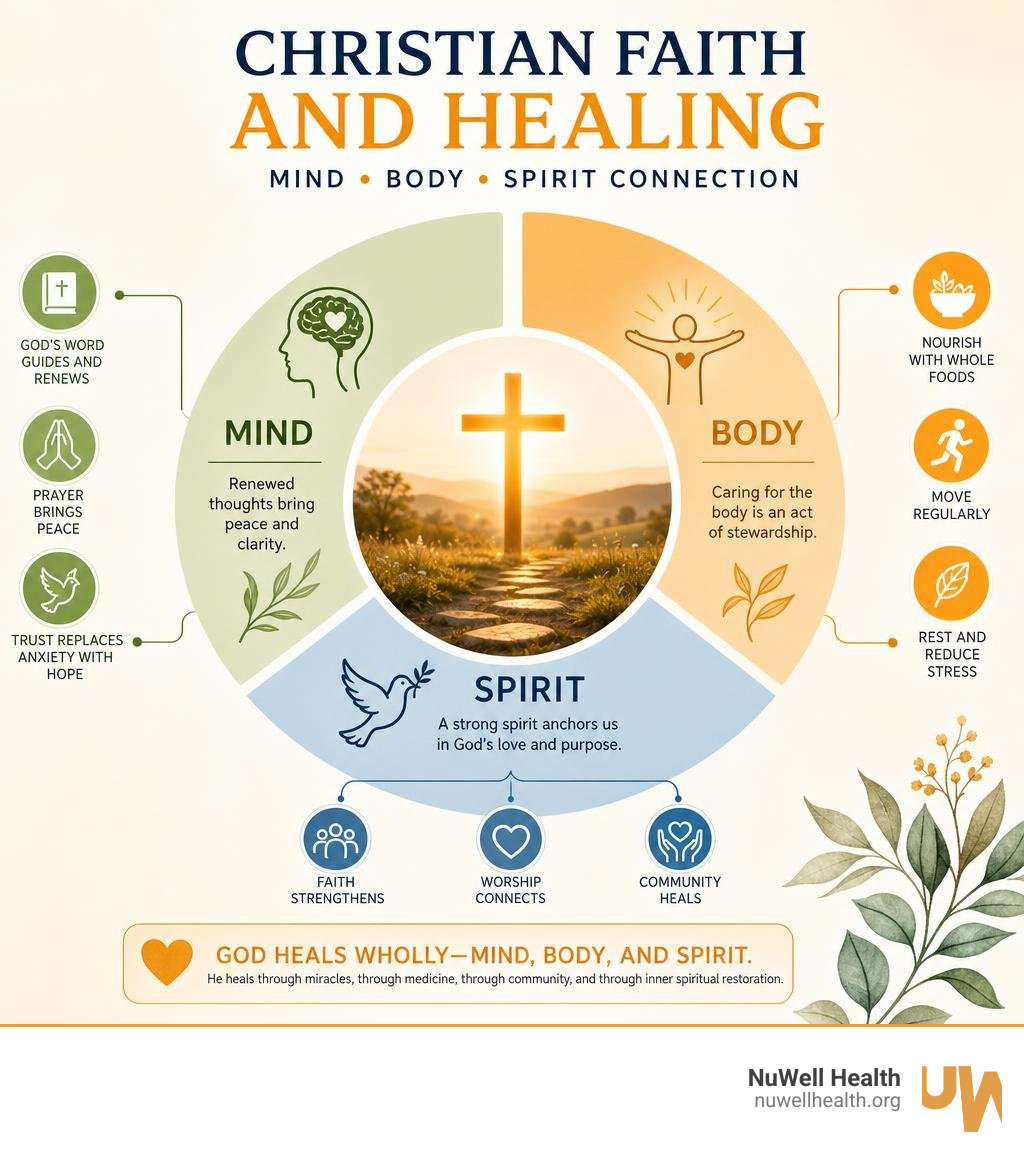
- God heals — through miracles, through medicine, through community, and through inner spiritual restoration
- Physical healing is real and biblical, but God’s healing is often bigger than the physical
- A lack of healing does not mean a lack of faith or hidden sin
- Suffering can coexist with deep faith, as seen in Paul, Job, and many others
- Complete healing — body, mind, and spirit — is part of God’s ultimate plan for His people
This is not a simple topic. If you have ever prayed desperately for healing and felt silence in return, you are not alone. Joni Eareckson Tada, who has lived with quadriplegia and chronic pain for decades, wrestled openly with the question “God, why won’t you heal me?” — and found that God’s answer was not what she expected, but it was still an answer.
Through our direct experience supporting individuals at NuWell Health, we have found that the most lasting healing — physical and mental — happens when faith, natural health practices, and wise stewardship of the body work together.
This guide walks you through what Scripture actually teaches, how to find strength when healing feels distant, and how to build a whole-person wellness approach rooted in Christian faith.
Relevant articles related to christian faith and healing:
Biblical Foundations of Christian Faith and Healing
To build a healthy, balanced perspective on wellness, we must first look at the foundations of Scripture. The relationship between faith, health, and restoration is woven throughout the entire biblical narrative. From the creation of the world to the promised restoration of all things, God reveals Himself as a healer who cares deeply about our physical, emotional, and spiritual well-being.
In the Christian worldview, humanity possesses a two-fold nature: physical and spiritual. Because of this, any complete plan of redemption must address both sides of our existence. We see this beautifully illustrated in the ministry of Jesus Christ, who did not merely preach a message of spiritual salvation but actively restored broken bodies, minds, and lives.
To explore this further, we can look to resources like A Biblical perspective on Faith and Healing | Joni and Friends, which emphasizes that divine healing is sovereignly determined by God and often defies simple human formulas.
Old Testament Covenant and the Promise of Restoration
The foundation of God’s healing nature is established early in the Old Testament. Following the dramatic rescue of Israel from Egypt, God entered into a covenant relationship with His people. In Exodus 15:26, He declared, “I am the Lord, who heals you” (Yahweh Rapha). This covenant of healing was not a fleeting promise; it was foundational to Israel’s identity and journey.
Scripture abounds with declarations of God’s desire to restore. In Psalm 103:2–3, David writes: “Praise the Lord, my soul, and forget not all his benefits—who forgives all your sins and heals all your diseases.” Here, forgiveness and physical restoration are beautifully paired, showing that God views the human person holistically.
Perhaps the most profound prophetic foundation for healing is found in Isaiah 53:4–5:
“Surely he took up our pain and bore our suffering… and by his wounds we are healed.”
This passage, which points directly to the sacrificial work of Jesus Christ on the cross, shows that our physical infirmities and spiritual brokenness were both carried by the Savior.
New Testament Miracles and the Ministry of Jesus
When Jesus began His public ministry, physical healing was not a side project; it was an integral sign of the arrival of the Kingdom of God. The Gospels record Jesus healing all types of illnesses: leprosy, blindness, paralysis, chronic hemorrhages, and mental afflictions.
In Matthew 8:17, the writer explicitly links Jesus’ healing ministry to the fulfillment of Isaiah’s prophecy: “He took up our infirmities and bore our diseases.” We see this active power at work in stories like:
- The Healing of the Paralytic (Mark 2): Where Jesus famously addresses both the man’s physical paralysis and his spiritual need for forgiveness, showing that holistic restoration is always His priority.
- The Blind Man (John 9): Where Jesus heals a man born blind, explicitly refuting the idea that his disability was caused by personal or parental sin.
- The Centurion’s Servant (Matthew 8): Where Jesus marvels at the faith of a Roman military leader who recognized Christ’s absolute authority over sickness.
As F.F. Bosworth teaches in his influential book Christ the Healer, understanding God’s willingness to heal is key to establishing a firm foundation of faith. Bosworth argues that the Word of God acts as a “seed” that must be planted in our hearts and nurtured. When we cultivate a childlike trust in Jesus’ authority, we align ourselves with His restoring power.
Understanding God’s Sovereignty: Why Healing is Not Always Physical
While the Bible is filled with incredible promises of physical restoration, we also live in a fallen, broken world where things do not always go according to our desires. This is one of the hardest realities for any believer to face: Why does God heal some people while others continue to suffer, even when they pray with deep, sincere faith?
To understand this, we must look at the biblical concept of God’s sovereignty. God is all-powerful, but He is also all-wise. His ultimate goal for our lives is not merely our temporary physical comfort, but our eternal, spiritual transformation.

Dispelling the Myth of Sin and Lack of Faith
One of the most damaging teachings in some modern circles is the idea that if you are not physically healed, it must be because you lack faith, have unconfessed sin, or did not “claim” your healing correctly. This “name it and claim it” mindset often leads to intense feelings of shame, guilt, and spiritual isolation.
Scripture soundly refutes this view:
- John 9: When the disciples asked Jesus who sinned to cause a man’s blindness, Jesus answered, “Neither this man nor his parents sinned, but this happened so that the works of God might be displayed in him.”
- Job: Job was described as blameless and upright, yet he endured devastating physical suffering and loss. His “friends” accused him of hidden sins, but God ultimately rebuked them.
- The Apostle Paul: Paul pleaded with God three times to remove a persistent “thorn in his flesh” (2 Corinthians 12). God’s response was not physical relief, but a promise of grace: “My grace is sufficient for you, for my power is made perfect in weakness.”
As outlined in the Divine Healing | Assemblies of God (USA) position paper, divine healing is a gift of God’s grace, not something we earn through perfect behavior or emotional performance. Sickness entered the world generally through the Fall of humanity, but individual sickness is rarely a direct result of specific personal sins.
When we shift the blame away from the suffering individual, we create a safe, compassionate space for true healing to occur.
Finding Spiritual Restoration and Soul Care
When physical healing does not manifest, God often does a much deeper work of restoration within our souls. This is the difference between being cured (having a physical ailment removed) and being healed (being made whole in our relationship with God, ourselves, and others).
Through our hands-on work with clients at NuWell Health, we have seen firsthand that true wellness requires looking beyond physical symptoms to address the root spiritual and emotional causes of our pain. In our practice, we have witnessed how practicing intentional soul care allows individuals to experience profound peace even in the midst of physical limitations.
If you are looking to cultivate this deeper, inner restoration, we encourage you to explore our guide on how to Cleanse Your Soul: A Guide to Total Healing. When we surrender our pain to God, He uses our trials to refine our character, deepen our empathy, and anchor our hope in the eternal rather than the temporary.
The Role of Community, Prayer, and Forgiveness in Recovery
Healing is not meant to be a solitary journey. God designed us for relationship, and He often uses the love, support, and prayers of a faith community to bring about physical and emotional restoration.

The Power of Intercessory Prayer and Anointing
The New Testament provides clear, practical instructions on how the church should respond to illness. In James 5:14–15, we are told:
“Is anyone among you sick? Let them call the elders of the church to pray over them and anoint them with oil in the name of the Lord. And the prayer offered in faith will make the sick person well…”
This passage highlights several key principles:
- Humility: The sick person must reach out and ask for help, acknowledging their vulnerability.
- Anointing with Oil: Anointing was a physical act of consecration, setting the person apart for God’s special care and attention.
- Corporate Faith: It is the faith of the community and the elders, not just the sick individual, that carries the request to God’s throne.
In our daily practice at NuWell Health, we regularly observe how closely our physical bodies are connected to our spiritual state, seeing physical symptoms improve as spiritual peace is restored. To learn more about aligning your physical life with your spiritual foundation, read our resource on Alignment 101: Reconnecting Your Inner Self.
Forgiveness as a Pathway to Emotional and Physical Release
One of the most overlooked aspects of healing is the power of forgiveness. Chronic bitterness, anger, and resentment act as emotional toxins that can manifest as physical tension, digestive issues, and weakened immune systems.
When we forgive, we break the spiritual and emotional chains that bind us to our past pain. This act of surrender releases a profound sense of peace that can accelerate physical recovery. For a deeper look at resolving these internal emotional dynamics, explore our insights on Healing from Within: A Deep Dive into Mind Root Cause Treatments.
Integrating Modern Medicine with Natural Health Practices
A common debate among believers is whether seeking medical help shows a lack of faith in God’s healing power. Some historical movements have rejected medicine entirely, sometimes with tragic consequences. However, a balanced biblical perspective shows that God has provided both supernatural and natural means for our recovery.
| Perspective | Divine Healing (Supernatural) | Medical Care & Natural Health (Natural) |
|---|---|---|
| Source | God’s direct, miraculous intervention. | God’s wisdom given to humanity through science and nature. |
| Method | Prayer, anointing, laying on of hands, and faith. | Medicine, surgery, natural remedies, and lifestyle changes. |
| Role of Individual | Surrender, trust, and spiritual alignment. | Wise stewardship, obedience to health principles, and self-care. |
| Ultimate Goal | To display God’s glory and restore wholeness. | To care for the body as the temple of the Holy Spirit. |
As the history of Faith healing – Wikipedia shows, throughout Christian history, the most balanced traditions have always viewed doctors and medicine as gifts from God. Luke, the author of the Gospel of Luke and the Book of Acts, was himself a beloved physician.
Balancing Divine Trust with Christian Faith and Healing
At NuWell Health, we believe that taking care of your body is an act of worship. First Corinthians 6:19 reminds us that our bodies are temples of the Holy Spirit. Therefore, practicing a preventive lifestyle, eating nourishing foods, resting, and utilizing natural remedies are not signs of weak faith; they are expressions of excellent stewardship.
We do not have to choose between trusting God and using the practical tools He has placed in creation. We can pray for healing while also eating a balanced diet, exercising, and seeking professional medical advice when necessary.
To understand how your physical choices affect your spiritual vitality, read our article on Why Your Holistic Mind Body Spirit Connection Matters.
Empowered Root Cause Healing: A Christian Perspective on Natural Remedies
Many modern health issues stem from chronic stress, poor nutrition, environmental toxins, and a lack of spiritual peace. Rather than simply suppressing these physical symptoms with medication, we are called to look deeper.
In our years of clinical experience at NuWell Health, we have consistently observed that empowering individuals to take charge of their own health through natural, root-cause solutions yields the most sustainable results. We have walked alongside hundreds of believers who found that combining prayer and scripture with natural remedies honors the way God designed our bodies to heal.
To begin your journey of self-care and natural restoration, read The Power is Yours: A Guide to Empowered Root Cause Healing.
Cultivating Hope and Strength During Times of Suffering
When chronic illness or trauma persists, it can feel as though God has forgotten us. During these seasons of waiting, faith is not about having all the answers; it is about holding onto the hand of the One who does.
Finding Comfort and Peace in Christian Faith and Healing
The Bible does not ask us to put on a fake smile and pretend that pain does not hurt. The Psalms are filled with raw, honest cries of lament. Even Jesus wept at the tomb of His friend Lazarus, even though He knew He was about to raise him from the dead.
We can find comfort in knowing that:
- God is Near: Psalm 34:18 promises that “The Lord is close to the brokenhearted and saves those who are crushed in spirit.”
- Our Suffering is Temporary: In the light of eternity, our current trials are preparing us for an eternal weight of glory that far outweighs them all (2 Corinthians 4:17).
- Ultimate Redemption is Coming: The ultimate hope of the Christian faith is not just a healthy body in this life, but the resurrection of our bodies in the next, where there will be no more pain, sickness, or death (Revelation 21:4).
Frequently Asked Questions about Christian Faith and Healing
Does a lack of physical healing mean I don’t have enough faith?
Absolutely not. Some of the greatest heroes of the Christian faith — including the Apostle Paul, Timothy (who had frequent stomach ailments), and modern saints like Joni Eareckson Tada — lived with ongoing physical limitations. God’s power is often made perfect in our physical weakness. Healing is always based on God’s sovereign will and grace, not on our ability to generate a specific level of belief.
How should a Christian respond when prayers for healing are not answered?
First, allow yourself to grieve and lament honestly before God; He can handle your questions and your pain. Second, look for the ways He may be offering a deeper, spiritual healing in your soul. Finally, rest in the promise that even if physical restoration does not happen in this lifetime, ultimate, perfect healing is guaranteed for every believer in eternity.
Is it wrong for a Christian to seek medical treatment instead of relying solely on prayer?
No, it is not wrong. God is the source of all truth, including medical science and the natural healing properties found in creation. Seeking medical treatment and using natural remedies are wise ways to care for the body God has entrusted to you. We should pray for wisdom for our doctors and thank God for the medical resources available to us.
Conclusion
The journey of christian faith and healing is not a simple, one-size-fits-all formula. It is a relationship with a loving, sovereign Creator who cares about every aspect of your being — your body, your mind, and your soul.
Whether God chooses to bring healing through a sudden miracle, the gradual process of natural remedies, the skill of medical professionals, or the ultimate restoration of the resurrection, we can trust that His plans for us are good.
At NuWell Health, we are committed to walking alongside you on this journey toward holistic wellness. By integrating a deep Christian faith with practical, natural health practices, we can experience the abundant, restored life that God desires for each of us.
To learn more about our approach to whole-person wellness, visit our homepage at NuWell Health.
This article was researched with AI and heavily edited by Jordan Oliver for accuracy and relevance.
Jordan is an author, ordained minister, and online host for His Glory TV, sharing biblically grounded insights on faith, prayer, and spiritual growth. She is the co-founder of Triple-Braided Cord Co., an intercessory prayer and healing ministry inspired by Ecclesiastes 4:12.
Jordan holds a Bachelor’s degree in Communications and Religious Studies from High Point University and is a certified Spiritual Life Coach through iCoachLife in Nashville, Tennessee. Drawing from her ministry, coaching, and academic experience, she creates trustworthy, faith-based content that helps readers grow in their relationship with God. Learn more about Jordan here.