

Recognizing the CMPA Allergy Rash: Types, Appearance, and Symptoms
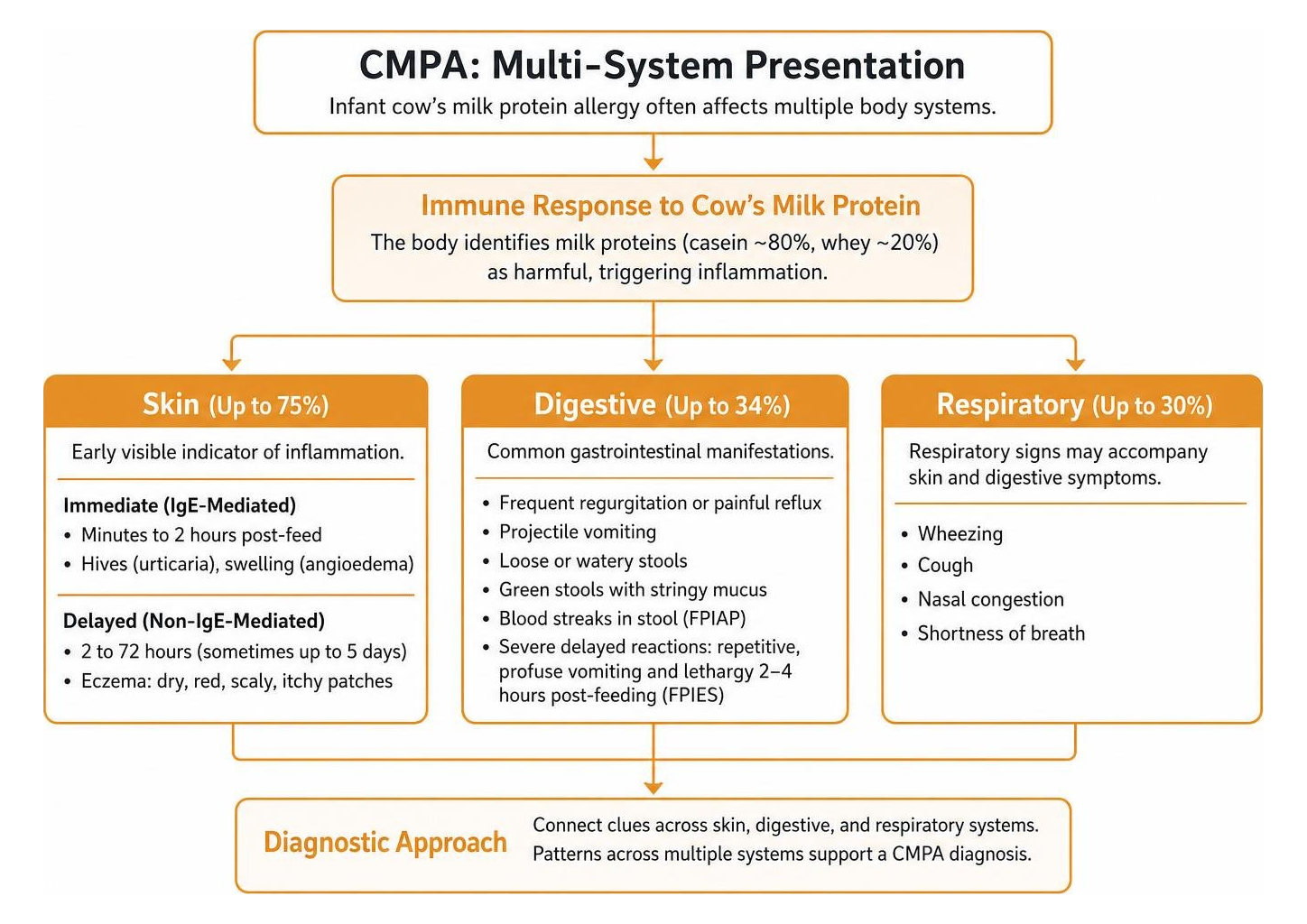
Up to 75% of infants with Cow’s Milk Protein Allergy (CMPA) present with cutaneous symptoms. Because a baby’s skin barrier is exceptionally thin and their immune system is rapidly developing, the skin often serves as an early visible indicator of internal inflammation. According to clinical research on cow’s milk protein allergy, the body identifies benign proteins in bovine milk—primarily casein (which makes up about 80% of milk protein) and whey (accounting for roughly 20%)—as harmful invaders.
When a sensitized infant comes into contact with these proteins, their immune system mounts an inflammatory response. The resulting skin manifestations typically fall into two primary categories: acute urticaria (hives) and atopic dermatitis (eczema). Recognizing how these skin responses develop helps differentiate an allergic reaction from transient newborn skin adaptations.
Immediate vs. Delayed CMPA Allergy Rash Responses
CMPA manifests along two distinct immunological pathways, each producing a different type of rash and symptom timeline:
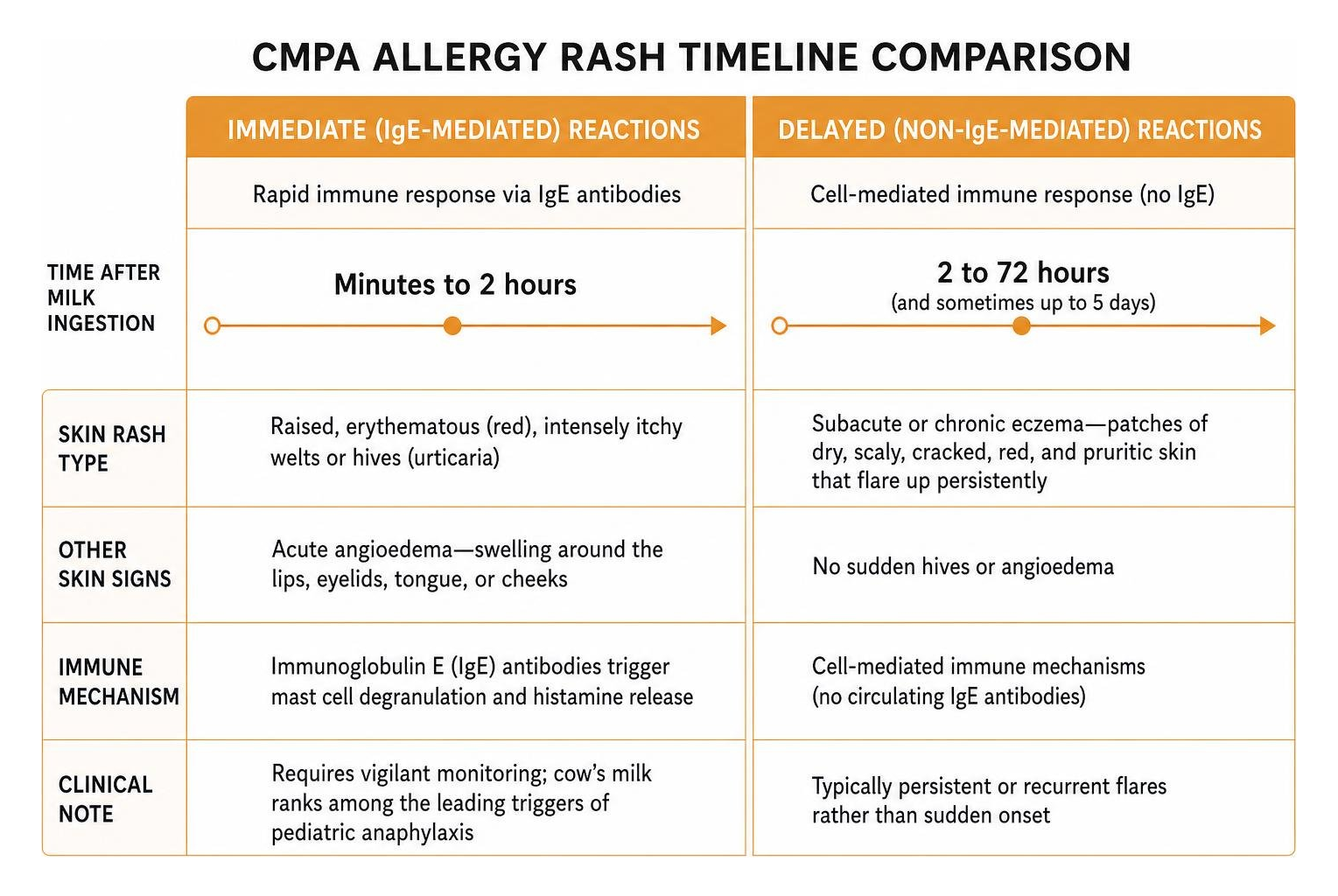
- Immediate (IgE-Mediated) Reactions: These occur when immunoglobulin E antibodies trigger rapid mast cell degranulation and histamine release. Symptoms appear quickly, typically within minutes to two hours following milk ingestion. The skin typically erupts in raised, erythematous (red), itchy welts or hives (urticaria). Parents may also observe acute angioedema—noticeable swelling around the lips, eyelids, tongue, or cheeks. These immediate reactions require vigilant monitoring, as cow’s milk ranks among the leading triggers of pediatric anaphylaxis.
- Delayed (Non-IgE-Mediated) Reactions: These involve cell-mediated immune mechanisms rather than circulating IgE antibodies. Delayed skin reactions do not produce sudden hives; instead, they appear between 2 and 72 hours (and sometimes up to 5 days) after milk protein exposure. They most commonly manifest as subacute or chronic eczema—patches of dry, scaly, cracked, red, and pruritic skin that flare up persistently. For guidance on supporting the skin barrier during chronic flares, explore A Practical Guide to Natural Dermatitis Treatment.
How to Differentiate a CMPA Allergy Rash from Other Infant Skin Conditions
Newborn skin frequently develops benign rashes during the first few months of life as oil glands adjust and skin flora establishes. Mistaking a harmless developmental rash for an allergy can lead to unnecessary dietary eliminations.
| Condition | Typical Onset | Visual Appearance | Typical Distribution | Associated Allergic Symptoms? |
|---|---|---|---|---|
| CMPA Rash (Hives / IgE) | Minutes to 2 hours post-feed | Raised, red-rimmed welts with pale centers; rapid swelling | Face, lips, trunk, or generalized | Yes: wheezing, acute vomiting, anaphylaxis risk |
| CMPA Rash (Eczema / Non-IgE) | 2 to 72 hours post-exposure | Dry, red, scaly, itchy rough patches | Cheeks, scalp, skin creases (elbows, behind knees) | Yes: reflux, mucous/bloody stool, chronic colic |
| Baby Acne (Neonatal Cephalic Pustulosis) | 2 to 6 weeks of age | Small red bumps or whiteheads; not itchy or painful | Cheeks, nose, forehead | No: baby is comfortable, digests normally |
| Cradle Cap (Seborrheic Dermatitis) | First 1 to 3 months | Thick, greasy, yellowish or crusty scales; non-pruritic | Scalp, eyebrows, behind the ears | No: entirely localized skin adaptation |
| Heat Rash (Miliaria) | Any age (warm conditions) | Tiny clear vesicles or red pinpoint bumps | Neck folds, chest, groin, back | No: resolves when the infant is cooled down |
| Erythema Toxicum Neonatorum | First few days of life | Blotchy red patches with tiny white or yellow central papules | Trunk, face, proximal extremities | No: benign, resolves spontaneously within days |
Accompanying Symptoms: Digestive, Respiratory, and Systemic Signs
Infants with a CMPA allergy rash rarely experience skin symptoms in complete isolation. Because the immune response is systemic, identifying clues across multiple bodily systems is key to confirming a diagnosis. Understanding dairy protein intolerance symptoms allows parents to spot patterns early.
Digestive and Respiratory Clues
Up to 34% of infants with CMPA exhibit gastrointestinal symptoms, while up to 30% present with respiratory signs. When evaluating a baby with a persistent rash, look for these concurrent markers outlined in pediatric milk allergy clinical guidelines:
- Digestive Manifestations: Frequent regurgitation or painful reflux, projectile vomiting, loose or watery stools, persistent green stools containing visible stringy mucus, or macroscopic blood streaks caused by Food Protein-Induced Allergic Proctocolitis (FPIAP). Severe delayed presentations can involve Food Protein-Induced Enterocolitis Syndrome (FPIES), characterized by repetitive, profuse vomiting and lethargy 2 to 4 hours post-feeding.
- Respiratory Signals: Chronic nasal congestion, recurrent runny nose unrelated to viral infections, persistent wheezing, coughing, or stridor.
- General Behavioral Distress: Inconsolable crying and colic lasting more than three hours a day, pulling the legs up to the abdomen, back arching during feeds, disturbed sleep architecture, and in chronic unmanaged cases, poor weight gain or failure to thrive.
CMPA in Exclusively Breastfed vs. Formula-Fed Babies
While CMPA is more prevalent in formula-fed infants, it can occur in exclusively breastfed infants.
- Breastfed Infants: Approximately 0.4% to 0.5% of exclusively breastfed babies develop CMPA. Intact maternal dietary proteins, such as alpha-s1-casein and beta-lactoglobulin, can pass through maternal gut tissue into circulation and appear in breast milk in trace amounts (roughly 100,000 times lower than in whole cow’s milk). Sensitized infants can still react to these microscopic peptide fragments.
- Formula-Fed Infants: Standard infant formulas contain concentrated bovine proteins. As a result, formula-fed infants often experience earlier onset, more acute symptoms, and higher reactivity. For a deeper look at gut-level immune reactions, read our food allergies and intolerances guide.
Clinical Diagnosis and Accurate Testing Methods
Diagnosing CMPA requires a systematic, evidence-based pathway. Unvalidated testing methods (such as direct-to-consumer IgG food sensitivity panels) are not medically indicated and frequently yield false positives, resulting in unnecessary food restrictions. For an overview of clinically validated testing methods, refer to The Definitive Guide to Food Sensitivity Testing.
Skin Prick and Blood Testing
Diagnostic testing differs based on the suspected immune pathway:
- Skin Prick Testing (SPT): Used primarily for immediate, IgE-mediated reactions. A tiny droplet of commercial milk extract or fresh cow’s milk is placed on the skin, and the epidermis is gently pricked. A positive result appears within 15 to 20 minutes as a raised wheal surrounded by redness.
- Serum Specific IgE (sIgE) Blood Tests: Measures the concentration of circulating IgE antibodies directed against whole cow’s milk or individual protein components (casein, alpha-lactalbumin, beta-lactoglobulin). This test is particularly valuable when extensive eczema or recent antihistamine use makes skin prick testing impractical.
- Limitations: These tests only detect IgE-mediated sensitization—not clinical allergy itself, and they are ineffective for non-IgE-mediated CMPA (which accounts for up to 70% of infant cases).
The Elimination and Home Challenge Protocol
For non-IgE-mediated CMPA, the diagnostic gold standard is a structured therapeutic elimination diet followed by a planned diagnostic reintroduction:
- Strict Elimination (2 to 4 Weeks): All cow’s milk proteins are removed from the infant’s diet. Formula-fed infants transition to an Extensively Hydrolyzed Formula (eHF) or, in severe cases, an Amino Acid Formula (AAF). For breastfed infants, the nursing mother eliminates all dairy products and hidden milk derivatives. Cutaneous symptoms typically improve within 1 to 2 weeks, while gastrointestinal symptoms resolve within 2 to 4 weeks.
- Planned Reintroduction Challenge: If symptoms clear, cow’s milk protein is reintroduced under medical guidance. A return of symptoms confirms the diagnosis of CMPA, ruling out coincidence or normal developmental changes.
Holistic and Medical Management for Infant Milk Allergy
Managing infant milk allergy involves both medical nutrition and gentle skin barrier support to keep your baby comfortable. At NuWell Health, we have found that addressing both internal triggers and external skin barrier integrity offers the most effective, lasting relief for sensitive infants.
Soothing Irritated Skin and Restoring the Barrier
Allergic skin reactions compromise the stratum corneum, allowing moisture to escape and environmental irritants to penetrate. To soothe inflammation and rebuild this natural defense:
- Lukewarm Cleansing: Bathe your baby in lukewarm water for 5 to 10 minutes. Avoid hot water, which strips natural lipids.
- Gentle Emollients: Within three minutes of bathing, gently pat the skin dry (do not rub) and apply a generous layer of fragrance-free, hypoallergenic emollient or ceramide cream to lock in hydration. For natural barrier support strategies, consult Natural treatments for eczema.
- Support Immune Homeostasis: Nourishing the body helps maintain healthy skin. Learn how immune pathways influence skin wellness in our guide on Eczema and the immune system balance.
- Physical Protection: Keep infant nails short and smooth to minimize skin trauma from scratching, and dress your baby in breathable, 100% organic cotton clothing.

Dietary Modifications and Tolerance Timelines
Eliminating dairy requires vigilance regarding ingredient labels. Cow’s milk derivatives appear under many names in packaged goods:
- Casein, caseinates (calcium, sodium, potassium, magnesium caseinate)
- Whey, whey protein concentrate, whey hydrolysates
- Lactalbumin, lactoglobulin, lactoferrin
- Curds, ghee, butter, butter fat, buttermilk
- Milk solids, non-fat dry milk, milk powder
- Note: Kosher products marked with a “D” contain dairy, whereas those labeled “Pareve” or “Parve” are free of milk proteins.
Maternal Nutritional Support: Breastfeeding mothers who eliminate dairy should consume adequate calcium (1,000 mg daily) and vitamin D (400 to 600 IU daily) through whole foods and quality supplementation to maintain bone health and nutritional status.
Hypoallergenic Formulas:
- Extensively Hydrolyzed Formulas (eHFs): First-line medical formulas where bovine proteins are broken down into small peptides. Approximately 90% of infants with CMPA tolerate eHFs well.
- Amino Acid Formulas (AAFs): 100% free amino acids containing no intact milk peptides. These are reserved for infants with severe anaphylaxis, FPIES, faltering growth, or those who continue to react on an eHF (roughly 10% of cases).
Frequently Asked Questions About Infant Milk Allergies
How long does it take for a dairy allergy rash to clear after eliminating milk?
Immediate IgE hives generally resolve within a few hours to a day once the trigger is removed. Delayed eczema patches take longer; parents typically see noticeable improvement within 7 to 14 days of strict dairy elimination, with deeper gut healing and complete skin stabilization occurring over 2 to 4 weeks.
Can goat milk or soy formula replace cow milk for a baby with CMPA?
No. Goat, sheep, and other mammalian milks share structural homology with bovine proteins, resulting in an estimated 90% cross-reactivity rate. Soy formulas are also not recommended as a first-line alternative for infants under six months of age; roughly 10% to 14% of infants with IgE CMPA and up to 50% with non-IgE CMPA also react to soy protein.
When do babies typically outgrow cow’s milk protein allergy?
The prognosis for pediatric CMPA is very positive. Most infants with non-IgE-mediated milk allergy achieve clinical tolerance between 1 and 3 years of age (with 50% outgrowing it by age one and over 75% by age three). Immediate IgE-mediated allergies can take longer, but over 85% to 90% resolve by school age (between 1 and 6 years). Over 70% of allergic children can safely tolerate baked milk (such as in muffins or breads) before they tolerate fresh milk, which helps accelerate natural tolerance acquisition.
Conclusion
At NuWell Health, we have found that navigating an infant’s food allergy is most effective when parents are equipped with calm, root-cause insights rather than temporary band-aids. Watching your baby struggle with uncomfortable skin eruptions, digestive distress, or restless nights can feel overwhelming, but understanding the biological pathways behind milk protein reactions restores confidence and clarity to your daily routine.
By working collaboratively with your pediatric care team, supporting your baby’s delicate skin barrier with non-toxic, gentle care, and carefully balancing maternal or infant nutrition, you lay a resilient foundation for long-term gut and immune health. For families navigating broader food sensitivities and looking to support their child’s digestive system naturally, explore our comprehensive guidance on identifying egg and food intolerance symptoms to continue fostering lasting wellness for the whole family.
This article was researched with AI and heavily edited by Jordan Oliver for accuracy and relevance.
Jordan is an author, ordained minister, and online host for His Glory TV, sharing biblically grounded insights on faith, prayer, and spiritual growth. She is the co-founder of Triple-Braided Cord Co., an intercessory prayer and healing ministry inspired by Ecclesiastes 4:12.
Jordan holds a Bachelor’s degree in Communications and Religious Studies from High Point University and is a certified Spiritual Life Coach through iCoachLife in Nashville, Tennessee. Drawing from her ministry, coaching, and academic experience, she creates trustworthy, faith-based content that helps readers grow in their relationship with God. Learn more about Jordan here.